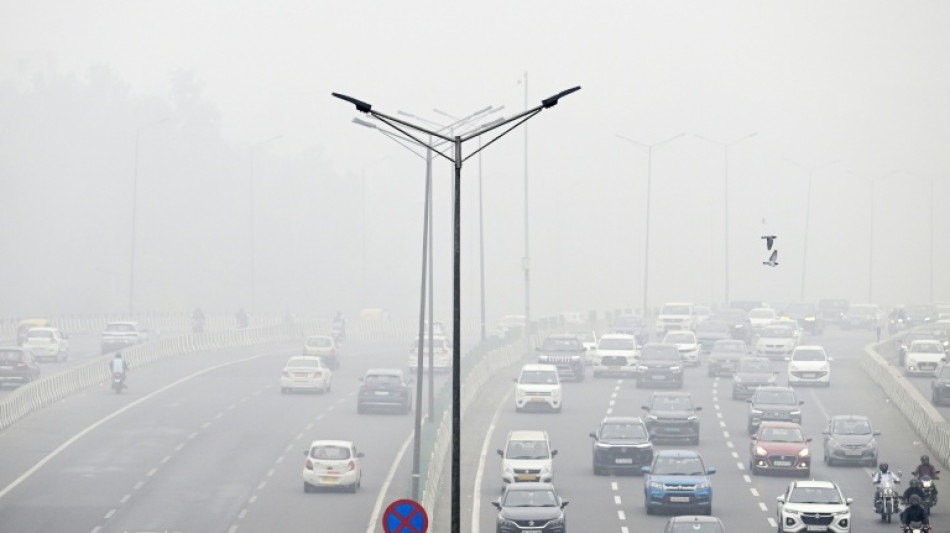
India's pollution refugees fleeing Delhi's toxic air / Photo: Arun SANKAR - AFP

 Indonesian court hears 'negligence' complaint against state over fires, haze
 Rubio in Greece to urge against Western civilisation 'decline'
 Micron workers at Taiwan plant vote in favour of strike

 In 'The Social Reckoning,' Jeremy Allen White takes on Facebook's 'frightening' ambition

 Chip industry activists call for South Korea to recognise cancer cases
 Famine-scarred southern Madagascar braces for El Nino
 How the EU regulates lobbyists
 I.Coast refuge offers lifelong care for youngsters scorned as 'sorcerers'

 Indian central bank hikes rates for first time in more than 3 years

 Hotel Blacklist Launches New Accommodation Industry Risk Assessment Tool

 Bangladesh nuclear plant draws hope -- and worry

 US beat Canada 1-0 to wrap up four-win international break

 Turkey, Australia's joint COP31 leadership raises doubts

 For Turkish NGOs, COP31 offers rare space for action

 Sleep, appetite, gene-editing experts contend for Nobel chemistry prize
 Nobel Peace Prize haunted by the 'spectre' of Trump

 Africa launches own credit agency in bid for cheaper borrowing

 US, China, EU: three paths to regulating AI

 Australia's High Court rules against coal mine in landmark climate case

 Australia touts new funds for Pacific infrastructure at Fiji 'pre-COP'

 Eva Marie Saint, Oscar winner of Hollywood classics, dies at 102

 Australia probes app used in cheap smart glasses over privacy fears

 England needed to 'move on' from World Cup pain, says Tuchel

 O'Neill to stay at Celtic after period of "reflection"

 Kane marks 125th England cap with Wembley Nations League double

Pollution levels in India's capital shaped Natasha Uppal and her husband's decision on parenthood -- either raise their child away from the city, or stay put and remain childless.
New Delhi and the surrounding metropolitan area, home to more than 30 million people, consistently tops world rankings for air pollution.
Uppal, who grew up in the city, often considered leaving -- especially on days spent indoors with air purifiers humming, or when she battled severe migraines.
The turning point came when the couple decided to try for a baby.
"When we thought about what we can curate for our child in Delhi," she told AFP, "the air just became such a blocker for so many of those things."
In 2022, they relocated to Bengaluru and, days later, she discovered she was pregnant.
They are among a small but growing number of families leaving Delhi because of health risks linked to air pollution.
Uppal, the 36-year-old founder of maternal health support group Matrescence India, said leaving was the "best decision".
Air pollution in Bengaluru can still sometimes hit three times World Health Organization (WHO) limits.
But that is far below Delhi's months-long haze -- and means her son "is in and out of the house as many times as he likes".
Clean air is "something that is a basic human right", she said. "Everyone should be able to take (it) for granted."
- 3.8 million deaths -
Each winter, Delhi is blanketed in acrid smog, a toxic mix of crop-burning, factory emissions and choking traffic.
Levels of PM2.5 -- cancer-causing microparticles small enough to enter the bloodstream -- have surged to as much as 60 times WHO limits.
Despite pledges of reform, measures such as partial vehicle bans or water trucks spraying mist have done little to clear the air.
This year, authorities promise cloud-seeding trials to cut pollution.
A study in The Lancet Planetary Health last year estimated 3.8 million deaths in India between 2009 and 2019 were linked to air pollution.
The UN children's agency warns that polluted air puts children at heightened risk of acute respiratory infections.
For Vidushi Malhotra, 36, the breaking point came in 2020 as her two-year-old son fell ill repeatedly.
"We had three air purifiers running continuously, and then I needed more," she said.
A year later, Malhotra, her husband and son moved to Goa. She urged friends to follow, starting what she calls a "mini-movement". A few did.
"I have to keep going back and see my loved ones go through this," she added. "That really makes me sad."
- Nebulisers, inhalers -
Others, like Delhi resident Roli Shrivastava, remain but live in constant anxiety.
The 34-year-old keeps inhalers for her smoke allegies and nebulisers ready for her toddler, whose cough worsens each winter.
"The doctor told us winter will be difficult," she said. "He just told us, 'When your kid starts coughing at night, don't even call me -- just start nebulising.'"
As winter nears, Shrivastava is preparing for another season indoors -- restricting outdoor play for her son, running air purifiers and checking air quality daily.
When the family visits relatives in the southern city of Chennai, her son's health improves "drastically".
"His nose stops running, his cough goes away," she said.
Shrivastava and her husband, who both work with a global advocacy group, say they would have left Delhi long ago if not for the "jobs we love and the opportunities".
Relocation, she admits, is never far from their minds.
"I don't think at the rate it's going, Delhi is a good place to raise kids -- when it comes to air pollution at least."
L.Hussein--SF-PST