US medical panel insists it's 'pro-vaccine' / Photo: Alex WROBLEWSKI - AFP/File

 Indonesian court hears 'negligence' complaint against state over fires, haze

 Rubio in Greece to urge against Western civilisation 'decline'

 Micron workers at Taiwan plant vote in favour of strike
 In 'The Social Reckoning,' Jeremy Allen White takes on Facebook's 'frightening' ambition

 Chip industry activists call for South Korea to recognise cancer cases
 Famine-scarred southern Madagascar braces for El Nino
 How the EU regulates lobbyists
 I.Coast refuge offers lifelong care for youngsters scorned as 'sorcerers'

 Indian central bank hikes rates for first time in more than 3 years
 Hotel Blacklist Launches New Accommodation Industry Risk Assessment Tool
 Bangladesh nuclear plant draws hope -- and worry

 US beat Canada 1-0 to wrap up four-win international break

 Turkey, Australia's joint COP31 leadership raises doubts

 For Turkish NGOs, COP31 offers rare space for action
 Sleep, appetite, gene-editing experts contend for Nobel chemistry prize

 Nobel Peace Prize haunted by the 'spectre' of Trump

 Africa launches own credit agency in bid for cheaper borrowing

 US, China, EU: three paths to regulating AI

 Australia's High Court rules against coal mine in landmark climate case
 Australia touts new funds for Pacific infrastructure at Fiji 'pre-COP'

 Eva Marie Saint, Oscar winner of Hollywood classics, dies at 102

 Australia probes app used in cheap smart glasses over privacy fears
 England needed to 'move on' from World Cup pain, says Tuchel

 O'Neill to stay at Celtic after period of "reflection"

 Kane marks 125th England cap with Wembley Nations League double
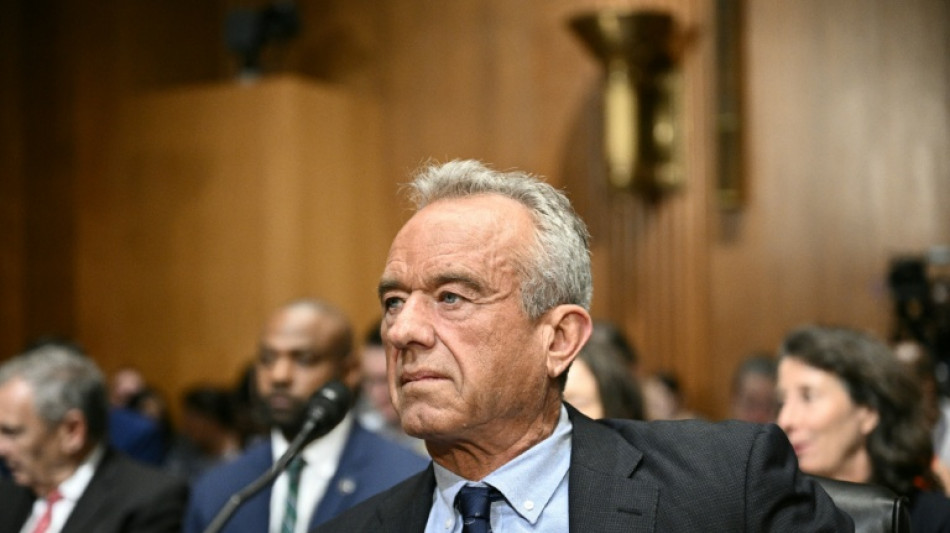
A US panel stacked with figures sympathetic to the anti-vaccine movement opened a highly politicized meeting Thursday on the defensive, insisting that they are "pro-vaccine" even as public health experts fear the group is set to upend longstanding medical advice.
President Donald Trump's top health official, the anti-vax crusader Robert F. Kennedy Jr., handpicked the members of the medical advisory group that will vote on whether to alter the standard childhood vaccine schedule, despite warnings from across the medical and public policy communities that dire consequences could result.
"We are currently experiencing heated controversies about vaccines, and a key question is, who can you trust?" said the chair of the Advisory Committee on Immunization Practices (ACIP), biostatistician Martin Kulldorff, in opening the two-day meeting.
He then criticized the American Academy of Pediatrics and the recently fired director of the US disease prevention agency, who told a Senate health panel Wednesday the Trump administration sacked her for refusing to pre-approve vaccination schedule recommendations without first analyzing science that would back up that advice.
Kulldorff insisted that members of the panel would "welcome scientific critique of any of our votes, as there are gray areas due to incomplete scientific knowledge" but cast as "false" accusations that the group's members are "unscientific."
On Thursday's ACIP agenda is a vote on whether to recommend delaying childhood shots including against the highly contagious disease Hepatitis B.
The Covid-19 vaccine is also on the docket, as well as the combination MMRV shot that covers measles, mumps, rubella, and varicella shot, which is offered as an alternative to separate MMR and chicken pox injections.
Earlier this year Kennedy fired all 17 members of the influential ACIP committee and replaced them with members whose vaccine skepticism tracks more closely with his own.
Their first meeting promoted anti-vax themes and raised questions about long-settled medical debates.
The revised committee and its agenda has triggered concern across medical, scientific and policy communities that ideology rather than science will guide the future of public health in the United States.
"Vaccines have added decades of life to our life expectancy. They have helped Americans live healthier lives. There's so much here that's riding," said epidemiologist Syra Madad.
She told AFP shifting the childhood vaccine schedule "is like pulling bricks out of the foundation of public health."
"It risks collapse, and creates real consequences for every community in America."
Experts including Madad say the votes could prompt unnecessary confusion and concern among parents.
Revised recommendations could also restrict federal funding of vaccines for low-income families, or shift requirements for private insurers.
- Preying on 'ignorance' -
Kennedy has spent decades promoting vaccine misinformation, including the widely debunked claim that the MMR shot causes autism.
He has also taken aim at the Hepatitis B shot. Since 2005 ACIP has recommended administering the first dose to most newborns within 24 hours of birth, to prevent any maternal transmission of the disease, which can cause severe liver damage.
But because Hepatitis B is also spread sexually and through needles, Kennedy and his allies have questioned why newborns need protection from it.
Amesh Adalja, an infectious disease specialist at Johns Hopkins University, said that notion is "a play on people's ignorance."
"RFK doesn't get rewarded when he prevents perinatal Hepatitis B, he gets rewarded when he panders to the anti-vax movement," Adalja told AFP.
The committee is also expected to consider this season's Covid-19 shot, including who should get it and who should pay for it.
Q.Jaber--SF-PST