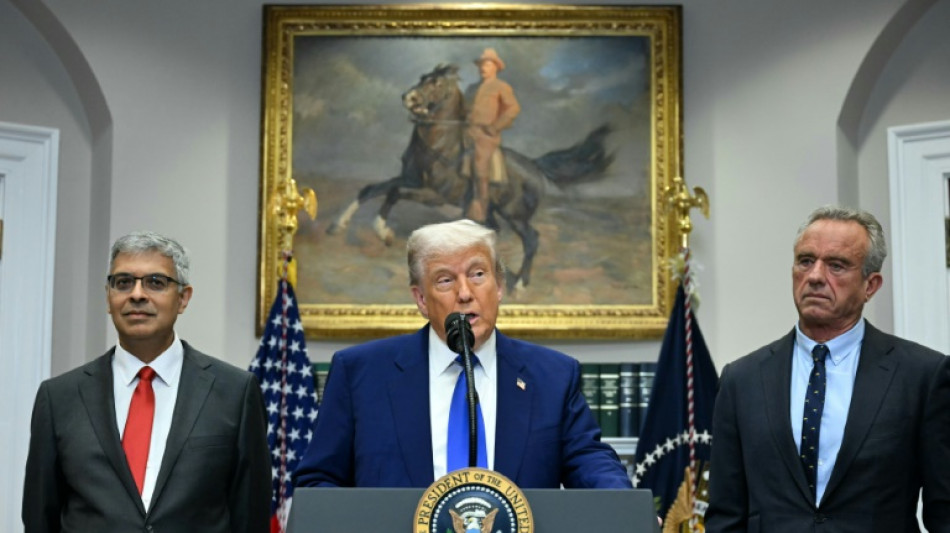
Trump announces drug prices cut with swipe at Europe / Photo: Jim WATSON - AFP

 West must embrace 'national power' or face decline: Rubio

 Shell refining margins reach record highs as wars hit supply
 Former Spain, Barca winger Pedro retires from football
 Arteta signs new Arsenal deal until 2030
 Stocks decline as oil climbs on Mideast flareup
 Gauff says online abuse was 'draining' after China Open exit
 As sector struggles, Porsche puts luxury ahead of volume
 'It's personal': Fiji minister pushes better climate finance at pre-COP

 Russia glosses over dark Soviet past in reinvented museum
 UK tax body opened probe into Man City in 2018: FT

 Yemen's Houthis claim new attacks on Saudi airports as conflict deepens
 Germany factory production at highest level for 18 months
 Thailand floods death toll rises to 60 since mid-September

 US pushes Russia for information on plague reports
 Myanmar leader lands in Malaysia for migrant return talks
 Indian central bank hikes rates for first time since 2023

 US military on Okinawa face curfew, alcohol ban after murder case
 Fierce lobbying in EU over 'forever chemicals'

 Dodgers beat Braves and Padres avoid sweep in MLB playoffs
 Mourning, war and elections as Israel marks October 7

 Messi says Argentina retirement is 'saddest day of my career'
 Oil rises and stocks fall as Hormuz worries flare

 Pacific presses world for help 'surviving' climate change at pre-COP summit
 Verstappen revival to be put to the test in steamy Singapore
 US woman who survived botched execution is conscious, speaking: lawyers
US President Donald Trump said Monday he would slash drug prices so that they match costs abroad, accusing the "brutal" European Union in particular of forcing pharmaceutical firms to lower prices on its turf.
Trump claimed as he signed the executive order at the White House that drug prices should fall by at least 59 percent -- and in some cases as high as 80 or 90 percent.
Under the plan, Trump aims to institute a "Most Favored Nation" policy that pins the cost of drugs sold in the United States to the lowest price paid by other countries for the same drug.
"Whoever is paying the lowest price, that's the price that we're going to get," Trump said.
The US president's plan will count mainly on the goodwill of pharmaceutical companies to negotiate their prices and could face legal challenges, as did a similar proposal Trump pushed during his first term.
Trump said American consumers had been treated like "suckers" and cited in particular the costs of the obesity-reducing drug Ozempic, which he said were vastly higher in Europe.
He blasted the European Union nation in particular over drug prices, alleging that the 27-nation bloc forced pharmaceutical firms to lower their costs on their territory.
"It was really the countries that forced Big Pharma to do things that, frankly, I'm not sure they really felt comfortable doing, but they've gotten away with it," Trump said.
"The European Union has been brutal, brutal. And the drug companies actually told me stories it was just brutal, how they forced them."
- 'Powerful lobby' -
Trump said he would also order an investigation into countries that "extort" drug companies by "blocking their products" unless they accepted low prices.
But Trump added that he was also "doing this against the most powerful lobby in the world -- the drug and pharmaceutical lobby."
Health Secretary Robert Kennedy Jr, who has caused controversy for his skepticism over vaccinations, praised the plan.
"There has never been a president more willing to stand up to the oligarchs than Donald Trump," Kennedy said as he stood next to the billionaire property developer.
Trump had trailed the announcement of the 59 percent cut earlier on Monday.
"DRUG PRICES TO BE CUT BY 59%, PLUS! Gasoline, Energy, Groceries, and all other costs, DOWN. NO INFLATION!!!" Trump posted on his Truth Social platform.
The reduction in prescription drug costs in the United States would, he added in his post, be counterbalanced by higher costs in other countries.
"Most favored nation" status is a World Trade Organization rule that aims to prevent discrimination between a country and its trading partners, levelling the playing field for international trade.
This is not the first time that Trump has attempted to lower US drug prices.
During his first 2017-2021 term in office, he announced a similar proposal to cut US drug prices but his plans failed in the face of strong opposition from the pharmaceutical industry.
Last month, the US president signed an executive order aiming to lower crippling drug prices by giving states more leeway to bargain-hunt abroad and improving the process for price negotiations.
M.AlAhmad--SF-PST