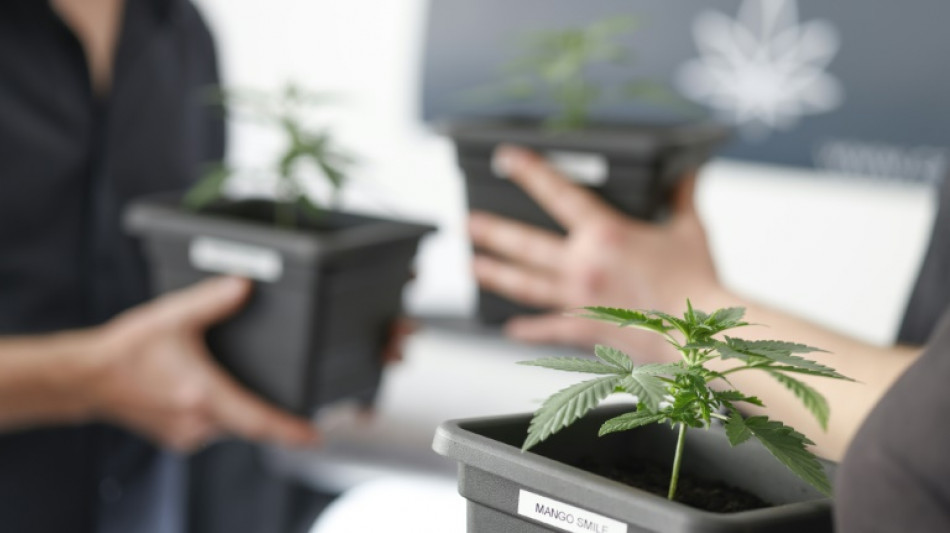
Legal weed limps into next phase in Germany / Photo: Michaela STACHE - AFP

 El Nino’s Weakening Grip on Tamil Nadu Rainfall Hinges on Potential Cyclone

 South Africa Places 36 Hospitals on Standby for Possible Imported Ebola Cases

 Two A1 Crashes Create Kilometres of Rush-Hour Congestion

 Luxembourg City Plans €13 Million Abrigado Centre for 2029

 Luxembourg Housing Petition Passes Threshold for Parliamentary Consideration

 Raheem Sterling Receives Suspended Sentence After Lamborghini Crash

 Tamil Nadu Secures Rs 58,214 Crore in Investments at Vettri Conclave

 فرنسا تدعو لتجريم "الفصل العنصري القائم على الجنس" دولياً

 أزمة الصواريخ الاعتراضية في البنتاغون: استنزاف المخزونات يفرض تعبئة صناعية حتى 2030

 Huawei Found Guilty of Trade Secret Theft in Landmark US Case

 Indian Markets Set for Gain as Foreign Inflows Offset Tariff Fears
So-called cannabis clubs will be allowed to sell the drug legally in Germany starting Monday, but in practice it will be some time before the associations get up and running.
Germany legalised cannabis in April, allowing adults to possess 25 grammes (0.9 ounces) and cultivate up to three marijuana plants at home.
As the next step in the reform, from July 1 it will be possible to legally obtain weed through regulated "cannabis clubs" in the country.
The associations will be allowed to have up to 500 members each and will be able to distribute up to 50 grammes of cannabis per person per month.
Mariana Cannabis, an umbrella organisation for around 180 future cannabis clubs across Germany, already has around 20,000 members.
But at the group's production site in Leverkusen, just north of the western city of Cologne, there are no seeds or cuttings to be seen.
That is because before the clubs can begin operating, they must apply for a licence that can take up to three months to obtain.
"We are impatient, but we still have to wait," Keno Mennenga, a spokesman for Mariana Cannabis, told AFP.
- Black market -
In Munich, members of the Cantura cannabis club have been paying 25 euros ($27) a month since March, before the first part of the law even came into force.
The club has invested thousands of euros in office space, security and cultivation equipment, according to its CEO, Fabian Baumann.
"We need around eight weeks from cutting to harvesting," he said. "If everything goes well, we'll be able to supply cannabis to our members this year. That would be wonderful."
When launching the first phase of the law in April, the German government insisted that it was not promoting cannabis use but rather seeking to curb the black market for the drug.
"The German model is based on a gradual approach. The idea is to be cautious and to evaluate in real time," said Ivana Obradovic, an expert with the France-based Monitoring Centre for Drugs and Drug Addiction (OFDT).
She said the model had incorporated lessons from several other systems that have been tested around the world.
"The idea is to keep control of supply so that it doesn't prosper rapidly," Obradovic said.
In the United States, the legalisation of cannabis in many states has created "a situation of overproduction, particularly in California and Oregon, where production exceeds local demand by five to six times", she said.
Nonetheless, all countries that have legalised cannabis have seen some level of decline in black market sales.
In Canada, around 75 percent of cannabis users now buy through legal channels, compared with just 40 percent in 2018, the year the drug was legalised, according to the OFDT.
Mennenga, at Mariana Cannabis, acknowledged that in Germany, "The black market is in control and it's getting worse".
"We can stop it getting worse."
- Political fears -
Bluetezeit, a Berlin-based start-up specialising in cannabis products, hopes that Germany will eventually authorise the sale of the drug in pharmacies or licensed shops.
For Nikolaos Katsaras, head of the company, only a competitive and lucrative legal market can compete with a black market that has been established for years.
In the meantime, Bluetezeit has already built up an online community of 10,000 members.
The company plans to develop cannabis clubs while also selling cannabis products online and offering consultations for people who want to use the drug for medical purposes.
Katsaras said he aimed to "take the pulse of the market" in deciding the right direction for the company.
His only fear is that a general election set for Germany in 2025 brings a change of government, which could put the brakes on the industry's development.
Friedrich Merz, leader of the Christian Democrats (CDU), the main opposition party, has said he will annul the legalisation of cannabis if his party returns to power.
S.Abdullah--SF-PST

