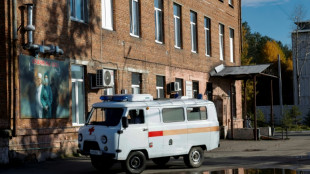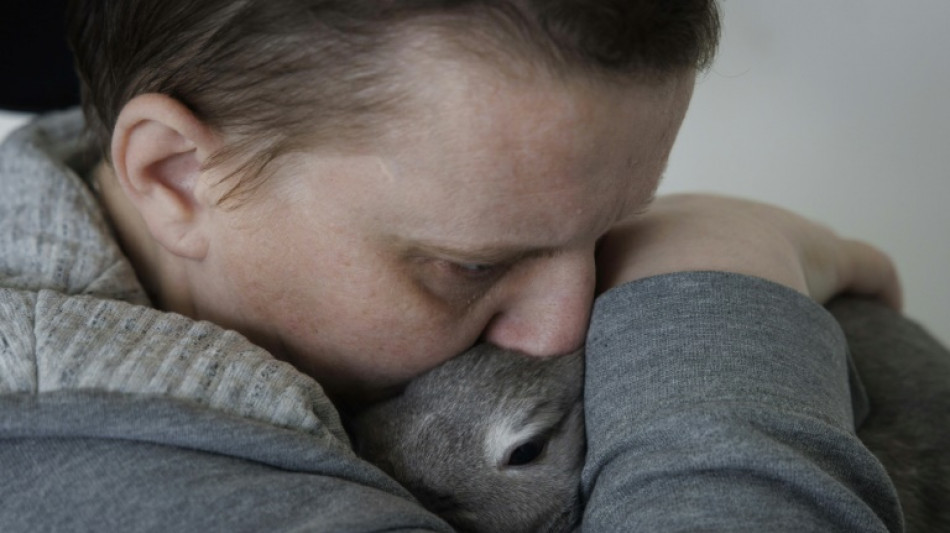
Euthanasia, a final journey from France to Belgium / Photo: Simon Wohlfahrt - AFP

 Morikawa says LIV players face 'business decision' after Rahm exit

 Tenzing Norgay's son says Himalayas sending climate warning

 On your bike! Bottas opts for two wheels to reach Singapore GP

 Alcaraz, Sinner, Osaka commit to Australian Open '1 Point Slam'

 Dodgers beat Braves to advance in MLB playoffs, Rays oust Yankees

 'A sun as black as my lungs': how corruption crucified a polluted Albania city

 The British historian helping the French rediscover de Gaulle

 Dodgers beat Braves to advance, Guardians survive in MLB playoffs
 Latin American, Caribbean women top Nobel literature buzz

 US says Fiji-based Chinese official paid bribes for Beijing
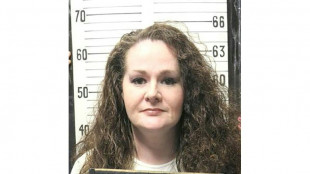 After botched US execution, Christa Pike was nearly taken off life support

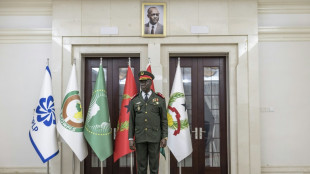 Guinea-Bissau junta urges military unit loyal to ex-president to disarm

 As species decline, green turtles offer glimmer of hope

 Brothers Scott and Beauden Barrett named to start for All Blacks

 EU trade chief seeks to dial down China tensions

 'Never again Bolsonaro': thousands march ahead of Brazil election runoff

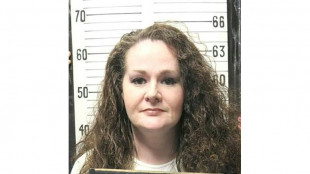 After botched execution, US woman was nearly taken off life support before revival
 Searing AIDS drama 'Elsinore' opens London film festival

 Evicted pensioner who sparked Spain housing protests dies: tenant union

 Golf star Rahm quitting LIV tour over 'unacceptable' terms

 Thousands march fearing return of a Bolsonaro presidency in Brazil

 French PM denies police ordered to confront student protesters
 Rubio touts US power, calls on Europe to emerge from 'slumber'

 Trump says 'we don't think' Russian plague is bio-weapon
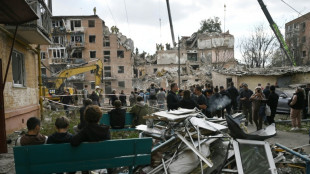
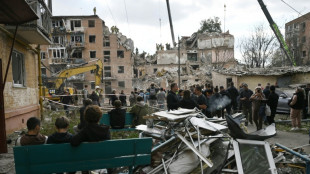 Five children among 26 killed in Ukraine after Russian strikes

Born hemiplegic, nearly blind, 43-year-old Lydie Imhoff was gradually losing the use of her limbs. Last year, she made the decision to travel from her native France to Belgium to undergo euthanasia -- for "fear of living in a dead body."
An AFP team first joined Lydie in March 2023, to meet with a psychiatrist in Brussels who gave a green light for her to undergo the procedure, made legal in Belgium two decades ago but still outlawed in France.
They travelled with her again early this year, on a final journey from the apartment in eastern France where she lived alone with her pet rabbit, to Brussels where her ashes have now been scattered.
Tuesday, January 30 - Besancon, France
Lydie's apartment lies almost empty, the light of the setting sun glinting at the bay windows. Huddled in her wheelchair, she sighs as her rabbit, Lucky, shuffles around the room. The sound of her breathing echoes through the empty space.
"On the one hand I can't wait for release. On the other I feel guilty for leaving behind the people I love. But at the end of the day, it's a choice I've made," she tells AFP.
The mood is solemn, but that doesn't stop Lydie cracking jokes.
"Don't let me forget to put the keys through the letterbox -- or they'll murder me for it!"
Wednesday, January 31 - departure at dawn
It's still dark outside when Denis Rousseaux and his wife Marie-Josee pull up outside Lydie's home in a rented van. Both retired, the former anaesthetist and nurse have been helping her since 2023 with the process of seeking euthanasia abroad.
Cut off from her family, Lydie relies wholly on the support of a handful of friends and volunteers like these.
Settling on the backseat, she snuggles against Marie-Josee and pulls up her blanket, still flecked with the fur of her rabbit -- which was taken in by a foster family the day before she left.
Once the wheelchair is loaded in, Denis Rousseaux starts the engine. It's the first time the couple have escorted someone to Belgium.
"It's first and foremost a humanitarian gesture," he says, his eyes locked on the road ahead. "The political aspect comes second."
Wednesday, January 31 - lunch at the border
They break the journey in Longwy, a French town just short of the border, where they meet Claudette Pierret, a right-to-die activist who first connected Lydie with Yves de Locht, the Belgian doctor who will perform the procedure.
A table is laid for them -- "It's like a birthday lunch!" quips Lydie, before turning serious.
"I just hope once I'm up there, that I'll be in peace, that I can get some rest," she says.
"I'm tired. I'm tired of every day being a battle -- against my illness, against my disabilities, against everything."
"I know I joke around, I shoot the breeze all day long -- but there you have it."
"What you see here," she says, pointing at her face, "that's not what's really underneath."
After the meal is over, they say goodbye at the front gate. The van sets off again, bound for Brussels. Lydie's day is not over yet. Arrived at the hospital, she settles into a large room, decorated with a seaside theme.
"OK then -- what's the last meal on death row tonight?" she asks.
Wednesday, January 31 - in hospital in Brussels
Before going to sleep, Lydie has a final interview with her doctor about the day ahead.
"Are you still OK to do this?" asks de Locht.
"Yes! You're sure I'm not going to wake up, right?" Lydie replies.
"Tell me what you still have on your mind," he asks.
"I'm thinking of the people I leave behind."
"You know what they will be thinking? However sad they are, they will know you have been set free."
At the end of their talk, Lydie hugs the doctor close. "Your sweater is so soft!" she tells him.
Thursday, February 1
The morning sky in Brussels is a crisp, bright blue. In Lydie's hospital room, the curtains are drawn.
Marie-Josee and Denis Rousseaux are seated on either side of her bed. Farmer protests are disrupting traffic all over the city, but the doctor arrives on time.
He asks Lydie one last time if she wishes to die. She answers yes.
"OK, we'll get the products ready. I'll leave you together for a little longer, and we'll be back in a few minutes."
De Locht is assisted by a fellow doctor, Wim Distelmans, head of the hospital's palliative care unit. In a small laboratory, Distelmans mixes up the substance, using three vials of Thiopental, a barbiturate.
The syringe is ready. The doctors walk together back to Lydie's room, where Denis Rousseaux introduces her to Distelmans.
"So he's the big boss?" she asks -- as the others burst out laughing.
They gather around the bed. Exchange last words. De Locht announces: "Lydie, I bid you farewell."
"See you up there?" she asks him. "All right. Bye bye to you Belgians, bye to the French!"
Lydie's empty wheelchair sits facing the bedroom door, as the doctors emerge back out.
De Locht shares his impressions.
"My feeling is that sickness was killing her little by little, and I put an end to her pain. That is in line with my ethics as a doctor," he says.
"I absolutely don't feel like I killed her. I feel like I cut short her suffering."
Afterwards, together with Distelmans, he finalises the paperwork he will need to submit to the country's oversight commission on euthanasia.
Before leaving, he exchanges a few words with Denis and Marie-Josee Rousseaux. "We set her free," he tells them.
Four days after her death, Lydie was cremated and her ashes scattered in a memorial garden on the outskirts of Brussels, by the staff of the crematorium. No family members were present.
Belgium's 2002 law decriminalizing euthanasia requires at least two professional opinions in support of the patient's decision, one by a psychiatrist and one by a doctor.
It stipulates that the request must stem from a "constant and unbearable physical or mental suffering that can not be alleviated, resulting from a serious and incurable disorder."
In 2022, 2,966 people underwent euthanasia in Belgium, according to the federal oversight commission. Of that total, 53 were resident in France.
N.Awad--SF-PST