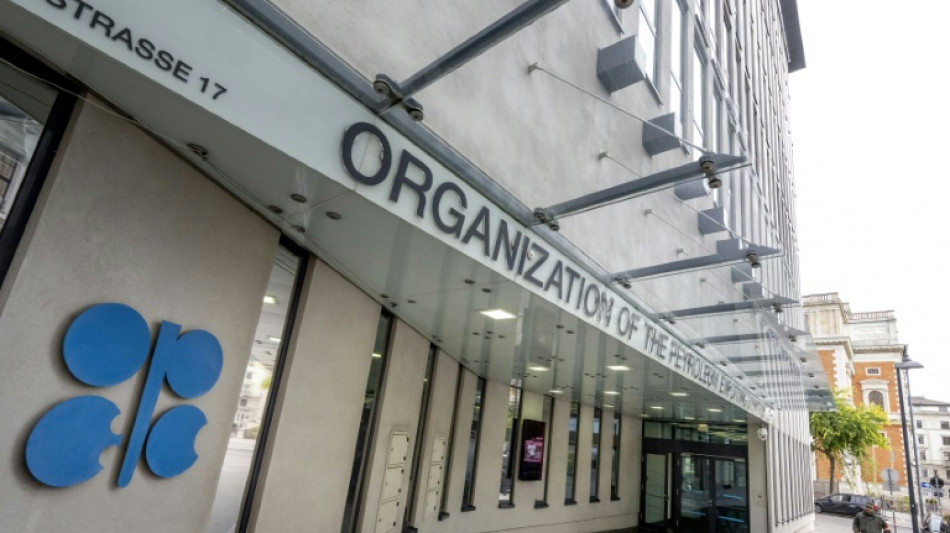
Opec+ likely to maintain oil output levels / Photo: JOE KLAMAR - AFP/File

 El Nino’s Weakening Grip on Tamil Nadu Rainfall Hinges on Potential Cyclone

 South Africa Places 36 Hospitals on Standby for Possible Imported Ebola Cases

 Two A1 Crashes Create Kilometres of Rush-Hour Congestion

 Luxembourg City Plans €13 Million Abrigado Centre for 2029

 Luxembourg Housing Petition Passes Threshold for Parliamentary Consideration

 Raheem Sterling Receives Suspended Sentence After Lamborghini Crash

 Tamil Nadu Secures Rs 58,214 Crore in Investments at Vettri Conclave

 فرنسا تدعو لتجريم "الفصل العنصري القائم على الجنس" دولياً

 أزمة الصواريخ الاعتراضية في البنتاغون: استنزاف المخزونات يفرض تعبئة صناعية حتى 2030

 Huawei Found Guilty of Trade Secret Theft in Landmark US Case

 Indian Markets Set for Gain as Foreign Inflows Offset Tariff Fears
Major oil-producing countries led by Saudi Arabia and Russia look set to maintain their current output levels at a meeting Sunday, ahead of fresh sanctions against Moscow coming into force.
The 13-member Organization of the Petroleum Exporting Countries (OPEC) is due to consult with 10 other oil-producing nations, including Russia, to review their decision in October to cut production by two million barrels per day.
The OPEC+ videoconference will take place from 1100 GMT Sunday.
On Friday, the EU, G7 and Australia agreed a $60-per-barrel price cap on Russian oil, which will come into effect on Monday or soon after, alongside an EU embargo on maritime deliveries of Russian crude oil.
It will prevent seaborne shipments of Russian crude to the European Union, which account for two thirds of the bloc's oil imports from Russia, an attempt to deprive Moscow's war chest of billions of euros.
While Russia denounced the incoming price cap on Saturday, threatening to suspend deliveries to any country that adopted the measure, Ukraine suggested the cap should have been set even lower.
For OPEC+, the big unknown in the oil equation is how heavily sanctions will hit Russian supply.
"The uncertainty for Russian supply is significant", DNB analysts said. OPEC would therefore "aim for a low-profile meeting that leaves existing production quotas unchanged".
- An 'uncomfortable position' -
Moscow's threat to suspend deliveries to countries abiding by the price cap would put "some in a very uncomfortable position", said OANDA analyst Craig Erlam: "Choosing between losing access to cheap Russian crude or facing G7 sanctions".
The choice of a virtual OPEC+ meeting instead of an in-person conference at the Vienna headquarters, suggested a policy rollover, UniCredit analyst Edward Moya said.
But "deeper oil output cuts" could still not be ruled out at this stage.
Amid economic gloom fuelled by soaring inflation and fears of China's weaker energy demand due to its Covid-related restrictions, the two global crude benchmarks remained close to their lowest level of the year, far from their March peaks.
Since the group's last meeting in early October, Brent North Sea oil and its US equivalent, WTI, have lost more than six percent of their value.
But speculation that a further OPEC+ production cut might still be on the table boosted prices throughout the week.
"OPEC+ might feel compelled to adopt a more aggressive stance" by cutting or threatening to cut production even further, UniCredit analyst Edoardo Campanella said.
"Russia might also retaliate by leveraging its influence within OPEC+ to push for more production cuts down the road, thus exacerbating the global energy crisis," he added.
S.AbuJamous--SF-PST

