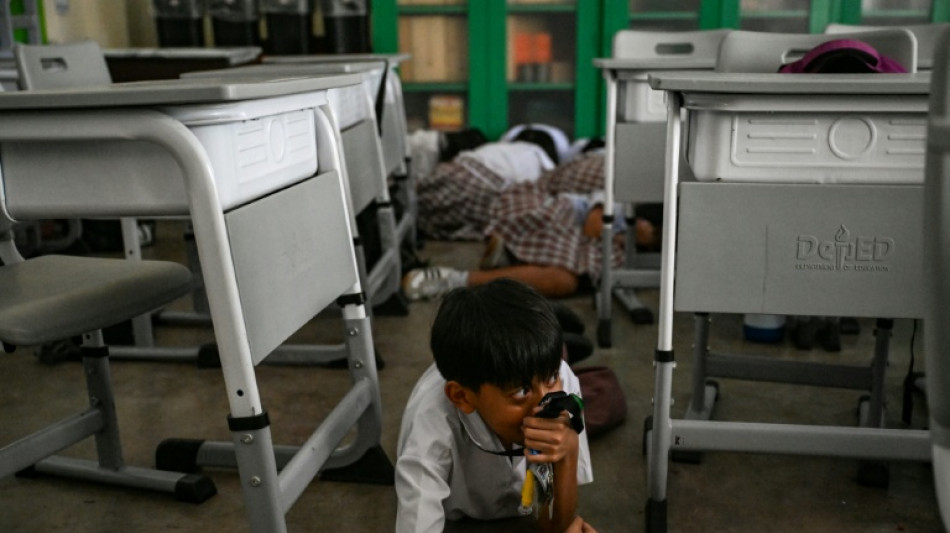
Philippines holds drills to safeguard students from armed intruders / Photo: Jam STA ROSA - AFP

 El Nino’s Weakening Grip on Tamil Nadu Rainfall Hinges on Potential Cyclone

 South Africa Places 36 Hospitals on Standby for Possible Imported Ebola Cases

 Two A1 Crashes Create Kilometres of Rush-Hour Congestion

 Luxembourg City Plans €13 Million Abrigado Centre for 2029

 Luxembourg Housing Petition Passes Threshold for Parliamentary Consideration

 Raheem Sterling Receives Suspended Sentence After Lamborghini Crash

 Tamil Nadu Secures Rs 58,214 Crore in Investments at Vettri Conclave

 فرنسا تدعو لتجريم "الفصل العنصري القائم على الجنس" دولياً

 أزمة الصواريخ الاعتراضية في البنتاغون: استنزاف المخزونات يفرض تعبئة صناعية حتى 2030

 Huawei Found Guilty of Trade Secret Theft in Landmark US Case

 Indian Markets Set for Gain as Foreign Inflows Offset Tariff Fears
As an alarm reverberated throughout a Philippine high school on Thursday, students scrambled behind locked doors and police swept corridors in a drill aimed at preparing for an attack once unthinkable in the Southeast Asian country.
About 3,000 junior and senior high school students at Carlos F. Gonzales High School north of Manila barricaded their classroom doors with tables and chairs, drew curtains and switched off the lights before crouching under tables to protect themselves.
The nationwide drills are part of a broader push by the Department of Education to strengthen security following two rare school shooting incidents that shook the Philippines in the past months.
In the disaster-prone country, where schools regularly conduct exercises for earthquakes and fires, active shooting drills are something new.
"We have already almost perfected our fire and earthquake drills, and this is something new, so we need to do this kind of exercise," Education Undersecretary Malcolm Garma told reporters.
"Through this kind of exercise, we want our schools... to be aware, to be able to recognize these kinds of threats and to be able to respond."
- 'Step to lessen that fear' -
The 12-minute Bulacan drill included the participation of the police, emergency responders and around 250 school staff and teachers.
AFP journalists saw teachers guide students with their arms raised, a measure to show they were not carrying weapons, from their classrooms to the covered court, where they waited for the school staff's psychological assessment and the arrival of their parents who would take them home.
"I also got scared when I heard that there will be drills like this, but participating in the drill is a step to lessen that fear and to prepare us and our students," Roy Fama, a teacher at Carlos F. Gonzales High School, said.
Initially scheduled last month, the drills were rescheduled due to bad weather and after mental health advocates warned that hyper-realistic drills can cause lasting psychological harm to students.
The Department of Education said on Thursday they updated their drill guidelines and prohibited hyper-realistic elements of active aggressor role-playing and graphic threat simulations, and instead triggered drills by a "distinct early warning alarm, separate from standard fire or earthquake signals, to build procedural muscle memory without creating distress."
April Tapion, 40, said she remained hesitant to send her Grade 5 and Grade 8 children to participate despite the changes.
"I am scared that they will think of the world as fearful and full of bad people because of the idea of the drill," Tapion told AFP.
Karina Mallonga, director of the Infant Jesus Academy Kalibo Campus, said schools and Philippine society could instead focus on strengthening other forms of support for students.
"I would rather that we strengthen other things, strengthen our guidance programs, make sure kids feel supported by their class advisers, and encourage kids to speak," Mallonga told AFP.
But Interior and Local Government Secretary Jonvic Remulla, who observed the Bulacan drill, said it not only taught the students how to respond to an attack, but also to improve coordination among the local police and emergency units.
"I am very confident that we will respond better (now)," Remulla said.
U.Shaheen--SF-PST