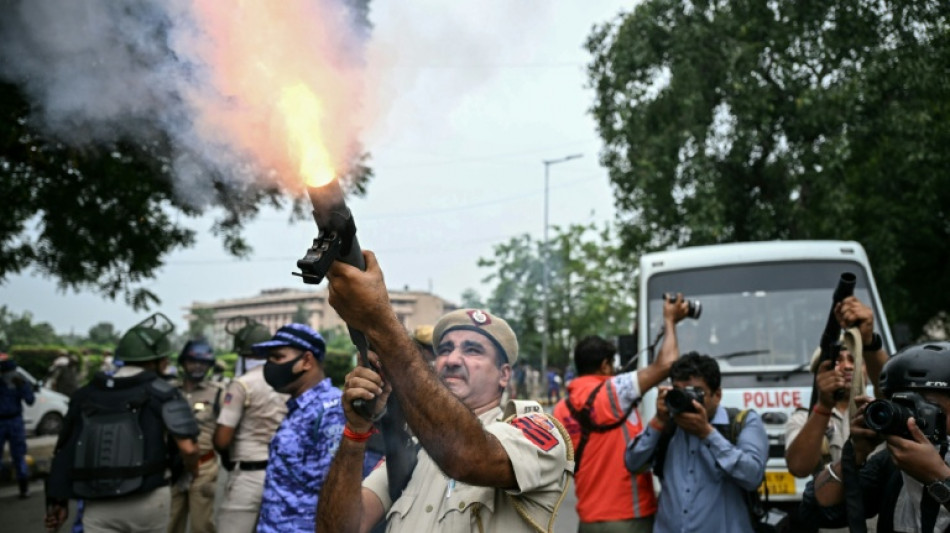
India police used excessive force during protests: Amnesty / Photo: Sajjad HUSSAIN - AFP

 El Nino’s Weakening Grip on Tamil Nadu Rainfall Hinges on Potential Cyclone

 South Africa Places 36 Hospitals on Standby for Possible Imported Ebola Cases

 Two A1 Crashes Create Kilometres of Rush-Hour Congestion

 Luxembourg City Plans €13 Million Abrigado Centre for 2029

 Luxembourg Housing Petition Passes Threshold for Parliamentary Consideration

 Raheem Sterling Receives Suspended Sentence After Lamborghini Crash

 Tamil Nadu Secures Rs 58,214 Crore in Investments at Vettri Conclave

 فرنسا تدعو لتجريم "الفصل العنصري القائم على الجنس" دولياً

 أزمة الصواريخ الاعتراضية في البنتاغون: استنزاف المخزونات يفرض تعبئة صناعية حتى 2030

 Huawei Found Guilty of Trade Secret Theft in Landmark US Case

 Indian Markets Set for Gain as Foreign Inflows Offset Tariff Fears
Indian police used excessive force, including electric shock devices and pellet guns, against youth-led protests that forced the education minister to resign last month, Amnesty International said Monday.
A report from the rights' group clashes with the police account that force was used only after protesters turned violent, and comes after India's Supreme Court set up a panel on Thursday to investigate violence by both police and demonstrators.
Demonstrations in the capital New Delhi, triggered by the leak of the national medical entrance test, turned violent on July 20 when thousands of protesters attempted to march towards parliament.
Amnesty said witness testimony and visual evidence it had verified confirmed the use of "pellet-firing shotguns, tear gas launchers, grenades, batons and electric shock devices against protesters" in Delhi and the eastern state of Bihar.
Amnesty said it had also verified two instances of a police officer "unlawfully using lethal force against a crowd" in Bihar's Siwan district. No one was killed.
"The weapons were deployed in a manner that breached international law and standards and domestic policing guidelines," it added.
Amnesty said that there were "isolated incidents of protesters throwing stones", but that the "heavy-handed response was state-sanctioned violence masked as crowd control."
Delhi Police said in a Supreme Court hearing last week they had used force only after protesters "resorted to violence".
They said anti-social elements "masquerading as aggrieved students" caused "grievous injuries" to security forces.
On Friday, opposition leader Rahul Gandhi staged a sit-in outside a Delhi police station with a 19-year-old protester who said he was injured by pellets during the July 20 demonstration.
Gandhi demanded a police investigation into the shooting, and officers later registered a case over the complaint.
Led by the online Cockroach Janta Party, the protests broadened from anger over exam irregularities into a wider movement over unemployment, opportunities for young people and what critics describe as Prime Minister Narendra Modi's increasingly authoritarian rule.
The protests proved to be the biggest challenge that Modi has faced after winning a third term in 2024.
E.Aziz--SF-PST