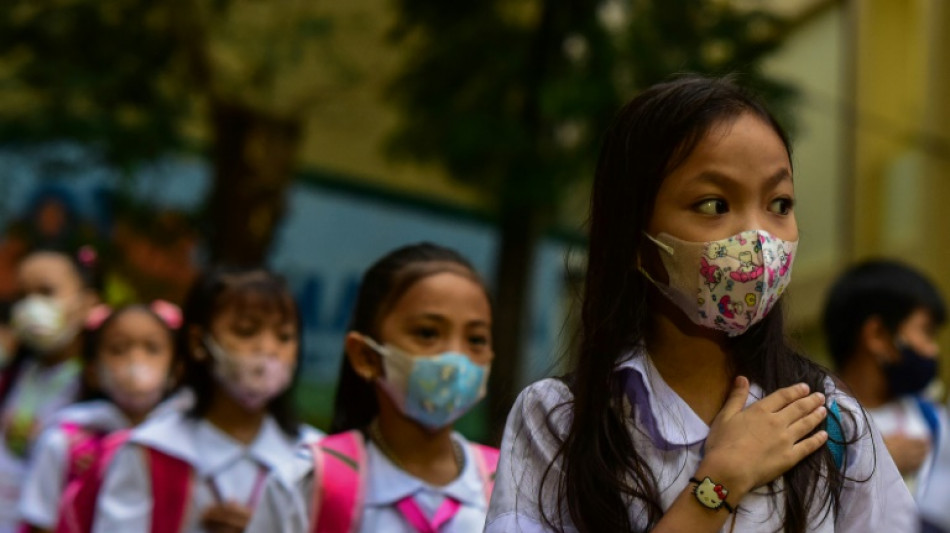
Philippine classrooms reopen after more than two years / Photo: Maria Tan - AFP

 Rain delays start of second day's play in England-Pakistan opener

 Russian strikes kill 16 in Kyiv, surrounding region
 'It is tough': Indonesia battles wildfires, bracing for worse to come

 Seoul detects North Korean missile launches after Trump says to meet Kim
 Thai, Myanmar military chiefs meet as post-coup thaw progresses
 Asian stocks rally as US Treasury steps in to ease bond fears

 Verstappen signs new Red Bull contract until 2030: team

 What property giant Evergrande's sentence means for China's economy

 Australian prosecutors demand life in prison for mushroom killer
 Fallout far-reaching for Australian Rules after latest scandal
 Rafts on Rome's Tiber River cool down overheated tourists
 Top seeds Sabalenka, Zverev stunned in Cincinnati fourth round
 Australia says relations with Israel 'difficult' after aid worker death

 PSG start Ligue 1 defence with eye on Champions League hat-trick
 Arsenal can become world's best club: Arteta
 Japan's King Kazu, 59, scores twice from spot to make cup history
 Kyiv's desperate vendors persevere outside obliterated flea market
 Australia races to shield little penguins from H5N1 bird flu
 Messi scores first goal since father's death
 US national debt exceeds $40 trillion for first time
 Brazilian narco violence spills over into tranquil Bolivia

 Trump's devoted 'human printer' in media glare

 Top seed Zverev bundled out by Paul in rain-hit Cincinnati upset
 WADA pledges vigilance on Russian athletes ahead of 2028 Olympics

 NASA satellite rescue mission fails

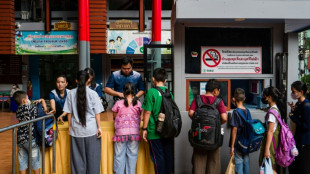
Millions of children in the Philippines returned to school as the academic year started on Monday, with many taking their seats in classrooms for the first time since the Covid-19 pandemic hit.
The Philippines is one of the last countries in the world to resume full-time, in-person lessons -- sparking warnings that the prolonged closure of classrooms had worsened an education crisis in the country.
Children in masks and uniforms lined up for a temperature check and squirt of hand sanitiser at Pedro Guevara Elementary School in Manila, which had shut classrooms since March 2020.
The school has adopted a hybrid system of in-person and remote learning as it transitions its nearly 6,000 students back to face-to-face classes by November -- a deadline set by President Ferdinand Marcos Jr soon after he took office two months ago.
Grade six student Sophia Macahilig said she was "excited" to meet her classmates and teachers after two years of Zoom lessons.
"We used to have fun and now I can have fun again," 11-year-old Macahilig told AFP.
But many students have a lot of catching up to do.
Even before the pandemic, nine out of 10 Filipino children could "not read a simple text with comprehension" by age 10, the World Bank and other agencies said in a recent report.
Only 10 countries were worse off, including Afghanistan, Laos, Chad and Yemen.
- Lagging behind -
After Philippine schools closed, a "blended learning" programme involving online classes, printed materials and lessons broadcast on television and social media was introduced.
As face-to-face classes resume, old problems persist: large class sizes, outdated teaching methods, poverty, and lack of basic infrastructure -- such as toilets -- have been blamed for contributing to the education crisis.
Pedro Guevara science teacher Ethel Tumanan, 32, said she was worried that students had missed out on valuable learning over the past two years.
"As a teacher, we really prefer face-to-face, at least we are the ones who can gauge and assess where our pupils are at."
In the lead-up to the reopening of classrooms, the government has been ramping up a vaccination drive and will provide students with free public transport until the end of the calendar year.
On Saturday, the government began handing out cash aid to students and parents struggling to cover expenses, leading to chaotic scenes outside distribution centres.
In the city of Zamboanga, 29 people were injured when several thousand tried to push through the gate of a high school.
J.AbuHassan--SF-PST