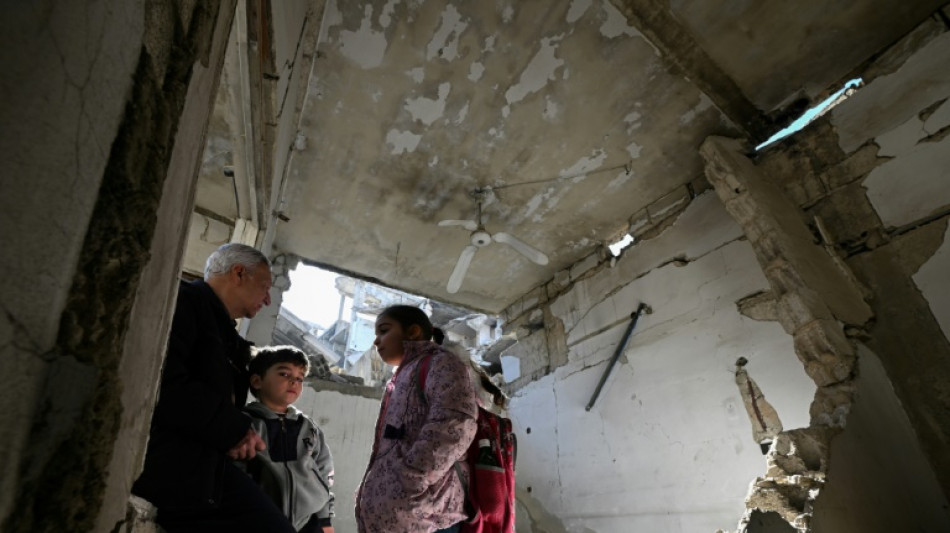
Syrians return to homes devastated by war / Photo: LOUAI BESHARA - AFP

 El Nino’s Weakening Grip on Tamil Nadu Rainfall Hinges on Potential Cyclone

 South Africa Places 36 Hospitals on Standby for Possible Imported Ebola Cases

 Two A1 Crashes Create Kilometres of Rush-Hour Congestion

 Luxembourg City Plans €13 Million Abrigado Centre for 2029

 Luxembourg Housing Petition Passes Threshold for Parliamentary Consideration

 Raheem Sterling Receives Suspended Sentence After Lamborghini Crash

 Tamil Nadu Secures Rs 58,214 Crore in Investments at Vettri Conclave

 فرنسا تدعو لتجريم "الفصل العنصري القائم على الجنس" دولياً

 أزمة الصواريخ الاعتراضية في البنتاغون: استنزاف المخزونات يفرض تعبئة صناعية حتى 2030

 Huawei Found Guilty of Trade Secret Theft in Landmark US Case

 Indian Markets Set for Gain as Foreign Inflows Offset Tariff Fears
When Syrian grandfather Omar Kafozi returned to his house near Damascus after Bashar al-Assad's ouster, he saw unfathomable destruction.
Now, cushions and plants brighten the wreckage that he is determined to call home again.
"As soon as we found out that... the regime was gone and that people were coming back... we sorted our things" and packed the car, said Kafozi, 74, standing in the wreckage of his home in a former rebel bastion near the capital.
"I had to come home and stay by any means," he told AFP. "We came back in the hope that our home would be different to this."
Plastic sheeting covers windows in what remains of the home where he and his family are living with no electricity, running water or even a proper bathroom, in the town of Hammuriyeh.
Syria's war began in 2011 when Assad unleashed a crackdown on democracy protests, prompting soldiers to defect from the army and civilians to take up weapons.
When Eastern Ghouta, where Hammuriyeh is located, fell out of Assad's control, the government imposed a siege and launched a ferocious air and ground assault.
Assad's forces were accused of conducting chemical attacks on rebel areas of Eastern Ghouta.
In 2018, tens of thousands of fighters and civilians were bussed to opposition-held northwest Syria under evacuation deals brokered by Assad backer Russia.
Among those who left the area at the time were Kafozi and his family.
His granddaughter Baraa, now eight and carrying a bright pink school bag, "was an infant in our arms" when they left, he said.
Fast-forward to December 2024, Assad was ousted in an offensive spearheaded by Islamist fighters, allowing displaced Syrians to return to their homes.
Kafozi said that when Baraa first saw the damage, "she just stared and said, 'what's this destroyed house of ours? Why did we come? Let's go back.'"
"I told her, this is our home, we have to come back to it," he said.
- No regrets -
Until their return to Hammuriyeh, his family sought refuge in the northwest and survived a 2023 earthquake that hit Syria and neighbouring Turkey.
Despite the damage to his home, Kafozi said: "I don't regret coming back."
Outside, children played in the dusty street, while a truck delivered gas bottles and people passed on bicycles.
Next door, Kafozi's nephew Ahmed, 40, has also returned with his wife and four children, but they are staying with relatives because of the damage to their home.
From the shell of a bedroom, the day worker looked out at a bleak landscape of buildings crumpled and torn by bombing.
"Our hope is that there will be reconstruction in the country," he said.
"I don't think an individual effort can bear this, it's too big, the damage in the country is great."
Syria's 13-year-war has killed more than 500,000 people, displaced millions more and ravaged the country's infrastructure and industry.
Local official Baibars Zein, 46, said bus transport had been arranged for people displaced from Hammuriyeh.
"We've taken around 106 families -- the total number of families that want to come back is around 2,000," he said near a mosque with a damaged minaret.
- 'Oppression is gone' -
Among those who returned was Zein's brother Saria, who left his wife and five children in northwest Syria to try to make their flat inhabitable before they return.
"This damage is from the battle that happened and regime bombardment -- they bombed us with barrels and missiles," said Saria, 47, pointing to cracked walls.
Rights groups documented the extensive use during the war by Assad's army of so-called barrel bombs, an improvised explosive dropped from planes.
To Saria, the devastation was a grim reminder of a 2015 strike that killed his seven-year-old daughter.
His wife narrowly missed being hit by shrapnel that took a chunk out of the wall, he said.
Saria hopes to finish basic repairs within a fortnight, but a lot of work will remain.
His children "are really excited, they call me and say 'Dad, we want to come back,'" he said.
"We are very very optimistic -- the oppression is gone," he said. "That's the most important thing."
C.AbuSway--SF-PST