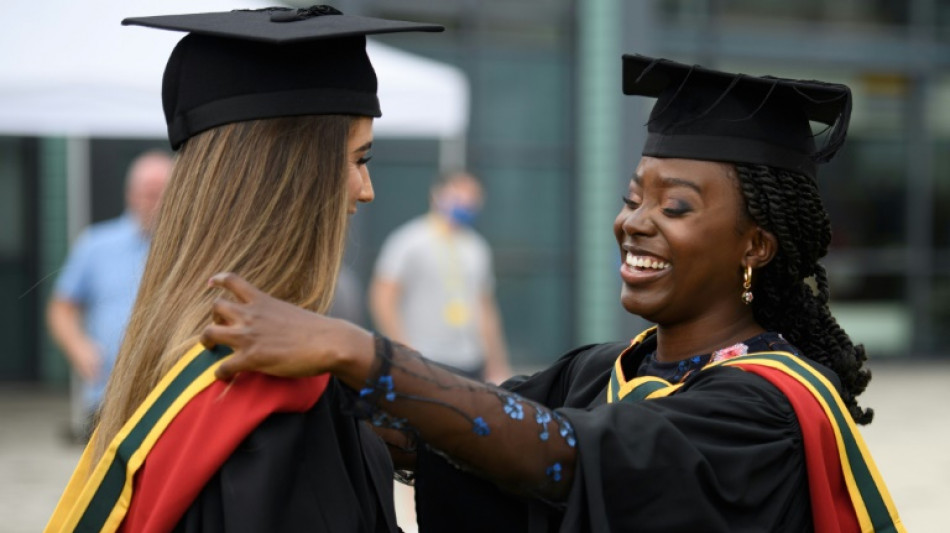
Rising student debt to worsen money woes of young Britons / Photo: OLI SCARFF - AFP

 Rain delays start of second day's play in England-Pakistan opener

 Russian strikes kill 16 in Kyiv, surrounding region
 'It is tough': Indonesia battles wildfires, bracing for worse to come

 Seoul detects North Korean missile launches after Trump says to meet Kim

 Thai, Myanmar military chiefs meet as post-coup thaw progresses

 Asian stocks rally as US Treasury steps in to ease bond fears

 Verstappen signs new Red Bull contract until 2030: team

 What property giant Evergrande's sentence means for China's economy

 Australian prosecutors demand life in prison for mushroom killer

 Fallout far-reaching for Australian Rules after latest scandal
 Rafts on Rome's Tiber River cool down overheated tourists

 Top seeds Sabalenka, Zverev stunned in Cincinnati fourth round

 Australia says relations with Israel 'difficult' after aid worker death

 PSG start Ligue 1 defence with eye on Champions League hat-trick

 Arsenal can become world's best club: Arteta

 Japan's King Kazu, 59, scores twice from spot to make cup history

 Kyiv's desperate vendors persevere outside obliterated flea market

 Australia races to shield little penguins from H5N1 bird flu

 Messi scores first goal since father's death

 US national debt exceeds $40 trillion for first time

 Brazilian narco violence spills over into tranquil Bolivia

 Trump's devoted 'human printer' in media glare

 Top seed Zverev bundled out by Paul in rain-hit Cincinnati upset

 WADA pledges vigilance on Russian athletes ahead of 2028 Olympics

 NASA satellite rescue mission fails

Rhiannon Muise graduated from Edge Hill University in northwest England last year with a mountain of student debt, which is growing even larger due to surging inflation.
The 21-year-old dance and drama graduate said it will take a "lifetime" for her to pay back the £45,000 ($55,000) she owes for tuition fees and living expenses, particularly if she stays within her chosen field where salaries can be low.
Muise's plight echoes that of students across Britain, who are already struggling with a cost-of-living crisis.
Britons heading to university next year face major changes that critics argue will worsen the financial pain.
- Exhausting -
The pressure is "exhausting, especially for someone in their 20s who has just started thinking about their career", Muise told AFP.
Her current job as Edge Hill student engagement officer pays below the threshold that activates repayments.
UK graduates shoulder more debt than any other developed country, according to House of Commons Library data.
About 1.5 million students borrow nearly £20 billion in loans every year in England alone.
And on average, graduates of 2020 have amassed £45,000 in debt.
Zeno, a 25-year-old student in London who gave only his first name, said he owes just short of £75,000 for his loans.
Unless he "wins the lottery", he accepts he will probably be paying the money back from his salary for the next 30 years.
- Tuition fees -
University used to be free in the UK, with means-tested grants for the poorest students to cover living costs.
But after the sector was opened up in the 1990s, numbers surged and, despite protests from student bodies, tuition fees have been gradually introduced in the last decade to help universities meet costs.
With education a devolved matter for the governments in Scotland, Wales and Northern Ireland, different tuition fee arrangements are in place across the UK.
Accommodation and living costs are extra.
In England, undergraduate tuition fees are capped at £9,250 a year for UK and Irish students -- up from £3,375 in 2011 when the government cut most ongoing direct public funding.
The cap in Wales is £9,000 and £4,030 in Northern Ireland.
Scottish students studying in Scotland pay £1,820 but those from the rest of the UK attending universities north of the border with England pay £9,250.
- Inflation worry -
The picture is further complicated by rocketing inflation because the student loan interest rate is linked to the retail price index (RPI).
Loan interest is calculated by adding up to 3.0 percentage points to the RPI rate.
Inflation however soared to 30-year highs this year, particularly on rocketing energy costs and fallout from the Ukraine conflict.
Graduates could therefore pay an interest rate of 12 percent from September -- or more if prices rise even higher.
The UK government plays a large part in student financing, providing loans that only demand repayment when a graduate earns above a threshold of £27,295 per year.
What borrowers repay depends on how much they earn. Unlike private lenders, they have up to 30 years to repay. The debt is cancelled after this time.
"This system is more progressive than in the United States, with generous write-offs for lower-paid graduates," said Nick Hillman, director of the Higher Education Policy Institute in Oxford.
Current and recent students faced huge upheaval during courses due to coronavirus restrictions, with the pandemic also hitting job opportunities.
A combination of high debt repayments, high cost of living and wages that have failed to keep pace with inflation, add yet more stress.
- Conundrum -
Student finance poses a major conundrum for the public purse because the UK forecasts outstanding loans will top £560 billion by 2050.
From next year, Britain will lower the repayment threshold for new borrowers to £25,000 and lengthen the repayment time from 30 to 40 years.
This will however increase costs for low-earners, while benefiting richer graduates who can pay back more quickly.
The UK government forecasts however that half of new students will repay their loans in full under the new plan.
Student debt has long been a concern in the United States, where the Federal Reserve estimates that it amounts to a staggering $1.76 trillion.
US students on average have outstanding debt of close to $41,000, according to think-tank Education Data Initiative.
President Joe Biden this year extended a moratorium on student loan repayment and interest -- and is holding talks over partial debt write-offs.
D.Khalil--SF-PST