Back to class after Bangladesh's student-led revolution / Photo: LUIS TATO - AFP

 El Nino’s Weakening Grip on Tamil Nadu Rainfall Hinges on Potential Cyclone

 South Africa Places 36 Hospitals on Standby for Possible Imported Ebola Cases

 Two A1 Crashes Create Kilometres of Rush-Hour Congestion

 Luxembourg City Plans €13 Million Abrigado Centre for 2029

 Luxembourg Housing Petition Passes Threshold for Parliamentary Consideration

 Raheem Sterling Receives Suspended Sentence After Lamborghini Crash

 Tamil Nadu Secures Rs 58,214 Crore in Investments at Vettri Conclave

 فرنسا تدعو لتجريم "الفصل العنصري القائم على الجنس" دولياً

 أزمة الصواريخ الاعتراضية في البنتاغون: استنزاف المخزونات يفرض تعبئة صناعية حتى 2030

 Huawei Found Guilty of Trade Secret Theft in Landmark US Case

 Indian Markets Set for Gain as Foreign Inflows Offset Tariff Fears
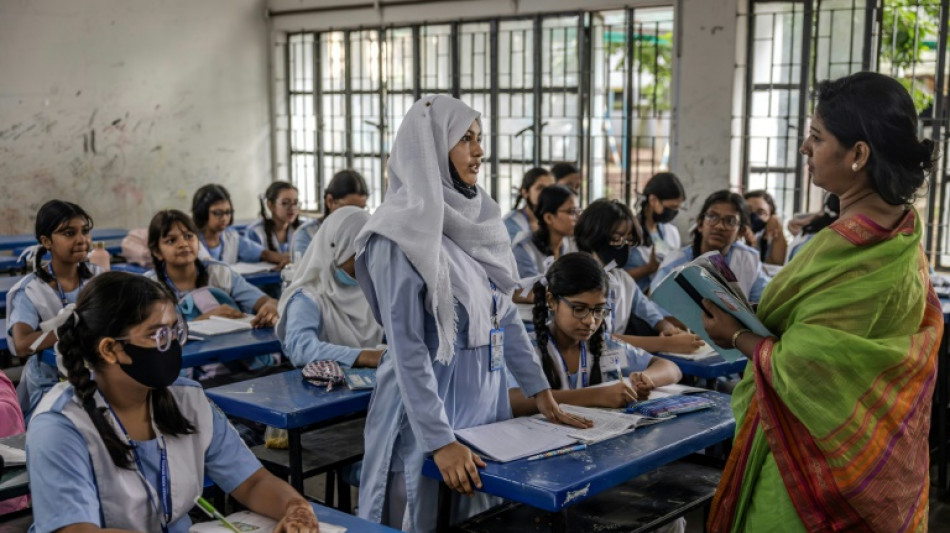
After weeks of deadly student-led protests in Bangladesh toppled the autocratic premier, among the first things children at a school in the capital Dhaka did when they returned to class was honour their slain friend.
Shafiq Uddin Ahmed Ahnaf, 17, was on the frontlines of the demonstrations this month when he was shot and killed.
While much remains politically uncertain in Bangladesh, two weeks after then-prime minister Sheikh Hasina fled to India, the reopening of schools on Sunday was a sign of daily life returning to normal.
Many of the 450 people who were killed -- most by police fire -- in the weeks of protests leading up to Hasina's August 5 ouster were students like Ahnaf.
And on Sunday, the first day back in class since the unrest, the slain boy's classmates honoured him by placing a bouquet on the desk he once occupied, Dhaka media reported.
Mazeda Begum, principal at another public school in Dhaka, said students were keen to return to the classroom "after going through the month-long trauma".
Begum is planning a cultural programme "so that they can get back their mental strength".
- 'Brave' -
Her colleague, English teacher Riah Hyder, cancelled her holiday to be there for the resumption of classes.
"This is the most important thing for us -- that students have come back to school," she said.
Many students said they had been inspired by the "courage" of the protesters.
"I'm proud of them because they were brave enough to protest against the malpractice," said 16-year-old schoolgirl Mahiba Hossain Rahee.
Rahee, her hair in neat pigtails and dressed in a blue uniform, said she had spent "sleepless nights thinking about the people of my country" during the protests.
"Those days were really bad," she told AFP, adding she hoped her country would change for the better.
"We don't want any more blood to shed," she said. "We want a happy nation."
- 'Newborn' nation -
Tenth-grade schoolgirl Naifa Tahin spent weeks holed up in her house in the capital Dhaka, but said returning to class felt like a homecoming.
The 16-year-old said she was excited to be back learning, seeing her friends -- and expressed hope for a better future for their country.
"For the past few weeks, we were not able to come back to school and attend classes and not see my classmates. In my mind there was a kind of restlessness working," she said.
"So being finally back... feels very nice," Tahin added. "It feels like I'm back at home."
Bangladesh's interim leader, 84-year-old Nobel laureate Muhammad Yunus, returned from Europe to take up the monumental task of steering democratic reforms in the country riven by institutional decay.
"Right now, all we can do is stay patient," Tahin said.
"Our country is under construction because it's kind of a newborn baby."
R.Halabi--SF-PST