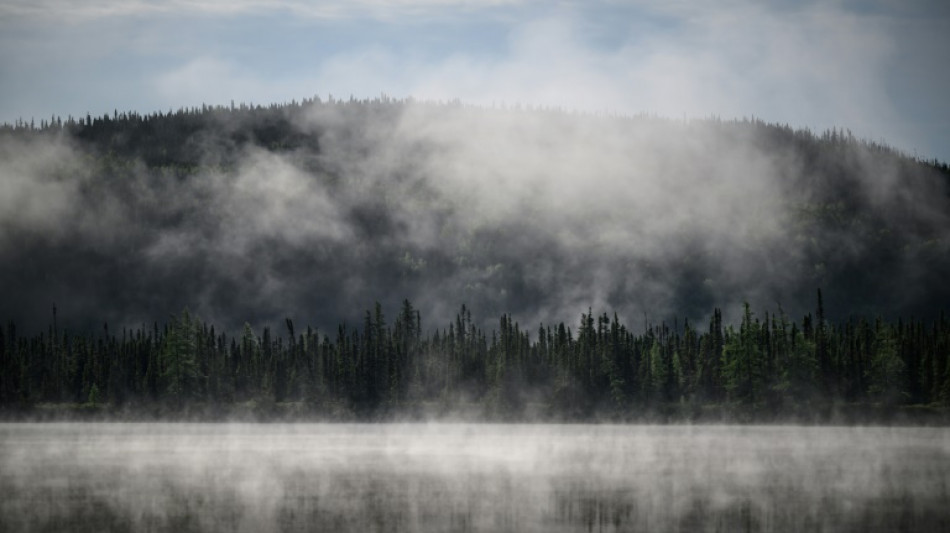
Subarctic boreal forest, vital for the planet, is at risk / Photo: Ed JONES - AFP

 US singer Chris Brown avoids jail over UK nightclub brawl
 Man Utd crisis deepens as Carrick faces axe

 Serbian student movement eyes power after resounding snap poll victory

 Eala breezes past world number 411 in Tokyo opener

 Swedish Centre Party leader says government coalition talks failed
 Barca's big-game defeats pose familiar questions

 Russia says open to mini Ukraine ceasefires, but no let up in war

 Bangladesh measles crisis 'warning sign' of other outbreaks: report

 'Historic victory': World leaders celebrate Lula's re-election
 Stock markets mixed ahead of tech earnings, central bank decisions

 الظفرة يطلب كشف تفاصيل قرار ركلة الإقصاء أمام خورفكان

 Canada-EU summit seeks deepened alliance as US ties fray

 Senegal to host Youth Games, Africa's first ever Olympics

 ITV drama Adultery examines temptation, class and family consequences

 Argentine police arrest stepfather after pregnant 10-year-old reaches hospital
 New levy on non-EU parcels kicks in November 1

 Saudi coalition says struck Houthi missile facilities after Riyadh airport attack

 مهرجان الظفرة الرابع يختتم منافسات الهجن بتتويج الفائزين

 Trump says Canada trade deal coming 'soon'

 بوتين يؤكد استمرار واردات أوروبا من الطاقة الروسية

 العاصفة «بويلو» تعطل الكهرباء والرحلات الجوية في بريطانيا

 Kane primed to pip Yamal, Mbappe to Ballon d'Or glory

 UK households advised to prepare for three days without essential services

 Redditch Santa fun run to return to Arrow Valley Park

 Obama links Trump trade policy to higher costs in Detroit speech

It burns, it drifts, it falls victim to insects. And it's shrinking.
The boreal forest, which is second only to the Amazon in terms of its vital role in ensuring the future of the planet, encircles the Arctic -- and it is in just as much danger from climate change as the South American rainforest.
The deep, verdant green ring -- which stretches across Canada, Scandinavia, Russia and Alaska -- has been weakened by increasing forest fires, the melting of permafrost, intensifying insect infestations and warming temperatures.
Experts are categorical in their warnings: the forest is encroaching on the tundra, and the prairies are slowly taking the place of the trees.
In his cabin in Quebec, not far from the banks of the St Lawrence River amid the trembling aspen and black spruces, Jean-Luc Kanape, a member of the Innu Indigenous group, says he likes to feel the "energy of the wind, the cold."
"When I'm in the heart of the forest, I feel like I'm part of it. The trees are like my roots," says the brawny 47-year-old, his hair askew and his skin bronzed from the sun.
Kanape has dedicated his life to the protection of the caribou, a species whose habitat is under threat because of the effects of deforestation and global warming. And he is worried.
"We often say we need to save the planet, but that's not true," he says, suggesting humanity's own existence is what is at stake.
The forest -- named for Boreas, the Greek god of the north wind -- covers 10 percent of the world's land surface and has a decisive impact on the globe's northern oceans and overall climate.
Its 1.2 billion hectares (nearly three billion acres), which account for nearly a third of all forested land in the world, help slow global warming by absorbing a significant amount of carbon emissions.
The boreal forest holds twice as much carbon as all tropical forests combined, and also helps purify a massive amount of freshwater.
There have always been natural changes to its makeup, but scientists are now concerned that those changes are happening more often, and are even becoming the norm.
- 'Monster' fire -
Dead tree trunks stretch towards the sky -- ghostly white shadows staining the green canopy in this corner of Alberta province.
On the ground, shrubs and grass battle to stay alive.
"I'll never again see a spruce tree in these hills," laments Harvey Sykes, a 70-year-old former oil industry worker who lives in the Fort McMurray area, home to the world's biggest oil sands production complex.
Here, the boreal forest still bears the signs of a huge fire in May 2016 that sent 90,000 residents scrambling for safety from a wall of flames along a lone access road.
"This one was a monster," recalls Sykes, pointing to the hills where the blaze began. "A fire like that, you don't confront it... you get out of there."
Like many in the region, Sykes lost everything in the inferno -- his house, his belongings and a lifetime of mementos.
The wildfire remains the most destructive natural disaster in Canada's history, with 2,500 buildings destroyed and damages totalling nearly 10 billion Canadian dollars ($7.4 billion US).
It was the first time in the country's history that residents found themselves in danger as a direct result of the consequences of climate change on the boreal forest.
- Adaptation -
Today, wildfires are multiplying in Alaska, Canada and Siberia. They are one of the greatest threats to northern woodlands even if, paradoxically, they are also essential to the forest's survival and evolution.
Fires release precious nutrients into the forest soil, and create holes in the tree canopy that allow sunlight to break through, contributing to the growth of new trees.
In the boreal forest, the most prevalent type of fire is a crown fire, which spreads quickly from treetop to treetop. These blazes are more intense and more difficult to fight than fires on the ground.
Fires can burn all winter under the snow, producing toxic smoke and significant amounts of carbon monoxide.
The forest's plants are resistant to the bitter Canadian cold, and have adapted to the recurrent fires -- the trembling aspen burn quickly but regenerate easily.
Some species even depend on the fires -- jack pines or black spruces have sap-coated cones that open up to deposit seeds as the flames spread, ensuring their survival.
But data collected over the last few decades indicates that the increasing frequency and intensity of the fires have reached an abnormal level.
"We now have a wildfire season that is longer and more severe. They are more fierce, and cover larger areas," explains Yan Boulanger, a researcher in forest ecology at Canada's ministry of natural resources.
Fires are now regularly twice as destructive in terms of surface area as they were a century ago, and 70 percent of the land consumed in fires over the last 20 years was in the boreal forest, according to satellite data made public in August.
Experts from Global Forest Watch, the World Resources Institute and the University of Maryland -- who collected the data -- also revealed that extreme heat waves are five times as likely as they were 150 years ago.
Global warming is having an especially devastating effect on northern lands including the boreal zone, as temperatures are increasing two or three times quicker than on the rest of the planet.
Extreme heat leads to more lightning, which in turn sparks the worst fires, Boulanger says. Destruction of forested lands in these blazes leads to massive greenhouse gas emissions, which fuel climate change.
While forest fires are one of the most extreme and visible results of warming temperatures, the actual increase in heat has even worse implications.
- 'Drunken trees' -
They are known as "drunken trees" -- tilted sideways due to melting permafrost. Eventually, the soil will completely erode away from the roots, and the trees will tumble.
This buckling and sinking is because of the degradation of the permafrost, ground that has remained frozen for at least two years in a row.
"You have potential for large shifts," says Diana Stralberg, an Edmonton-based researcher for the natural resources ministry. Sometimes areas "might be flooded and lose forests," she explains, becoming bogs or lakes.
As the ground is thawing, bacteria eat away at the biomass compiled for thousands of years, generating carbon and methane emissions that are contributing to the acceleration of global warming.
Elsewhere, in the far north of the boreal zone, trees are crowding the tundra, which features better conditions for their survival.
Scientists recently discovered that white spruces were being displaced towards the north in Alaska, to a part of the Arctic tundra that had not seen such tree growth in thousands of years.
In a decade, the tree cover advanced a whopping four kilometers (2.5 miles).
On the southern edge of the boreal forest, drought has reduced stands of trees to shrubs and high grasses.
"In the west, we could end up with forests that simply become prairies because the extent of the drought or the frequency of climatic change is too great to sustain the tree population," Boulanger warns.
Stralberg remembers seeing computer maps modeling the effects of climate change for the first time when she started working on issues related to the boreal forest a few years ago.
"I thought it was just wrong, because it was just so extreme," she says.
And then her colleagues started reaching the same conclusions: that the boreal forest was rapidly shifting north, absorbing a part of the tundra and losing ground to the prairies at the southern edge.
The displacement of an ecosystem is not without consequences.
"You can lose forest a lot faster than it can grow and provide habitat for wildlife," says the 52-year-old Stralberg.
As the mercury rises, evaporation occurs more easily and plants lose water more quickly due to transpiration. They close the pores of their leaves and battle to survive.
But by slowing their own growth, the plants lose some of their capacity to eliminate carbon dioxide from the atmosphere -- a vicious circle indeed.
- 'Snowball effect' -
In the western part of Quebec province, government research scientist David Pare and his team are studying tree litter -- the decomposing organic material on the forest floor that has acted as a giant carbon sink for centuries.
Here, the sun struggles to break through due to the twisting, intertwined tree canopy. Thousands of pine needles cover the mossy ground.
Tree litter can store five to six times as much carbon dioxide as other plant matter, and Pare wants to see how resilient the ground is.
A plethora of experiments are being carried out across Canada to better understand the tree litter and predict its future role in reducing the amount of greenhouse gases in the atmosphere.
In some areas, the subsoil is heated, and in others, the amount of organic matter on the ground is varied. Tree roots are cut elsewhere.
Dozens of tiny orange flags and wooden trays embedded in the fallen pine needles mark off the various trials that have been in place for six years.
"We want to know how much carbon has accumulated in the soil and how it happens," Pare explains.
"Because if global warming is diminishing the carbon sink, that will only lead to more warming," says the 59-year-old Pare.
Scientists are fearful of such a "snowball effect," which could eventually lead to significant loss of the boreal forest's role as a carbon sink.
But the forest is also at risk of falling victim to another phenomenon brought on by higher temperatures: insect infestations.
- The curious case of the hemlock looper -
It's a surprising sight: on a green hillside peppered with vibrant trees, there is a square marked off by dead trees stripped of their limbs, their dried out trunks stretching skyward.
"It's like a bomb went off. All the trees are dead in this area, killed by the hemlock looper," says Pare, his white hair covered by a construction helmet.
The hemlock looper is a moth native to North America that can devour all leaves and needles on trees in one season, explains the researcher as he walks through the raspberry bushes that have cropped up in the area.
Several events linked to global warming seem to be converging and could explain the insect infestations, which are also happening in Scandinavian forests.
Trees are already weakened by drought and so struggle to fend off the voracious bugs who take advantage of longer summers and warmer winters.
Hundreds of thousands of hectares of forest land have been devastated by the eastern spruce budworm, another species native to Canada and the eastern United States that mainly attacks fir trees.
"As global warming progresses, the budworm now can reach areas that it could not get to in the past," says researcher Louis De Grandpre, who has studied the boreal forest for 30 years.
The key now is to measure the long-term effects of these infestations "because we really don't know what the future of these forests will look like," he added.
- Tipping point? -
For Pare, "there is a limit to how much trees can endure."
For now, scientists are pondering whether the boreal forest is approaching a so-called "tipping point," a threshold beyond which carbon and methane emissions are inevitable and changes to the ecosystem are irreversible.
Experts say they still hope for the ecosystem's continued resilience.
Stralberg believes the damage can still be limited.
"We looked at areas that will remain cooler and wetter in a warming world, like the shores of large interior lakes, large peatland complexes and north-facing hillsides," she explains.
"These are areas where we can buy time for cold-adapted species like spruce trees and caribou to adjust to climate change in the near term."
Careful monitoring, reforestation, legal protections, technological progress and time-honored Indigenous methods can help maintain the carbon sink.
"I think that cultural burning can be one of the solutions... combined with some of the new technology," says Amy Cardinal Christianson, a research scientist with the Canadian Forest Service who studies how fires affect Indigenous communities.
Cultural burning, long practiced by Indigenous communities, can help reduce the impact of forest fires by eliminating ground cover. Christianson, a member of the Metis people, explains the burning as "a slow fire, a cool burn."
Unlike in the Amazon, in this inhospitable cold-climate forest, human action -- like deforestation or oil sands mining -- is less detrimental to the environment than natural phenomena caused by climate change.
Experts say that in order for the boreal forest to maintain its essential role in ensuring the survival of the planet, the solution must be a global one.
For Boulanger, the government forest researcher, we must "have faith in the next generation."
F.AbuShamala--SF-PST