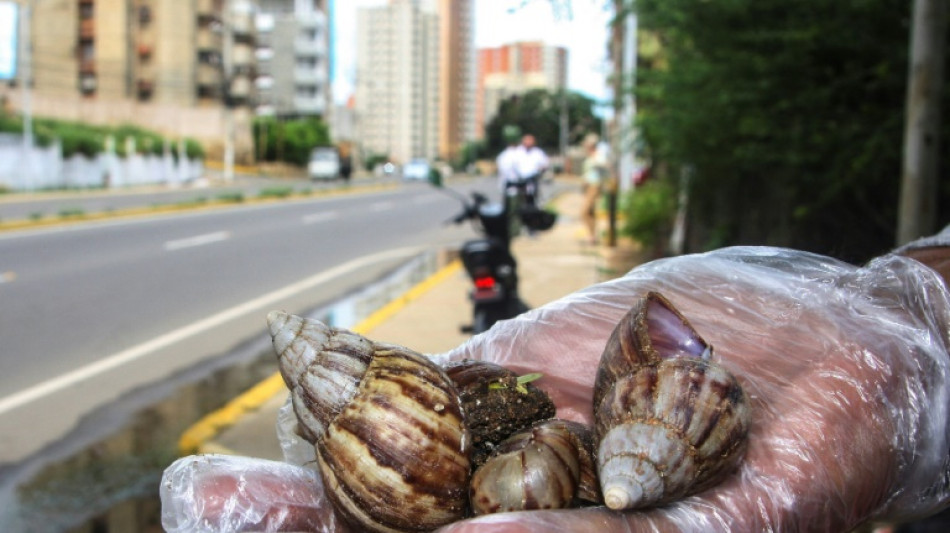
'Voracious' giant snails spark alarm in Venezuela / Photo: Luis BRAVO - AFP

 US singer Chris Brown avoids jail over UK nightclub brawl
 Man Utd crisis deepens as Carrick faces axe

 Serbian student movement eyes power after resounding snap poll victory

 Eala breezes past world number 411 in Tokyo opener

 Swedish Centre Party leader says government coalition talks failed

 Barca's big-game defeats pose familiar questions

 Russia says open to mini Ukraine ceasefires, but no let up in war

 Bangladesh measles crisis 'warning sign' of other outbreaks: report

 'Historic victory': World leaders celebrate Lula's re-election

 Stock markets mixed ahead of tech earnings, central bank decisions

 الظفرة يطلب كشف تفاصيل قرار ركلة الإقصاء أمام خورفكان

 Canada-EU summit seeks deepened alliance as US ties fray

 Senegal to host Youth Games, Africa's first ever Olympics

 ITV drama Adultery examines temptation, class and family consequences

 Argentine police arrest stepfather after pregnant 10-year-old reaches hospital

 New levy on non-EU parcels kicks in November 1

 Saudi coalition says struck Houthi missile facilities after Riyadh airport attack

 مهرجان الظفرة الرابع يختتم منافسات الهجن بتتويج الفائزين

 Trump says Canada trade deal coming 'soon'

 بوتين يؤكد استمرار واردات أوروبا من الطاقة الروسية

 العاصفة «بويلو» تعطل الكهرباء والرحلات الجوية في بريطانيا

 Kane primed to pip Yamal, Mbappe to Ballon d'Or glory

 UK households advised to prepare for three days without essential services

 Redditch Santa fun run to return to Arrow Valley Park

 Obama links Trump trade policy to higher costs in Detroit speech

A "plague" of giant African snails that pose potential health risks to humans is causing alarm in Venezuela where sustained rains have facilitated their proliferation.
The first colonies of the sub-Saharan Achatina fulica snail were discovered at the beginning of November on the shores of Lake Maracaibo in western Venezuela.
Since then, more snails have been found in agricultural areas in the region, as well as in neighboring Tachira state.
"Specific sites have been verified... where approximately 350 to 400 snails are being collected per day," Rafael Ramirez, the mayor of the city of Maracaibo, told AFP.
He said authorities were working hard combat the snails.
The giant African snail is considered an invasive species because of its reproductive capacity -- up to 600 eggs every two weeks -- and its relatively long lifespan of six years on average.
It can be devastating to crops and also carries parasites that can cause meningitis, encephalitis and intestinal disorders in humans.
The snail has been present in Venezuela since 1997 with the last plague detected in 2017 although in smaller quantities, said Jose Sandoval, director of wildlife at the Azul Ambientalista NGO.
"This will be unstoppable because they are big and already adults: They have already laid eggs," said Sandoval.
"We are faced with an invasion, a plague, and so it is hard to eradicate them when they reach these numbers, but they can be controlled."
Sandoval took AFP on an eradication mission in Maracaibo in which he collected 437 snails in just two hours.
He said the prolonged rainy season was to blame for the snails' reappearance and rapid reproduction.
"They will remain until March, they will damage crops... they are voracious," he added.
O.Salim--SF-PST