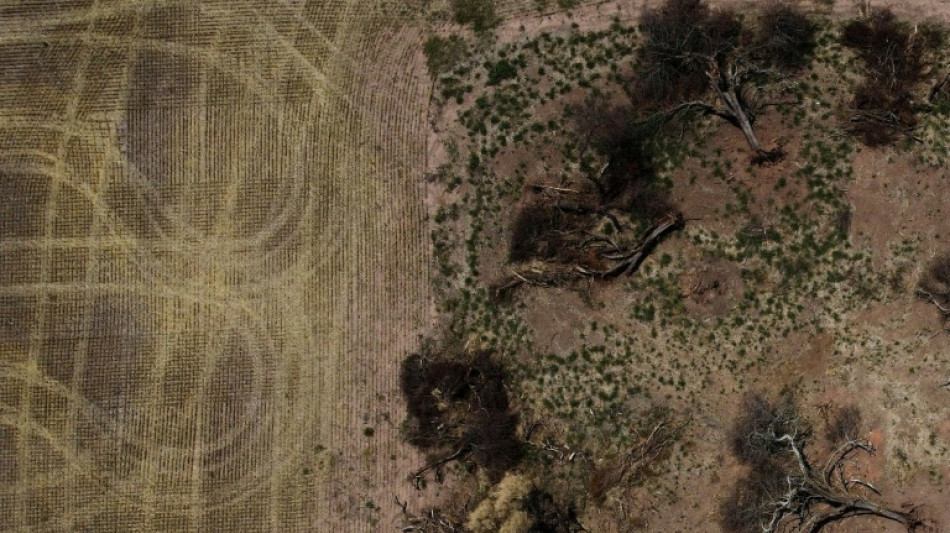
Colonists nibble at Gran Chaco, South America's other big forest / Photo: Luis ROBAYO - AFP

 France's Macron accuses social media of sowing discord ahead of election
 Anthropic unveils IPO filing showing soaring sales and AI risks

 US singer Chris Brown avoids jail over London nightclub brawl

 US singer Chris Brown avoids jail over UK nightclub brawl
 Man Utd crisis deepens as Carrick faces axe

 Serbian student movement eyes power after resounding snap poll victory

 Eala breezes past world number 411 in Tokyo opener

 Swedish Centre Party leader says government coalition talks failed

 Barca's big-game defeats pose familiar questions

 Russia says open to mini Ukraine ceasefires, but no let up in war

 Bangladesh measles crisis 'warning sign' of other outbreaks: report

 'Historic victory': World leaders celebrate Lula's re-election

 Stock markets mixed ahead of tech earnings, central bank decisions

 الظفرة يطلب كشف تفاصيل قرار ركلة الإقصاء أمام خورفكان

 Canada-EU summit seeks deepened alliance as US ties fray

 Senegal to host Youth Games, Africa's first ever Olympics

 ITV drama Adultery examines temptation, class and family consequences

 Argentine police arrest stepfather after pregnant 10-year-old reaches hospital

 New levy on non-EU parcels kicks in November 1

 Saudi coalition says struck Houthi missile facilities after Riyadh airport attack

 مهرجان الظفرة الرابع يختتم منافسات الهجن بتتويج الفائزين

 Trump says Canada trade deal coming 'soon'

 بوتين يؤكد استمرار واردات أوروبا من الطاقة الروسية

 العاصفة «بويلو» تعطل الكهرباء والرحلات الجوية في بريطانيا

 Kane primed to pip Yamal, Mbappe to Ballon d'Or glory

Dwarfed by its more prestigious sibling, the Amazon, South America's second largest forest is a little-known victim of 25 years of gradual invasion by agriculture.
The Gran Chaco indigenous forest that spans one million square kilometers (386,000 square miles) across Argentina, Paraguay and Bolivia is at the mercy of ravenous soybean and sunflower crops, as well as pasture land.
Comprising a mix of dry thorn shrubland, woodlands and palm savannas, the dense tropical dry forest contains massive scars -- vast areas of deforestation gouged out with alarming regularity.
The harm to local fauna and flora is immeasurable.
In some places, as far as the eye can see, carob trees uprooted by heavy machinery lie waiting to be taken away and used as charcoal, tannin, furniture and railway sleepers, for which this dense hardwood is particularly prized.
Here, in Argentina's northeast, some 1,100-kilometers (685 miles) from Buenos Aires, is the country's agriculture frontier.
It is where the agro export industry, so crucial for a country short on foreign currency, advances at the expense various species of fauna and flora, as well as people.
"Practically all of Chaco province used to be covered by forests," agricultural engineer Ines Aguirre from the Chaco Argentina Agroforestry Network told AFP.
"But when the technological package of genetically modified soyabean appeared in the 1990s, the Chaco zone began to be colonized."
- 'Strong agro pressure' -
Two of Argentina's main exports, soybean (30 percent) and genetically-modified corn are, like sunflowers, resistent to dry climates, allowing them to thrive in the semiarid Chaco region.
Deforestation in the region has averaged around 40,000 hectares (154 square miles) a year, peaking at 60,000 on occasions, said Aguirre.
"This shouldn't happen because all forms of deforestation have been suspended in the province," said Noemi Cruz, the forests campaign co-ordinator at Greenpeace, while picking up a handful of dusty earth from a patch of ground cleared of trees.
Without the protection of those trees "water slides on the surface but won't penetrate the ground during the rainy season."
Chaco includes a 128,000 hectare national park called The Impenetrable that is designated a "red zone" and strictly protected by a forestry law. But there are also "yellow" zones where tourism and "soft" agriculture are allowed, and "green" zones that are a free-for-all.
But this law has not proved sufficient to protect the forests.
"There is strong pressure from companies and agricultural producers that want to open up more farmland and there is a permanent international demand for primary materials, especially soyabean and beef," said biologist and researcher Matias Mastrangelo, from the CONICET national scientific and technical research institute.
In the case of illegal logging, a lightly punitive fine "does not discourage clearing and the companies incorporate it as another production cost."
What this means is that deforestation around The Impenetrable park affects the rich fauna living within it, such as anteaters, peccaries, coral snakes, tapir and the continent's largest feline, the jaguar, which is endangered in the region and the subject of an ambitious reintroduction program.
"A forest that becomes a soybean field can no longer provide shelter for the jaguar, nor any of its prey. The destruction is absolute," said biologist Gerardo Ceron, coordinator of the Rewilding Argentina team managing the predator's reintroduction.
- Large mammals at risk -
"In the dry Chaco, we are probably facing a very serious effect of losing fauna. We are seeing especially the extinction of large mammals," said Micaela Camino, a biologist at CONICET, citing the giant armadillo and white-lipped peccary as examples.
"When a species is lost, you lose what is unique about the species. But also the nutritional security of local families and all the functions that this species performed in the ecosystem.
"You're losing the ability of this ecosystem to survive, regenerate and be resilient, which is very dangerous in a context of climate change."
It is not just fauna and flora being pushed out but also local indigenous communities, such as the Wichi and Criollo who live in the forest.
"What generally happens is that before the logging, the rights of these families are violated. They are swindled (out of their land) and forced to leave their homes," added Camino.
Aguirre says there are solutions to regenerate the lost Chaco forest, starting with the replanting of the carob tree.
"The carob tree, which is a legume, produces a reaction between bacteria and the tree's roots that recomposes the nitrogen in the soil. It's amazing, the growth is incredible," she said.
But such programs are for later, for now the priority is "stopping deforestation."
L.Hussein--SF-PST