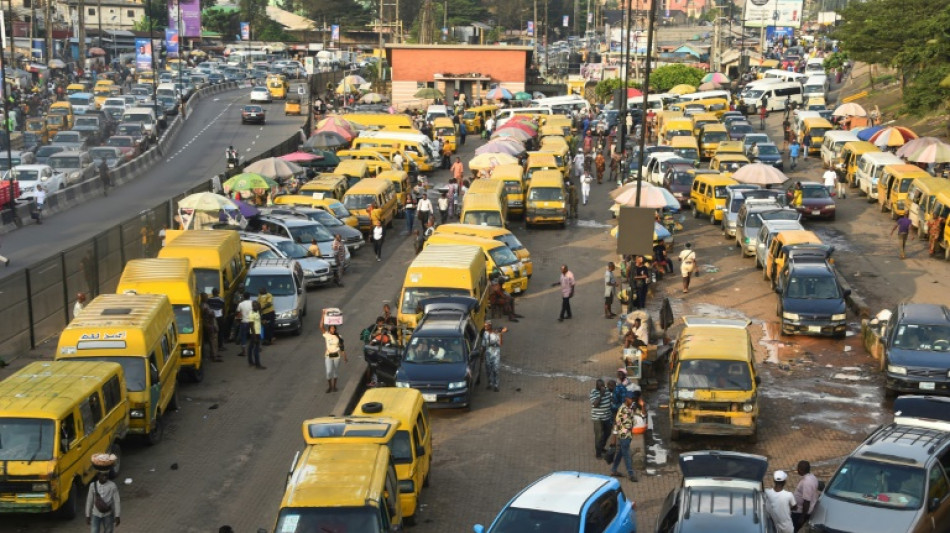
Africa's mega-cities look to mass transit to ease growing pains / Photo: PIUS UTOMI EKPEI - AFP

 France's Macron accuses social media of sowing discord ahead of election
 Anthropic unveils IPO filing showing soaring sales and AI risks

 US singer Chris Brown avoids jail over London nightclub brawl
 US singer Chris Brown avoids jail over UK nightclub brawl
 Man Utd crisis deepens as Carrick faces axe

 Serbian student movement eyes power after resounding snap poll victory

 Eala breezes past world number 411 in Tokyo opener
 Swedish Centre Party leader says government coalition talks failed
 Barca's big-game defeats pose familiar questions

 Russia says open to mini Ukraine ceasefires, but no let up in war
 Bangladesh measles crisis 'warning sign' of other outbreaks: report
 'Historic victory': World leaders celebrate Lula's re-election
 Stock markets mixed ahead of tech earnings, central bank decisions

 الظفرة يطلب كشف تفاصيل قرار ركلة الإقصاء أمام خورفكان

 Canada-EU summit seeks deepened alliance as US ties fray

 Senegal to host Youth Games, Africa's first ever Olympics
 ITV drama Adultery examines temptation, class and family consequences
 Argentine police arrest stepfather after pregnant 10-year-old reaches hospital

 New levy on non-EU parcels kicks in November 1

 Saudi coalition says struck Houthi missile facilities after Riyadh airport attack

 مهرجان الظفرة الرابع يختتم منافسات الهجن بتتويج الفائزين

 Trump says Canada trade deal coming 'soon'
 بوتين يؤكد استمرار واردات أوروبا من الطاقة الروسية

 العاصفة «بويلو» تعطل الكهرباء والرحلات الجوية في بريطانيا

 Kane primed to pip Yamal, Mbappe to Ballon d'Or glory
Tade Balogun times his commute like a military operation.
Each day, the Lagos consultant leaves home before dawn, arrives for work early and takes a nap before before starting his day.
He then stays until 9 pm -- that way, he escapes the chaos and gridlock that can transform his 29-kilometre (18-mile) drive into a three-hour nightmare.
By the time he gets home, Balogun says, his daughters are fast asleep. But, he adds wryly, his blood pressure has remained in the safety zone: "Lagos traffic can cause a health hazard."
Balogun's trek highlights the plight of Nigeria's economic hub and other fast-growing African cities as the world's population reaches the eight billion mark in the coming days.
In a metropolitan area sprawling across nearly 1,200 square kilometres (450 square miles), much of which has been informally settled, Lagos's 20 million people struggle each day with notoriously poor infrastructure, except for a few wealthy enclaves.
Arguably the worst problem is transport, for the city is dependent on roads -- and they are a choke of cars, trucks, motorbikes and packed yellow Danfo minibuses, along with hawkers who weave in between the unruly lanes of traffic.
Seeking to change this, the Lagos State government has drawn up ambitious plans, including a new airport and a mass transit network of trains, buses and ferries.
"For the economy of any city to thrive, your transport system must be adequate, efficient," Lagos metropolitan transport authority chief Abimbola Akinajo told AFP.
"It is a big part of what we need to get right in order for the city to function right."
- Delayed train network -
But experts say the funding and logistical challenges of this blueprint are mountainous, and some wonder whether some basic questions have been asked.
"We have to understand, what is Lagos? Whether Lagos as a state, Lagos as a metropolis, or as a megacity," said Muyiwa Agunbiade, a University of Lagos urban development professor.
"If you don’t know the population, it's difficult for us to plan for the people."
Delivering big transport projects on time and on budget is a headache almost anywhere in the world.
But in Lagos's case, a much-trumpeted city rail network has been delayed by more than a decade.
Akinajo acknowledged funding and implementation problems had snarled the scheme but insisted a part of one rail line would be finished this year and start taking passengers by early 2023.
Engineers are running test trains along half of the Blue line route -- one of six in a planned network to eventually link rail to more regulated buses and ferries.
With one line running, Akinajo said, Lagos hopes investors will come. British advisers and the French development agency are helping.
Agunbiade agreed getting things moving was crucial.
"If you have all this working, it will be a major game changer."
- Urbanising Africa -
The challenges facing Lagos are mirrored elsewhere in quickly urbanising Africa, where population growth typically outstrips basic infrastructure and planning.
DR Congo's Kinshasa and Tanzania's Dar Es Salaam are on track to join Lagos as the world's three most populated cities by 2100, according to researchers at the University of Toronto Global Cities Institute.
Dar Es Salaam already has had some success with its dedicated Bus Rapid Transit routes, which with widened roads reduced dense congestion.
Kinshasa is more complex -- a civil war in the early 2000s and regional violence in 2016 added displaced people to the city's swiftly growing population.
The roads are so clogged with traffic that many people prefer to walk. Public transport is by taxis and minibuses dubbed "spirits of death".
"When you see the size of the traffic jams and the mass of people, you realise road transport cannot solve the problem," said Martin Lukusa, Kinshasa's director of public transport.
The "Metrokin" project is still under construction to rehabilitate old rail lines.
- Water a 'quicker win' -
Lagos State is also eyeing another resource -- using the lagoon that lies between the city and a narrow strip of coast on the Atlantic as a means of transport.
Lagos State waterways agency chief Oluwadamilola Emmanuel said the plans are to increase the number of operators and expand jetty and safety infrastructure.
Around 300 private boat operators will be brought into a more regulated system along with larger state ferries able to move more people.
Small boat owners recently formed a union, making a transition easier, he said.
"Water is a quicker win because we have a natural asset," he said, acknowledging the need to overcome Lagosian worries about marine safety to encourage more use.
Travelling from mainland Ikorodu to the Victoria Island business area can take two hours by car, but small boats can skip across the lagoon in 25 minutes.
The trip, though, is pricey -- at 1,000 naira ($2.30), it is double a Danfo bus ride.
"The vision is there," said one development partner. "Financing is a problem. Cost is also a problem. There will still be a lot of people who will pay less to sit in a bus."
Lindsay Sawyer, an urban studies researcher at Sheffield University in northern England, agreed that to tame the traffic, the city had to keep costs low and absorb existing informal structures.
"It's about affordability and capacity. The Danfo are still everywhere because they are still the most affordable option," he said.
Most harried Lagos commuters can only wait for solutions.
"It's a madhouse," said Lagos stock manager Ochuko Oghuvwu, who commutes 20 hours a week. "By now Lagos should have a metro line."
O.Farraj--SF-PST