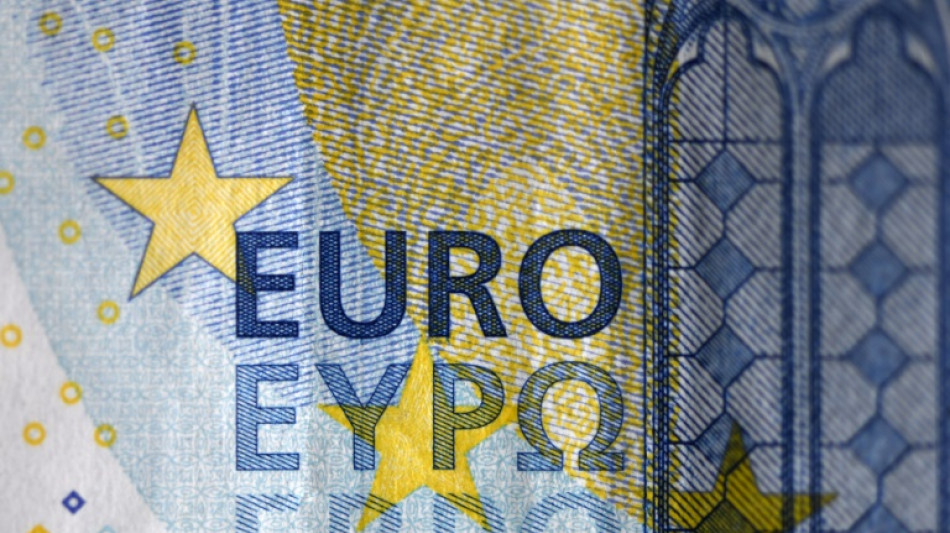
ECB warns of 'looming recession' as it again hikes rates / Photo: INA FASSBENDER - AFP/File

 Netanyahu, rivals trade attacks over Iran as clock counts down to Israel vote

 Townsend urges Scotland to use Nations Championship as World Cup springboard

 Microsoft offers voluntary exit packages to 60,000 staff

 S.Africa ambassador calls for talks with US over 'tense' ties

 'Smells of freedom': Serbians hopeful after landmark election

 South Africa select 'enforcer' Coetzee for Australia decider

 Botanists comb Gabon's rich rainforests with nature on the line

 New levy on non-EU parcels kicks in Sunday
 Stocks climb ahead of tech earnings, central bank calls

 Part of London's Oxford Street pedestrianised 'forever'

 Canadian youth seek climate action in landmark trial

 Trump blasts Norway over Nobel Peace Prize snub

 Japan PM vows swift response to wave of cyberattacks

 Stocks mostly rise before tech earnings, central bank calls
 France's Macron to visit Marseille after protest violence

 German union slams Audi boss's appearance at Trump rally
 UK set for 'limited' budget giveaways as borrowing costs surge

 Anthropic's AI model accessed US voter data: Axios

 Malaysia's Johor reopens schools as haze eases

 Carragher says Fernandes benching was intended as public punishment

 Mother renews anti-bullying appeal a decade after son’s death
 'Historic victory': Leftist leaders in the Americas celebrate Lula's re-election

 African players in Europe: Jackson brace ends City's perfect record

 طرق دبي تفتتح الجمعة الجسر الأخير في مشروع دوار المركز التجاري

 نقل رالي دكار 2027 من السعودية في قرار استثنائي

The European Central Bank announced another jumbo interest rate hike on Thursday and said further increases would follow to combat soaring inflation, even as its president, Christine Lagarde, warned a eurozone recession was looming.
The ECB's 25-member governing council repeated last month's unprecedented move and opted for another bumper increase of 75 basis points, leaving its three main rates sitting in a range of between 1.5 and 2.25 percent.
"We will have further rate increases in the future," Lagarde said. "There is still ground to cover."
The Frankfurt institution is under pressure to rein in record-high inflation, mainly driven by surging food and especially energy prices in the wake of Russia's war in Ukraine.
Eurozone inflation stood at 9.9 percent in September, nearly five times the ECB's two-percent target.
Inflation "remains far too high" in the 19-nation currency club, Lagarde said.
Like other central banks, the ECB is fighting back with a series of rate hikes intended to dampen demand by making credit more expensive for households and businesses.
But higher borrowing costs also weigh on economic activity, and the eurozone outlook has deteriorated significantly.
"The likelihood of recession (is) looming much more on the horizon," Lagarde told a press conference.
And inflation could go "higher than expected if there are increases in the prices of energy and food commodities", she added.
"Obviously we're concerned, particularly about those who have low income," Lagarde said.
- Political grumbling -
Moscow's move to curb gas supplies to Europe has triggered an energy crisis on the continent, fuelling fears of power shortages and sky-high heating bills this winter.
If Russia completely cuts off gas flows to Europe, the eurozone economy could shrink by nearly one percent in 2023, ECB vice-president Luis de Guindos recently warned.
That scenario has become more likely after Russia in late August shut down the crucial Nord Stream 1 pipeline to Europe's economic powerhouse Germany.
As European governments race to unveil multi-billion-euro support measures to help citizens through a cost-of-living crisis this winter, the ECB's monetary policy tightening has come under scrutiny.
Italian Prime Minister Giorgia Meloni this week criticised the ECB's "rash choice" to aggressively hike rates, saying it created "further difficulties for member states that have elevated public debt".
French President Emmanuel Macron expressed "concern" that the ECB was "shattering demand" in Europe.
But Lagarde hit back at the criticism.
"The decision that we made today is the most appropriate in order to restore price stability, which... is critically important for not just the stability of prices but also for the economy to actually prosper and recover," she said.
The former French finance minister also warned governments against adding to their debt pile as they try to shield citizens from price shocks.
"Governments should pursue fiscal policies that show they are committed to gradually bringing down high public debt ratios," Lagarde said, stressing that policymakers should pick measures which are "temporary and targeted at the most vulnerable".
- Excess liquidity -
Also in focus on Thursday were the ECB's efforts to bring other monetary policy levers in line with its inflation-busting efforts, including unwinding its massive balance sheet.
The governing council moved to reduce the benefits gained by eurozone banks from super-cheap loans issued at ultra-low rates during the pandemic.
The interest rate for so-called TLTRO III loans would rise, the ECB said, and lenders will be offered "additional voluntary early repayment dates".
Lenders are currently able to make an easy profit by parking their excess TLTRO cash at the ECB and pocketing the new, higher deposit rate.
This is not considered a good look at a time when many consumers and companies are struggling, and the ECB had signalled it wanted to make the loan scheme less generous.
Lagarde was also grilled by reporters on how the ECB intends to shrink its five-trillion-euro bond portfolio, after years of hoovering up government and corporate debt to keep credit flowing.
Given the economic uncertainty and the risk of rattling financial markets, analysts believe the start of any "quantitative tightening" -- letting the bonds mature or actively selling them -- is some way off.
Lagarde said the topic would be discussed at the next meeting in December.
X.AbuJaber--SF-PST