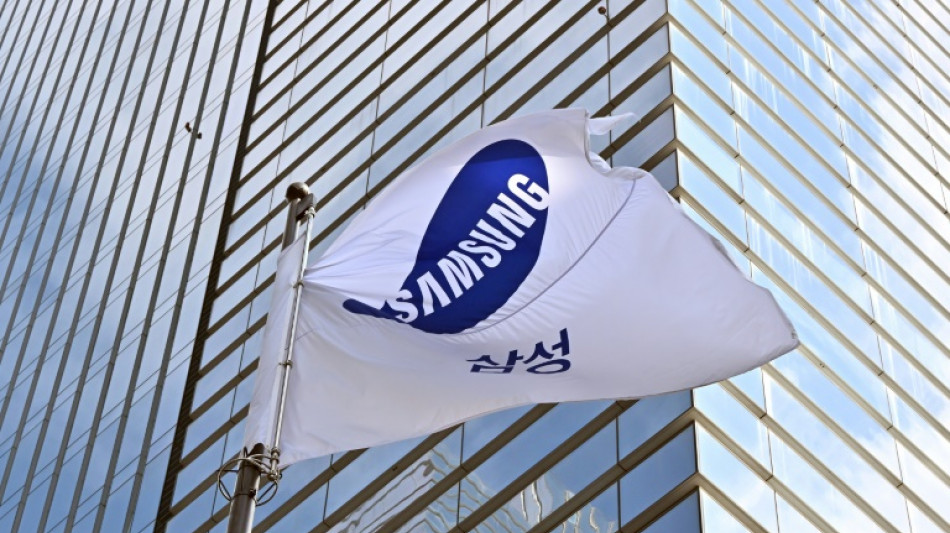
Samsung Electronics says Q3 operating profit down 31% on-year / Photo: Jung Yeon-je - AFP

 Netanyahu, rivals trade attacks over Iran as clock counts down to Israel vote

 Townsend urges Scotland to use Nations Championship as World Cup springboard

 Microsoft offers voluntary exit packages to 60,000 staff

 S.Africa ambassador calls for talks with US over 'tense' ties

 'Smells of freedom': Serbians hopeful after landmark election

 South Africa select 'enforcer' Coetzee for Australia decider

 Botanists comb Gabon's rich rainforests with nature on the line

 New levy on non-EU parcels kicks in Sunday

 Stocks climb ahead of tech earnings, central bank calls

 Part of London's Oxford Street pedestrianised 'forever'

 Canadian youth seek climate action in landmark trial

 Trump blasts Norway over Nobel Peace Prize snub

 Japan PM vows swift response to wave of cyberattacks

 Stocks mostly rise before tech earnings, central bank calls

 France's Macron to visit Marseille after protest violence

 German union slams Audi boss's appearance at Trump rally

 UK set for 'limited' budget giveaways as borrowing costs surge

 Anthropic's AI model accessed US voter data: Axios

 Malaysia's Johor reopens schools as haze eases

 Carragher says Fernandes benching was intended as public punishment

 Mother renews anti-bullying appeal a decade after son’s death

 'Historic victory': Leftist leaders in the Americas celebrate Lula's re-election

 African players in Europe: Jackson brace ends City's perfect record

 طرق دبي تفتتح الجمعة الجسر الأخير في مشروع دوار المركز التجاري

 نقل رالي دكار 2027 من السعودية في قرار استثنائي

South Korean tech giant Samsung Electronics on Thursday said its third-quarter operating profits were down 31.39 percent year-on-year after a global economic downturn hit demand for consumer electronics.
Earnings in its crucial memory chips division were down, the company said in a statement, adding that "demand for consumer products remained weak".
Operating profit for July to September 2022 fell to 10 trillion won ($7 billion), down from 15.8 trillion won for the same period last year, the company said.
The results are the first year-on-year decline in profit in nearly three years for Samsung Electronics, the world's biggest smartphone maker.
But the company said it had seen an increase in sales, which were up by 3.79 percent from the same period last year to 76 trillion won.
The world's biggest memory-chip maker is the flagship subsidiary of the giant Samsung group, by far the largest of the family-controlled empires known as chaebols that dominate business in South Korea, Asia's fourth-largest economy.
The conglomerate is crucial to the country's economic health -- its overall turnover is equivalent to a fifth of the national gross domestic product.
Until the second quarter of this year, Samsung, along with other tech companies, significantly benefitted from strong demand for electronic devices -- as well as chips that power them -- during the pandemic.
But the global economy is now facing multiple challenges, including soaring inflation, rising interest rates and the growing threat of a broad debt crisis.
The situation has been exacerbated by Russia's invasion of Ukraine -- which has spurred a surge in energy prices and pushed global food prices up -- along with China's adherence to a strict zero-Covid policy.
"In 2023, demand is expected to recover to some extent, but macroeconomic uncertainties are likely to persist," Samsung Electronics said.
"In the Memory Business, after a dampened first half, demand is expected to rebound centering on servers as data center installations resume," it added.
Analyst Park Sung-soon of Cape Investment & Securities told AFP he did not expect consumer demand for tech products to recover until the second half of 2023.
"So the focus for Samsung will be adjusting its supply rather than relying on demand recovering anytime soon," he said.
Samsung also said it had benefited from the strength of the US dollar against the Korean won, "resulting in an approximately 1.0 trillion won company-wide gain in operating profit compared to the previous quarter."
- Geopolitics -
The vast majority of the world's most advanced microchips are made by just two companies -- Samsung and Taiwan's TSMC -- both of which are running at full capacity to alleviate a global shortage.
The supply of memory chips has become an issue of global geopolitical significance recently, with leading governments scrambling to secure supplies.
That was demonstrated in May when US President Joe Biden kicked off a South Korea tour by visiting Samsung's sprawling Pyeongtaek chip plant.
Russia's invasion of Ukraine has "further spotlighted the need to secure our critical supply chains", Biden said at the plant, underscoring the importance of bolstering technology partnerships among "close partners who do share our values".
Samsung employs about 20,000 people in the United States and work is under way to build a new semiconductor plant in Texas, scheduled to open in 2024.
The US also recently introduced new measures to limit China's access to high-end semiconductors with military uses, a move that has wiped billions from chip companies' valuations worldwide.
U.AlSharif--SF-PST