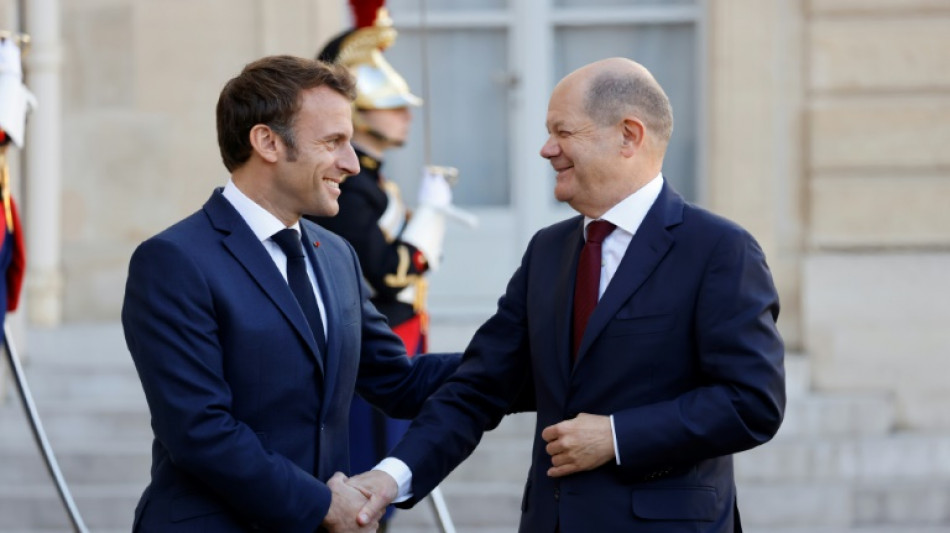
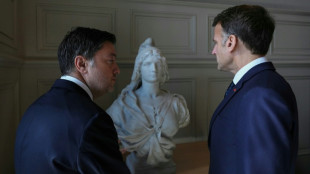
Macron, Scholz meet in bid to defuse Paris-Berlin tensions / Photo: Ludovic MARIN - AFP

 Netanyahu, rivals trade attacks over Iran as clock counts down to Israel vote
 Townsend urges Scotland to use Nations Championship as World Cup springboard
 Microsoft offers voluntary exit packages to 60,000 staff
 S.Africa ambassador calls for talks with US over 'tense' ties
 'Smells of freedom': Serbians hopeful after landmark election
 South Africa select 'enforcer' Coetzee for Australia decider
 Botanists comb Gabon's rich rainforests with nature on the line
 New levy on non-EU parcels kicks in Sunday
 Stocks climb ahead of tech earnings, central bank calls
 Part of London's Oxford Street pedestrianised 'forever'
 Canadian youth seek climate action in landmark trial
 Trump blasts Norway over Nobel Peace Prize snub
 Japan PM vows swift response to wave of cyberattacks
 Stocks mostly rise before tech earnings, central bank calls
 France's Macron to visit Marseille after protest violence
 German union slams Audi boss's appearance at Trump rally
 UK set for 'limited' budget giveaways as borrowing costs surge
 Anthropic's AI model accessed US voter data: Axios
 Malaysia's Johor reopens schools as haze eases
 Carragher says Fernandes benching was intended as public punishment
 Mother renews anti-bullying appeal a decade after son’s death
 'Historic victory': Leftist leaders in the Americas celebrate Lula's re-election
 African players in Europe: Jackson brace ends City's perfect record
 طرق دبي تفتتح الجمعة الجسر الأخير في مشروع دوار المركز التجاري

 نقل رالي دكار 2027 من السعودية في قرار استثنائي
French President Emmanuel Macron hosted German Chancellor Olaf Scholz for lunch Wednesday, with the leaders hoping to pare back differences on energy and defence and revitalise the European Union's key double act.
Both leaders were all smiles as Scholz climbed out of his black Mercedes in the courtyard of the Elysee Palace to shake hands, although the German appeared to sidestep Macron's attempts to put an arm around him.
Hackles have been raised on both sides since Russia's invasion of Ukraine -- less than three months after Scholz took office last December -- prompted crisis decisions taken under the pressure of the war and its knock-on effects.
Berlin's move to spend up to 200 billion euros ($200 billion) subsidising soaring gas prices and refusal to consider an EU-wide energy price cap nettled Paris and other European capitals, who fear the effect on their energy costs.
And France also sees commitments to cooperate on defence procurement floundering, given Germany's plans for a shared missile shield with other NATO nations using American equipment.
Longer-term projects to jointly develop new fighter jets and tanks also face reluctance from big arms companies, which has worsened since war broke out.
The depth of the differences was laid bare by the recent delay to a regular joint cabinet meeting between Paris and Berlin, which would have been Scholz's first as chancellor.
And limited expectations for Wednesday's talks were clear from the schedule released by Macron's Elysee Palace office, which did not provide for a joint press conference.
"The two leaders will continue their talks on defence, the economy and energy with the aim of strengthening Franco-German cooperation," the presidency said in a statement.
- 'Destabilising' Ukraine war -
Differences between the EU's two largest and most populous economies -- in the past often the brokers of compromise among the bloc's 27 members -- have come at exactly the wrong time.
Russia's invasion and the resulting disruption to the energy system have coincided with rising tensions between China and the West, as well as fears that more isolationist forces could return to power in Washington.
Berlin and Paris also differ on how to adapt the European Union to be more agile faced with the new challenges, and how quickly to admit new members.
"We can't allow ourselves not to have a united, strong Europe at this moment in history," former French foreign minister Dominique de Villepin warned on France Inter radio.
"That starts with a fruitful French-German dialogue," he added.
Moscow's burning of bridges with Europe means Germany faces "a change to its model whose destabilising nature must not be underestimated", Macron has said.
That was made clear earlier this year, when Scholz announced a "new era" in German defence policy supported with massive spending on its creaking military.
Although Berlin's allies welcomed the change of direction after years of under-investment, the flow of cash has not translated into big contracts for EU or especially French arms firms -- one of the undertones of Macron's calls for greater European sovereignty.
Instead Germany is rushing to buy big-ticket American-made items like F-35 fighter jets and Patriot air defence systems.
- 'No fundamental crisis' -
Many observers suggest that spats are inherent to the relationship between two large nations with interests that often diverge.
"The truth is that it's a marriage of necessity" between France and Germany, a French diplomatic source said.
"This isn't a fundamental crisis, it's the basis of the relationship," they added.
"This French-German relationship has always been made up of chilly patches, moments of tension and then warming up again," agreed Alexandre Robinet-Borgomano, a German politics expert at French think-tank Institut Montaigne.
"It's often during moments of crisis where a European response is indispensable that France and Germany manage to overcome their differences to propose a joint solution."
That may be more difficult with leaders who have yet to develop personal warmth.
"Macron and (former chancellor Angela) Merkel texted every day. I don't think (Macron and Scholz) are talking every day," the diplomatic source said.
O.Farraj--SF-PST