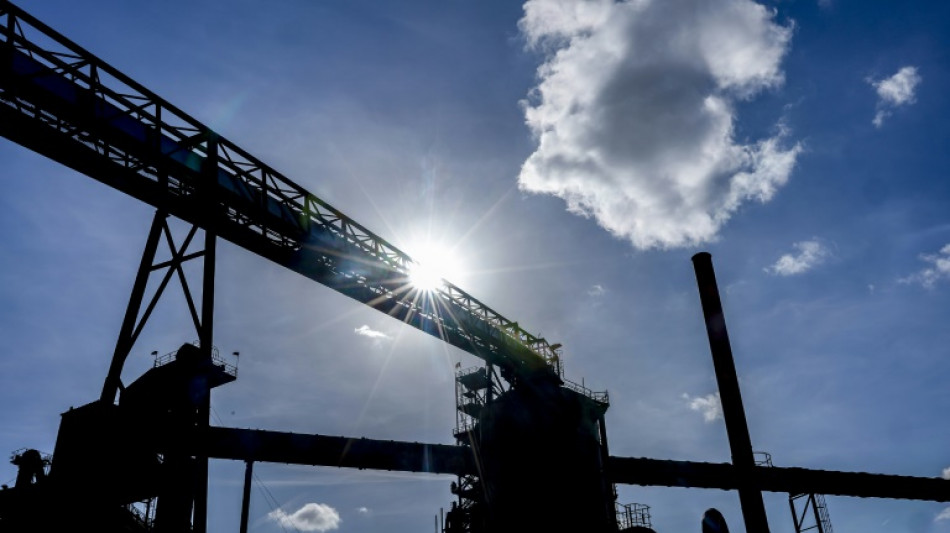
Eurozone contracts further as Germany heads for recession / Photo: Axel Heimken - AFP/File

 Venezuela leader criticizes Machado over dramatic return from exile

 Brazil markets battered after Lula win, AI in focus elsewhere

 Lula savors Brazil win as Bolsonaro rejects result, markets tumble

 Canadian youths ask court to impose binding climate protections

 Walter Koenig, who played original Chekov on 'Star Trek,' dies at 90
 Netanyahu, rivals trade attacks over Iran as clock counts down to Israel vote

 Townsend urges Scotland to use Nations Championship as World Cup springboard

 Microsoft offers voluntary exit packages to 60,000 staff

 S.Africa ambassador calls for talks with US over 'tense' ties

 'Smells of freedom': Serbians hopeful after landmark election

 South Africa select 'enforcer' Coetzee for Australia decider

 Botanists comb Gabon's rich rainforests with nature on the line

 New levy on non-EU parcels kicks in Sunday

 Stocks climb ahead of tech earnings, central bank calls

 Part of London's Oxford Street pedestrianised 'forever'

 Canadian youth seek climate action in landmark trial
 Trump blasts Norway over Nobel Peace Prize snub

 Japan PM vows swift response to wave of cyberattacks

 Stocks mostly rise before tech earnings, central bank calls

 France's Macron to visit Marseille after protest violence

 German union slams Audi boss's appearance at Trump rally
 UK set for 'limited' budget giveaways as borrowing costs surge

 Anthropic's AI model accessed US voter data: Axios

 Malaysia's Johor reopens schools as haze eases

 Carragher says Fernandes benching was intended as public punishment

Germany, the EU's top economy and Europe's export powerhouse, looks headed for imminent recession, according to a closely watched survey Monday that pointed to a deepening eurozone contraction.
There are "growing signs of an impending recession in the eurozone's largest economy," S&P Global Market Intelligence said as it released its eurozone purchasing managers' index for October.
The PMI for the 19-nation area fell to 47.1, down from 48.1 a month earlier -- its fourth consecutive drop and that fastest decline in nearly two years -- as soaring inflation and high energy prices bit deeper.
In Germany, the PMI dropped to 44.1, from 45.7 in September.
A reading below 50 signals an economic contraction.
The downward pressure on eurozone economic activity underlined the woes thrown up by Russia's war in Ukraine, which has crimped energy supplies.
Germany's reading was the lowest since initial business shutdowns in Germany when the Covid-19 pandemic hit.
Both manufacturing and services in Germany were showing accelerated rates of shrinkage, though that had yet to feed through into jobs-shedding, the survey showed.
German businesses were "deeply pessimistic" about the year-ahead outlook.
In France, the second-biggest economy in the EU, the economy was stagnating, with a PMI of 50 compared with 51.2 in September.
Although France is suffering less than other countries in Europe from inflation, rising prices are still putting pressure on consumers, leading to a severe fall in factory orders.
Across the eurozone, the PMI indicated that factory output had dropped for the fifth consecutive month, at a rate unseen since the worst of the pandemic.
Supply congestion and shortages had eased a bit, against a backdrop of flagging demand. While input demand had slumped, rising energy bills and wage pressure kept costs high.
A eurozone-wide recession "is looking increasingly inevitable," S&P Global Market Intelligence chief business economist Chris Williamson said.
"The region's energy crisis remains a major concern and a drag on activity, especially in energy intensive sectors."
- ECB rate decision -
The PMI data came ahead of a Thursday meeting of the European Central Bank's governing board that is expected to deliver a big interest rate cut in a bid to cool inflation.
Inflation in the 19-nation eurozone stood at nearly 10 percent in September, five times the ECB's target of two percent.
The German economy, whose energy-hungry industries relied heavily on Russian gas before the war, is now forecast to shrink by 0.4 percent in 2023.
Higher interest rates typically mean putting a dampener on business activity, as credit becomes more expensive and consumer spending decreases.
The EU is struggling to find ways to mitigate energy prices.
A summit last week agreed on a number of measures, but a key one, of capping wholesale gas prices, was kicked into future deliberations by Germany, which fears gas supplies being diverted to more lucrative markets in Asia.
Berlin has unholstered a massive 200-billion-euro ($197-billion) plan to shield German consumers from high energy prices, triggering unease among EU partners at its go-it-alone approach that risks distorting the single market.
At the summit German Chancellor Olaf Scholz reluctantly agreed to have the bloc look further at the price cap measure but only after an impact analysis.
The International Monetary Fund on Sunday said that downturns in parts of Europe could turn into "deeper recessions" across the continent.
Government support to tackle energy costs and inflation would "only partly" offset those strains, it said.
The IMF already predicted that Germany and Italy would slip into recession next year.
H.Nasr--SF-PST