Plastic recycling remains a 'myth': Greenpeace study / Photo: Brendan Smialowski - AFP/File

 Venezuela leader criticizes Machado over dramatic return from exile

 Brazil markets battered after Lula win, AI in focus elsewhere
 Lula savors Brazil win as Bolsonaro rejects result, markets tumble

 Canadian youths ask court to impose binding climate protections

 Walter Koenig, who played original Chekov on 'Star Trek,' dies at 90
 Netanyahu, rivals trade attacks over Iran as clock counts down to Israel vote
 Townsend urges Scotland to use Nations Championship as World Cup springboard

 Microsoft offers voluntary exit packages to 60,000 staff

 S.Africa ambassador calls for talks with US over 'tense' ties

 'Smells of freedom': Serbians hopeful after landmark election

 South Africa select 'enforcer' Coetzee for Australia decider

 Botanists comb Gabon's rich rainforests with nature on the line

 New levy on non-EU parcels kicks in Sunday
 Stocks climb ahead of tech earnings, central bank calls

 Part of London's Oxford Street pedestrianised 'forever'

 Canadian youth seek climate action in landmark trial

 Trump blasts Norway over Nobel Peace Prize snub

 Japan PM vows swift response to wave of cyberattacks

 Stocks mostly rise before tech earnings, central bank calls

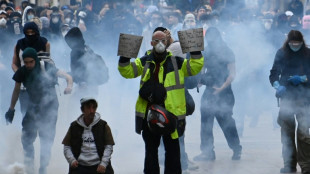 France's Macron to visit Marseille after protest violence

 German union slams Audi boss's appearance at Trump rally

 UK set for 'limited' budget giveaways as borrowing costs surge

 Anthropic's AI model accessed US voter data: Axios

 Malaysia's Johor reopens schools as haze eases

 Carragher says Fernandes benching was intended as public punishment

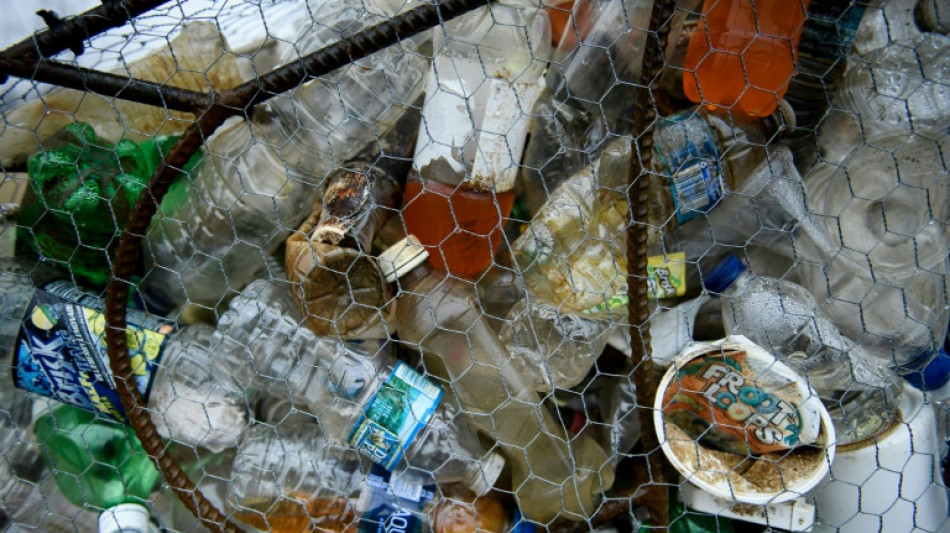
Plastic recycling rates are declining even as production shoots up, according to a Greenpeace USA report out Monday that blasted industry claims of creating an efficient, circular economy as "fiction."
Titled "Circular Claims Fall Flat Again," the study found that of 51 million tons of plastic waste generated by US households in 2021, only 2.4 million tons were recycled, or around five percent.
After peaking in 2014 at 10 percent, the trend has been decreasing, especially since China stopped accepting the West's plastic waste in 2018.
Virgin production -- of non-recycled plastic, that is -- meanwhile is rapidly rising as the petrochemical industry expands, lowering costs.
"Industry groups and big corporations have been pushing for recycling as a solution," Greenpeace USA campaigner Lisa Ramsden told AFP.
"By doing that, they have shirked all responsibility" for ensuring that recycling actually works, she added. She named Coca-Cola, PepsiCo, Unilever and Nestle as prime offenders.
According to Greenpeace USA's survey, only two types of plastic are widely accepted at the nation's 375 material recovery facilities.
The first is polyethylene terephthalate (PET), which is commonly used in water and soda bottles; and the second is high density polyethylene (HDPE), seen in milk jugs, shampoo bottles and cleaning product containers.
These are numbered "1" and "2" according to a standardized system in which there are seven plastic types.
But being recyclable in theory doesn't mean products are being recycled in practice.
The report found that PET and HDPE products had actual reprocessing rates of 20.9 percent and 10.3 percent, respectively -- both down slightly from Greenpeace USA's last survey in 2020.
Plastic types "3" through "7" -- including children's toys, plastic bags, produce wrappings, yogurt and margarine tubs, coffee cups and to-go food containers -- were reprocessed at rates of less than five percent.
Despite often carrying the recycling symbol on their labels, products that use plastic types "3" through "7" fail to meet the Federal Trade Commission classification of recyclable.
This is because recycling facilities for these types aren't available to a "substantial majority" of the population, defined as 60 percent, and because the collected products are not being used in the manufacturing or assembly of new items.
According to the report, there were five main reasons why plastic recycling is a "failed concept."
- Economically unfeasible -
First, plastic waste is generated in vast quantities and is extremely difficult to collect -- as becomes clear during what the report called ineffective "volunteer cleanup stunts" funded by nonprofits such as "Keep America Beautiful."
Second, even if it were all collected, mixed plastic waste cannot be recycled together, and it would be "functionally impossible to sort the trillions of pieces of consumer plastic waste produced each year," the report said.
Third, the recycling process itself is environmentally harmful, exposing workers to toxic chemicals and itself generating microplastics.
Fourth, recycled plastic carries toxicity risks through contamination with other plastic types in collection bins, preventing it from becoming food-grade material again.
Fifth and finally, the process of recycling is prohibitively expensive.
"New plastic directly competes with recycled plastic, and it's far cheaper to produce and of higher quality," said the report.
Ramsden called on corporations to support a Global Plastics Treaty, which United Nations members agreed to create in February, and move toward refill and reuse strategies.
"This isn't actually a new concept -- it's how the milkman used to be, it's how Coca-Cola used to get its beverages to people. They would drink their beverage, give the glass bottle back, and it would be sanitized and reused," she said.
Some countries are leading the way, including India, which recently banned 19 single-use plastic items. Austria has set reuse targets of 25 percent by 2025 and at least 30 percent by 2030 for beverage packaging, while Portugal has also set the 30 percent by 2030 goal.
Chile is moving to phase out single-use cutlery and mandating refillable bottles.
O.Mousa--SF-PST