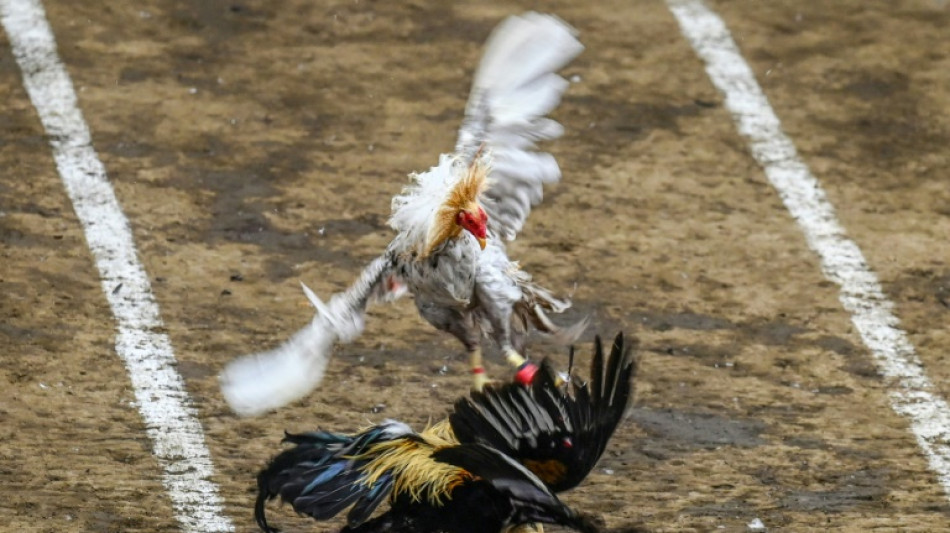
Feathers fly as Philippine cockfighting shakes off Covid closures / Photo: Jam STA ROSA - AFP

 Venezuela leader criticizes Machado over dramatic return from exile

 Brazil markets battered after Lula win, AI in focus elsewhere

 Lula savors Brazil win as Bolsonaro rejects result, markets tumble

 Canadian youths ask court to impose binding climate protections

 Walter Koenig, who played original Chekov on 'Star Trek,' dies at 90

 Netanyahu, rivals trade attacks over Iran as clock counts down to Israel vote

 Townsend urges Scotland to use Nations Championship as World Cup springboard

 Microsoft offers voluntary exit packages to 60,000 staff

 S.Africa ambassador calls for talks with US over 'tense' ties

 'Smells of freedom': Serbians hopeful after landmark election

 South Africa select 'enforcer' Coetzee for Australia decider

 Botanists comb Gabon's rich rainforests with nature on the line

 New levy on non-EU parcels kicks in Sunday

 Stocks climb ahead of tech earnings, central bank calls

 Part of London's Oxford Street pedestrianised 'forever'

 Canadian youth seek climate action in landmark trial

 Trump blasts Norway over Nobel Peace Prize snub

 Japan PM vows swift response to wave of cyberattacks

 Stocks mostly rise before tech earnings, central bank calls

 France's Macron to visit Marseille after protest violence

 German union slams Audi boss's appearance at Trump rally

 UK set for 'limited' budget giveaways as borrowing costs surge

 Anthropic's AI model accessed US voter data: Axios

 Malaysia's Johor reopens schools as haze eases

 Carragher says Fernandes benching was intended as public punishment
In a raucous cockpit in the Philippines, Dennis de la Cruz grins from ear to ear as he watches his roosters slash their opponents to death in a frenzy of blood and feathers.
Shut for two years during the Covid-19 pandemic, traditional cockfighting arenas are getting back to full capacity across the archipelago nation.
Cockfighting is hugely popular in the Philippines, where millions of dollars are bet on matches every week.
Roosters wearing bladed spurs on their legs go beak to beak in a brutal fight to the death, as spectators -- mostly men -- wager on the result.
Supporters defend the blood sport as being part of the Filipino identity and argue the birds would be eaten if they did not fight.
But opponents maintain it is cruel and should be banned, as it is in many other countries.
"In our village, more than half the residents are cockfighters," de la Cruz, 64, told AFP at a recent derby in San Pedro, a city south of Manila, where he fell one win short of the one-million-peso ($17,000) champion's pot.
The son of a longtime cockpit operator, de la Cruz said he had never held a regular job. Instead, he relied on his winnings from the roosters bred by his nephews on a large farm.
In a country plagued by inequality, cockfighting is a unique "neutral zone" where rich and poor mingle and play by the same rules, said University of the Philippines anthropologist Chester Cabalza.
Adhering to a strict honour code, spectators prior to the pandemic used hand signals like stock brokers to lay their bets during a match that can last less than a minute.
It is common for 300,000 to 400,000 pesos to be bet on a single fight, one aficionado told AFP.
After each fight -- there are 15 per hour -- crumpled banknotes are flung towards the winning bettor.
Losers welching on bets run the risk of being attacked.
When cockpits reopened, regulators wary of spreading the coronavirus through excessive crowd interaction ordered operators to install betting machines, so winners could collect their money from the cashier instead.
"If your cock wins, you stride out of the ring like a tough guy -- you exude a macho image," said gamefowl breeder Edwin Lumbres, thrusting his chest out for emphasis.
"But if you lose, you hang your head and shuffle out like somebody whose manhood is suspect."
- 'Forced to fight' -
Katrina Del Espiritu Santo, of People for the Ethical Treatment of Animals, is pushing for cockfighting to be banned as the birds are "forced to fight to the death".
But the activist's efforts have failed to gain much traction in the Philippines.
Fighting roosters are ubiquitous across the country and are prized possessions -- despite their loud crowing at all hours.
A bird can cost between 3,000 and 15,000 pesos depending on its parents' win record.
Fighting fowls are kept in wire cages outside homes in urban areas or in triangular shelters on farms that dot the countryside.
As cockpits fell silent at the start of the pandemic, many small breeders could not afford to feed their flocks and were forced to sell roosters at firesale prices -- or throw them in the cooking pot.
Others admitted staging illegal fights to make ends meet.
To revive the sport and get revenue flowing into government coffers drained by the Covid-19 response, former president Rodrigo Duterte issued permits to seven outfits to operate online cockfighting.
Known as e-sabong, fights were held in empty arenas and streamed 24 hours a day, allowing people to place minimum bets of 200 pesos per fight on their mobile phones.
The sport's popularity exploded -- and so did the earnings.
People who had never watched cockfighting before began betting, while large breeding farms saw demand for their fowl surge.
Duterte said the national government was raking in 640 million pesos a month in fees -- even as the economy tanked.
It was also lucrative for e-sabong operators.
Charlie Ang, who runs Lucky 8 Star Quest, told a Senate inquiry this year that Filipinos wagered between one and two billion pesos on his platform every day, which he claimed accounted for about 95 percent of e-sabong bets.
But the disappearance earlier in the year of 34 cockfighting workers, who are feared dead, and reports of gamblers being driven to financial ruin revealed the seedy side of e-sabong.
Some punters reportedly killed themselves, while a woman was arrested for allegedly selling her baby to pay off debts.
Under growing pressure from the public and lawmakers, Duterte reluctantly shut down online cockfighting shortly before his term ended in June.
But as pandemic restrictions eased in the past year, local governments began giving traditional cockpit operators permission to resume fights -- to the relief of millions of Filipinos.
"People were angry because their favourite pastime was taken away," said Dondon Clanor, 45, a cockfighting enthusiast.
"Now everyone is happy."
B.Khalifa--SF-PST