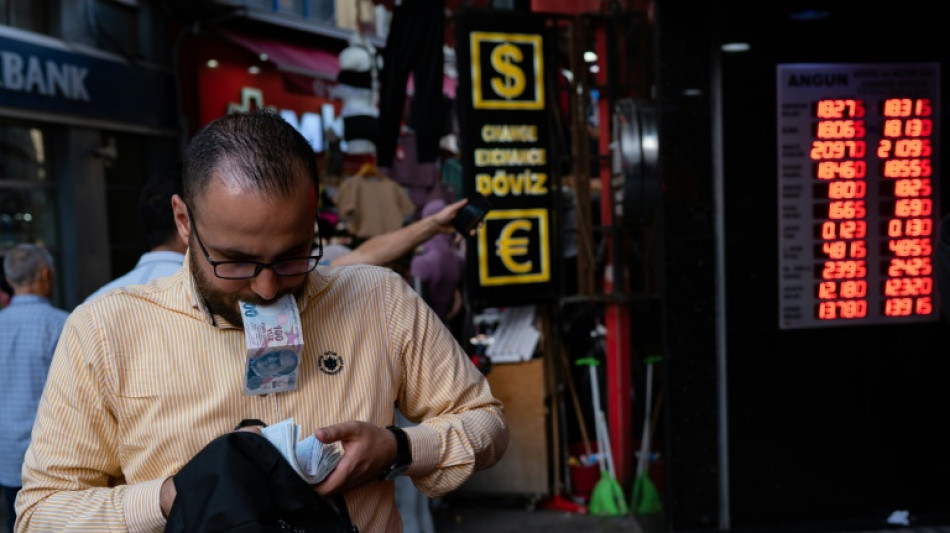
Turkish central bank cuts rates again as inflation rockets / Photo: Yasin AKGUL - AFP

 Venezuela leader criticizes Machado over dramatic return from exile

 Brazil markets battered after Lula win, AI in focus elsewhere

 Lula savors Brazil win as Bolsonaro rejects result, markets tumble

 Canadian youths ask court to impose binding climate protections

 Walter Koenig, who played original Chekov on 'Star Trek,' dies at 90

 Netanyahu, rivals trade attacks over Iran as clock counts down to Israel vote

 Townsend urges Scotland to use Nations Championship as World Cup springboard

 Microsoft offers voluntary exit packages to 60,000 staff

 S.Africa ambassador calls for talks with US over 'tense' ties

 'Smells of freedom': Serbians hopeful after landmark election

 South Africa select 'enforcer' Coetzee for Australia decider

 Botanists comb Gabon's rich rainforests with nature on the line

 New levy on non-EU parcels kicks in Sunday

 Stocks climb ahead of tech earnings, central bank calls

 Part of London's Oxford Street pedestrianised 'forever'

 Canadian youth seek climate action in landmark trial

 Trump blasts Norway over Nobel Peace Prize snub

 Japan PM vows swift response to wave of cyberattacks

 Stocks mostly rise before tech earnings, central bank calls
 France's Macron to visit Marseille after protest violence

 German union slams Audi boss's appearance at Trump rally
 UK set for 'limited' budget giveaways as borrowing costs surge

 Anthropic's AI model accessed US voter data: Axios

 Malaysia's Johor reopens schools as haze eases

 Carragher says Fernandes benching was intended as public punishment

Turkey's central bank on Thursday cut its policy rate for the third consecutive month despite a plunging lira and an annual inflation rate that has soared over 83 percent.
Turkey's monetary policymakers are bucking the global trend of central banks raising interest rates to combat inflation, as high borrowing rates cool down the economy and prices.
The latest decision comes after President Recep Tayyip Erdogan said the central bank would keep cutting rates every month for "as long as I am in power" -- and despite inflation hitting 83.45 percent in September on an annual basis.
Erdogan wants to lower interest rates to single digits by the end of the year as he prioritises economic growth eight months before a general election -- which could promise to be the closest since he came to power nearly two decades ago.
Turkish policymakers have insisted on following this unconventional economic model at the expense of an astronomical inflation.
The central bank said Thursday it was cutting its one-week repo rate to 10.5 percent from 12 percent, with a surge in consumer prices it said was "driven by the lagged and indirect effects of rising energy costs" caused by Russia's war on Ukraine.
The interest rate cut was widely anticipated, but the 150 basis points cut was larger than expected after two 100 basis points moves in both August and September.
The bank hinted that the easing cycle would end next month.
"The (Monetary Policy) Committee evaluated taking a similar step in the following meeting and ending the rate cut cycle," the bank said.
Liam Peach, senior emerging markets economist at the London-based Capital Economics, said this guidance "appears to be an admission that lowering interest rates is hardly the right thing to be doing when inflation is so high."
"But at the same time, it would take interest rates to nine percent and satisfy Erdogan's wish to bring rates down into single digits," he added.
- 'Re-election strategy'-
Inflation began to rise worldwide after economies emerged from Covid lockdowns but it worsened this year as Russia's invasion of Ukraine sent energy and food prices through the roof.
Erdogan, a vocal opponent of higher borrowing costs, has called high interest rates his "biggest enemy".
Earlier this month he vowed that while he remained in power, "the interest will continue to come down with each passing day, each passing week, each passing month."
As a result, the Turkish lira keeps losing its value against the US dollar and is down 28 percent since January.
"Erdogan's economic re-election strategy is clear... use money from Russia and (the) Gulf to fund FX intervention to defend the lira, cut policy rates as far as possible to get credit and growth going," BlueBay Asset Management analyst Timothy Ash said.
The powerful Turkish leader has responded to the economic crisis by an overhaul of his foreign policy and repairing ties with his former rivals in the Arab world, including oil-rich Saudi Arabia.
Additional trade-focussed deals with Russia have helped shore up Turkey's dwindling foreign currency reserves and potentially given Erdogan enough breathing room to ride out the economic storm until the June election.
However, Washington has been warning Turkish companies and banks trading with Russia for several months they could face possible sanctions.
Elizabeth Rosenberg, the US assistant secretary for terrorist financing and financial crimes, traveled to Ankara and Istanbul this week, the Department of the Treasury said.
Her meetings "affirmed the importance of close partnership between the United States and Turkey in addressing the risks caused by sanctions evasion and other illicit financial activities."
I.Yassin--SF-PST