Spain minister says EU energy crisis measures too 'timid'
/ Photo: OSCAR DEL POZO - AFP

 Venezuela leader criticizes Machado over dramatic return from exile

 Brazil markets battered after Lula win, AI in focus elsewhere
 Lula savors Brazil win as Bolsonaro rejects result, markets tumble
 Canadian youths ask court to impose binding climate protections

 Walter Koenig, who played original Chekov on 'Star Trek,' dies at 90
 Netanyahu, rivals trade attacks over Iran as clock counts down to Israel vote
 Townsend urges Scotland to use Nations Championship as World Cup springboard

 Microsoft offers voluntary exit packages to 60,000 staff

 S.Africa ambassador calls for talks with US over 'tense' ties
 'Smells of freedom': Serbians hopeful after landmark election

 South Africa select 'enforcer' Coetzee for Australia decider
 Botanists comb Gabon's rich rainforests with nature on the line
 New levy on non-EU parcels kicks in Sunday
 Stocks climb ahead of tech earnings, central bank calls

 Part of London's Oxford Street pedestrianised 'forever'

 Canadian youth seek climate action in landmark trial
 Trump blasts Norway over Nobel Peace Prize snub
 Japan PM vows swift response to wave of cyberattacks

 Stocks mostly rise before tech earnings, central bank calls
 France's Macron to visit Marseille after protest violence

 German union slams Audi boss's appearance at Trump rally
 UK set for 'limited' budget giveaways as borrowing costs surge
 Anthropic's AI model accessed US voter data: Axios
 Malaysia's Johor reopens schools as haze eases
 Carragher says Fernandes benching was intended as public punishment
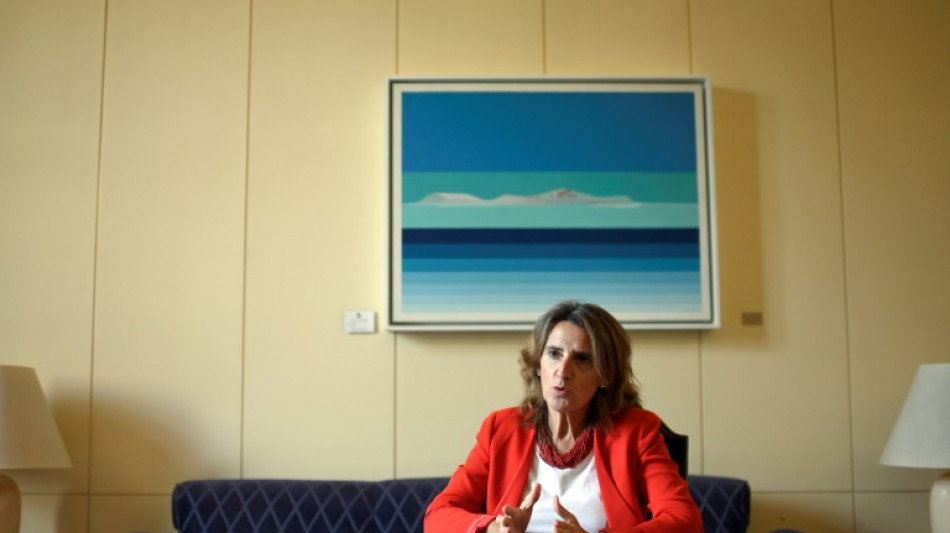
The EU's proposals to rein in soaring energy prices are too "timid" and could lead to a "breakdown in confidence" in European institutions, Spain's Energy Minister Teresa Ribera said Wednesday during an interview with AFP on the eve of an EU leaders summit.
Energy prices and inflation have surged across the 27-nation European Union as Moscow slashed gas supplies apparently in response to EU sanctions over Russia’s invasion of Ukraine in February.
As winter approaches, the European Commission, the EU's executive arm, has been under intense pressure to tackle soaring heating bills for household and businesses.
On Tuesday it unveiled its latest proposals which put the emphasis on joint purchasing among EU countries in order to better command lower prices to refill gas reserves.
"The proposals are, in my view, still too timid: we are still missing concrete measures regarding the vast majority of subjects," Ribera said.
While there has been a "real effort" to tackle the energy crisis over the past year, it is "frustrating to see" that "Europe's reaction in the face of this challenge is slow and laboured," she added.
Spain, the fourth largest eurozone economy, has been one of the loudest voices within the bloc calling for a vigorous reform of the EU's energy market.
The commission's latest plan -- which will be taken up at a two-day summit of EU leaders which begins Thursday in Brussels -- does not include an immediate gas price cap.
A large group of EU countries, led by Italy, have pushed hard for some form of price cap, which is opposed by Germany which fears scaring off alternative suppliers that have stepped in to replace Russia as the bloc's main source of gas.
"I think it is important to go a bit faster on this issue," Ribera said.
"We shouldn't have to ask the Commission four times the same thing to have a proposal. But I trust that the Commission will speed up and make the proposals. It would be risky not to take the decisions in time."
- 'Tough situation' -
The skyrocketing energy prices have fuelled large protests in several European nations against rising inflation and to demand higher wages.
"The energy crisis causes a tough situation for families and for the productive fabric. If we do not respond quickly enough, there may be a breakdown of confidence in the European institutions," Ribera said.
"The current situation is a very important stress test for Europe," she added.
Ribera said she was "moderately”"optimistic that Spain will be able to convince France to lift its opposition to the construction of a new gas pipeline across the Pyrenees mountains.
With Russia withholding gas deliveries to most of Europe in reaction to sanctions over its invasion of Ukraine, there has been a resurgence of interest -- especially from Germany -- in a link to bring in much-needed supplies from Spain to the rest of the continent.
Plans for such a pipeline, known as MidCat, emerged a decade ago but were dropped in 2019 over regulatory and funding issues.
"We respect and understand some of France’s arguments but not all," Ribera said.
"It is important to find a European solution to the problem, and that the demand for help from Germany and other member states be heard."
E.Qaddoumi--SF-PST