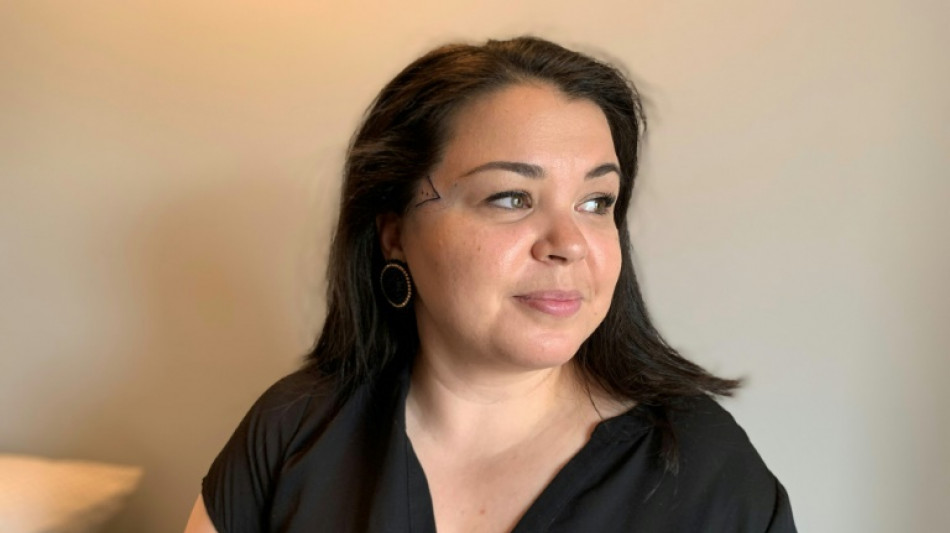
Inuit women's facial tattoos make a comeback in Canada's Arctic / Photo: Anne-Sophie THILL - AFP

 Venezuela leader criticizes Machado over dramatic return from exile

 Brazil markets battered after Lula win, AI in focus elsewhere

 Lula savors Brazil win as Bolsonaro rejects result, markets tumble

 Canadian youths ask court to impose binding climate protections

 Walter Koenig, who played original Chekov on 'Star Trek,' dies at 90

 Netanyahu, rivals trade attacks over Iran as clock counts down to Israel vote
 Townsend urges Scotland to use Nations Championship as World Cup springboard

 Microsoft offers voluntary exit packages to 60,000 staff
 S.Africa ambassador calls for talks with US over 'tense' ties
 'Smells of freedom': Serbians hopeful after landmark election

 South Africa select 'enforcer' Coetzee for Australia decider

 Botanists comb Gabon's rich rainforests with nature on the line

 New levy on non-EU parcels kicks in Sunday

 Stocks climb ahead of tech earnings, central bank calls

 Part of London's Oxford Street pedestrianised 'forever'

 Canadian youth seek climate action in landmark trial

 Trump blasts Norway over Nobel Peace Prize snub

 Japan PM vows swift response to wave of cyberattacks
 Stocks mostly rise before tech earnings, central bank calls
 France's Macron to visit Marseille after protest violence

 German union slams Audi boss's appearance at Trump rally
 UK set for 'limited' budget giveaways as borrowing costs surge
 Anthropic's AI model accessed US voter data: Axios

 Malaysia's Johor reopens schools as haze eases

 Carragher says Fernandes benching was intended as public punishment

Inuit women in Canada's far north are bringing back a lost ancient tradition of facial tattooing that missionaries once declared "evil."
Time-honored tattoos for Inuit women include V-shapes on temples, dots on cheeks and lines on chins.
A tattoo artist uses a shiny needle to dot ink on the temple of Micheline Kilabuk-Cote, 37, a symbol depicting the close bond she has with her two sisters.
Kilanuk-Cote is a civil servant in Iqaluit, the capital of the Nunavut territory. She said she has been "wanting to do this for a very long time," to reclaim her heritage and honor her mother, who died 19 years ago.
"I hadn't had a chance to really connect with her and her culture," she told AFP, explaining that her mother had been denied an opportunity to be tattooed. "This is for her."
Strikingly visible on the chin, forehead and chest, such traditional tattoos were for a long time a means to transmit information about the life of a woman, her interests, or her status in the community.
Some had their fingers and hands tattooed to honour Sedna, the goddess of the sea in Inuit mythology. Others on thighs indicated that they were mothers.
But the practise faced opposition from Anglican and Catholic churches who sent missionaries to the Arctic. They said "tattoos were evil," Gerri Sharpe, president of Pauktuutit Inuit Women of Canada, which represents Inuit women in Canada, told AFP.
Bit by bit, the tradition faded.
But a few years ago, an Inuit artist started a revitalization project after learning that the last traditionally tattooed Inuit woman was dying. Hovak Johnston traveled to northern communities to teach different techniques for Inuit women of all ages to get tattoos.
Public figures have also contributed to the art form's rise, such as Mumilaaq Qaqqaq, who at age 25 became the first Inuit woman with a facial tattoo to be elected to Canada's parliament in 2019. She served a single two-year term.
Then in 2021, Shina Nova, an Inuit singer and influencer, posted videos of her tattoo session, viewed more than 40 million times on TikTok.
- Tattoos empowering -
There's strong demand wherever there are Inuit, says Zorga Qaunaq, who recently led a workshop with six people in Iqaluit.
The Inuit university program staffer does two tattoos a week at her home in the national capital of Ottawa -- home to the largest population of Inuit outside of the far north. It mainly receives young people aged 20 or 30, but also a few teenagers.
"It's healing and therapeutic," for some Inuit, she said.
After leaving the north when she was young, the now 34-year-old said she felt "disconnected" from her culture.
Getting a tattoo was a way of asserting her identity. "It's empowering to have my tattoos," she said.
Gerri Sharpe, 52, with markings on her fingers, wrists and face, echoed this sense of pride.
"They are very significant and sacred," she said, adding that she showed off her tattoos to Pope Francis during his visit to Canada in July to apologize for abuses at church-run Indigenous residential schools. The pontiff made a stop in Iqaluit.
"It was important for me to show him that we still had our tattoos, (that) they are still alive and well and being revitalised, that (the tradition) was not lost," she explained.
W.AbuLaban--SF-PST