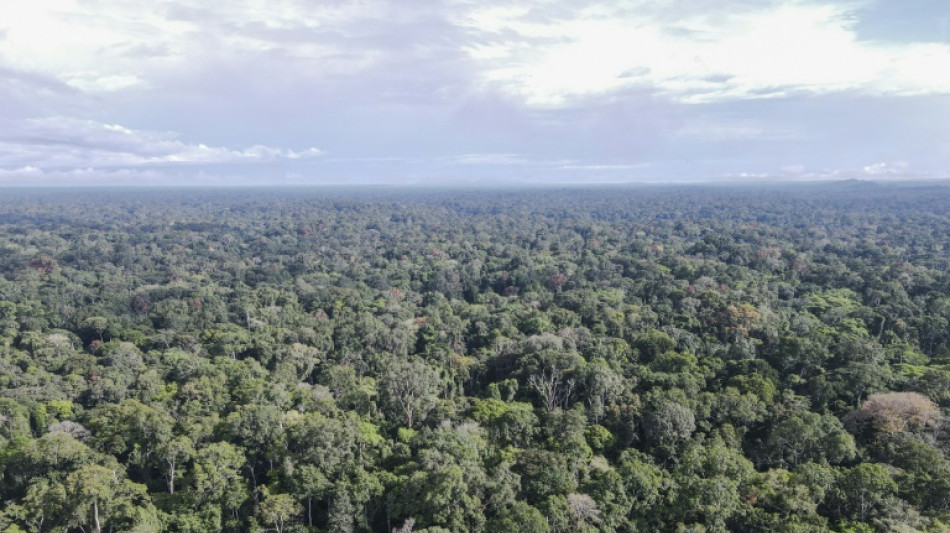
Hungry elephants, Cameroon farmers struggle to coexist / Photo: Daniel Beloumou Olomo - AFP

 Lula win rattles Brazil markets over spending spree fears

 De la Fuente wins men's Ballon d'Or coach of year

 Trump slams 'rigged' Brazil election after ally loses to leftist Lula

 Nadal returns for Vegas hardcourt event

 Fainga'anuku named as loose forward for All Blacks northern tour

 Anthropic points to AI dangers, soaring sales in IPO filing

 Sinner to play rescheduled Saudi Six Kings in December
 Brazilian lawmaker Andre Janones, Lula's social media 'general'

 Swiss Ebola patient repatriated from Nigeria

 Nations far from a deal as UN nature talks enter final stretch

 Brazil markets battered, tech in focus elsewhere

 French court adjourns trial over 2020 death of delivery driver

 Serbian student movement eyes power after election triumph

 Machado ready to meet Venezuela leader after shock return

 Lula celebrates election win as Brazil markets tumble
 France's Macron accuses social media of sowing discord ahead of election
 Anthropic unveils IPO filing showing soaring sales and AI risks

 US singer Chris Brown avoids jail over London nightclub brawl

 US singer Chris Brown avoids jail over UK nightclub brawl
 Man Utd crisis deepens as Carrick faces axe

 Serbian student movement eyes power after resounding snap poll victory

 Eala breezes past world number 411 in Tokyo opener

 Swedish Centre Party leader says government coalition talks failed

 Barca's big-game defeats pose familiar questions

 Russia says open to mini Ukraine ceasefires, but no let up in war

Banana growers on the edge of a giant national park on Cameroon's Atlantic coast say they can take no more crop destruction from hungry elephants as the conflict between man and animal escalates.
Near the southern border with Equatorial Guinea, eight villages have registered complaints with the Campo Ma'an national park, a vast area of virgin forest from where the animals emerge.
An estimated 500 gorillas and more than 200 elephants -- both endangered species -- roam the reserve's 264,000 hectares (652,000 acres).
A week after elephants flattened his banana plantation close by the park, Simplice Yomen, 47, is struggling to cope.
"We are at the end of our tether," he sighs.
The elephants eat the new growth inside the banana tree trunks after splitting them open.
Manioc, maize, sweet potato and peanuts are also favourite snacks, says park administrator Michel Nko'o.
In Cameroon, co-existence between humans and animals on the edge of dense forests is proving increasingly challenging.
Most of the crop destruction is recorded near protected wildlife reserves.
For Nko'o, the elephant raids have become noticeably more frequent since agro-industrialists began setting up by the park.
More 2,000 hectares of forest has been chopped down to grow palm oil trees for Cameroun Vert, an industrial plantation project for which the government first approved a clearing of 60,000 hectares before reducing it to 39,000 hectares after protests.
"The elephants who lived here no longer have any place to go and end up in people's fields," regrets park conservationist Charles Memvi.
- 'Discouraging' -
Affected villages near the town of Campo have seen "three to four hectares of plantations destroyed, which is a major financial loss for the local people", says Nko'o.
Elephants are blamed for 80-90 percent of the attacks.
The rest is accounted for by gorillas, chimpanzees, hedgehogs, pangolins and porcupines.
Nearly all these species are endangered due to habitat loss and/or poaching.
Daniel Mengata's two hectares of banana trees were "devastated" in 2020.
"The animals really are discouraging us," the 37-year-old admitted.
"I started crying after seeing the damage because in one night a year's work was wiped out. That really hurts."
"I can no longer feed my family," adds Emini Ngono, 57. Hungry elephants have ruined her smallholding, which once produced gourds, manioc and potato.
Ngono says she could make more than 1,000 euros ($970) from selling seeds for gourds, a traditional stable food across the region.
- Reconciliation -
Not far off, logs of wood extracted from the forest are piling up.
The high-pitched noise from a saw masks the birdsong as a group of trackers set off looking for rare gorillas.
The World Wide Fund for Nature (WWF) launched a "primate habituation" project a decade ago focused on gorillas in a bid to develop ecotourism in the area.
Part of the income was to go to local communities to encourage them to help protect the animals and reduce the conflict with humans.
Chimene Mando'o is out tracking primates.
"There! That's Akiba", the 25-year-old cries after the gorilla calls out.
Shortly after, Akiba -- meaning "thank you" in the local Mvae language -- briefly appears at the foot of a tree just a dozen metres (yards) away, before scampering off into the jungle.
"We have to find a way to generate some development ... in such a way that everyone benefits from this natural resource," explains WWF biodiversity economist Yann Laurans.
The ministry for forests and wildlife says Cameroon has no legal framework to compensate people after attacks by animals from national parks.
The WWF is testing and studying an insurance system to cover people who lose their livelihoods to animal attacks.
Smallholder Simplice Yomen is hoping for a more secure future after setting up beehives to dissuade elephants from encroaching on his plantation.
Others are trying lemon trees and other spiky bushes to keep the elephants out.
F.AbuShamala--SF-PST