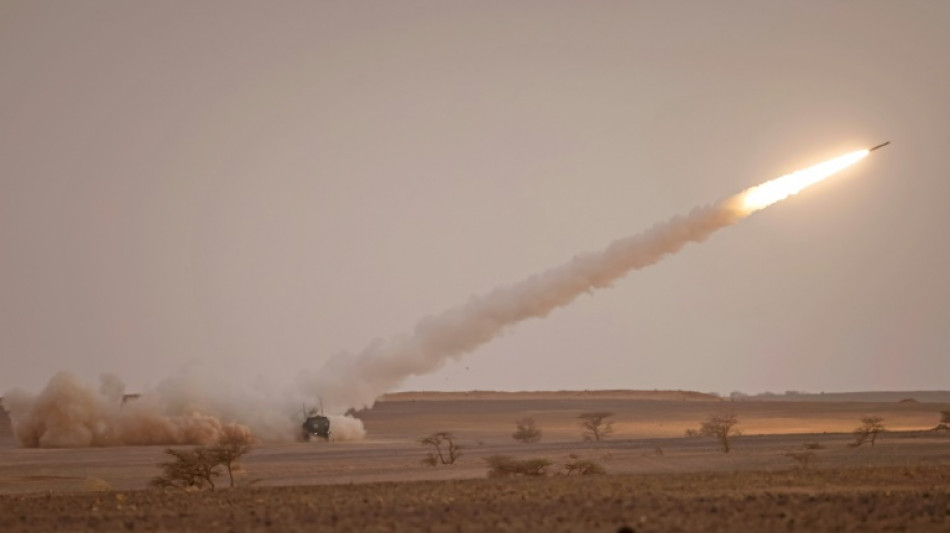
US ammunition supplies dwindle as Ukraine war drains stockpiles / Photo: FADEL SENNA - AFP/File

 Jay-Z to perform at Super Bowl LXI halftime show: NFL

 Climate-threatened Fijian utopia rejects calls to relocate

 Israel to give verdict on Netanyahu in pivotal election

 $1m bounties, dawn arrests: Trump presses voter fraud campaign

 Gasping for air: Borneo residents struggle as island burns

 Doha exhibition charts a millennium of Chinese maritime ceramics trade

 New Zealand ex-PM Ardern to teach leadership in Sydney

 Ballon d'Or 'beyond wildest dreams' but Kane has plenty more to prove

 No envy, no secrets: How Spain's Gipuzkoa became football coaching hotbed

 South Korea economy grows three times faster than expected in Q3

 Al-Thawadi urges technology to deepen human connection through shared experiences

 Ballon d'Or: Harry Kane's crowning moment

 Harry Kane wins men's Ballon d'Or

 مسؤولون إماراتيون: الشراكة مع بنين تفتح فرصاً للتجارة والاستثمار

 المعاشات الإماراتية: اكتمال التغطية التأمينية للقطاع الخاص

 الإمارات تعرض تجربتها في توظيف الذكاء الاصطناعي حكومياً

 شراكة إماراتية لدعم سينما ومحتوى الأطفال والشباب

 الأردن ينفذ ضربات على أهداف في سورية بعد توقيف منفذي هجوم الكنيسة

 دراكنميلر: تحركات الأسواق تحمل إشارات ينبغي الإصغاء إليها

 وزير الصناعة المصري: القطاع الخاص يقود مسار التنمية الصناعية

 تقدير احتياجات 420 مصنعاً متعثراً بنحو أربعة مليارات جنيه

 افتتاح فرع جديد للمرشدي مارتس في التجمع الخامس

 مصر والدنمارك تبحثان توسيع التعاون في الطاقة المتجددة

 تركيا والسعودية وباكستان وإيران تواصل مشاوراتها الإقليمية

 كريستو بوبوف يرسخ حضوره بين نجوم الريشة الطائرة العالمية

The United States will soon be unable to provide Ukraine with certain types of ammunition that are essential to Kyiv's battle against Russia's invasion, as supplies are being used up faster than they can be replaced.
Washington has become by far the largest supplier of arms to Ukraine since Russia launched the invasion on February 24, with more than $16.8 billion in military assistance provided since that date.
But US stockpiles of some equipment are "reaching the minimum levels needed for war plans and training," and restocking to pre-invasion levels could take years, Mark Cancian of the Center for Strategic and International Studies wrote in a recent analysis.
Washington is "learning lessons" from the conflict about ammunition needs in a great power war, which are "far greater" than expected, a US military official acknowledged on condition of anonymity.
American defense firms were forced to drastically reduce production in the 1990s as the United States slashed defense spending following the collapse of the Soviet Union, and their number fell dramatically, from dozens to single digits.
Now, the US government must convince the industry to reopen assembly lines and relaunch production of items such as Stinger anti-aircraft missiles, which have not been made since 2020.
Some US-provided equipment has become emblematic of the war in Ukraine, such as Javelin anti-tank weapons that were widely used by Kyiv's forces to blunt the Russian advance on the capital, and the Himars, a precision rocket system now playing a key role in counter-offensives against Moscow's troops in the east and south.
- 'No alternatives' -
But US stocks of ammunition for Himars -- which fires GPS-guided rockets known as GMLRS, with a range of more than 80 kilometers (50 miles) -- are dwindling.
"If the United States sent one-third of that inventory to Ukraine (as has been the case with Javelin and Stinger), Ukraine would receive 8,000 to 10,000 rockets. That inventory would likely last several months, but, when the inventory is exhausted, there are no alternatives," said Cancian, who previously worked on weapons procurement for the US government.
"Production is about 5,000 a year. Although the United States is working to increase that amount, and money has recently been allocated for that purpose, it will take years," he said, adding that older equipment could help fill the gap.
The United States has provided some 8,500 Javelin missiles to Kyiv, but production of a weapon that has become a symbol of Ukrainian resistance is only about 1,000 per year.
- 'As long as it takes' -
The US government ordered $350 million worth of the missiles in May, but it will again take several years before stockpiles are replenished.
The United States has also supplied more than 800,000 NATO standard 155 mm artillery shells to Kyiv -- three-quarters of the total amount delivered by all Western countries, according to official Pentagon statistics.
The amount of shells Washington has provided "is probably close to the limit that the United States is willing to give without risk to its own warfighting capabilities," Cancian said.
US production of these shells currently stands at 14,000 per month, but the Pentagon has announced that it aims to increase that figure to 36,000 within three years. That would still only bring annual production to 432,000 -- less than half of what has been provided to Ukraine in seven months.
And the US defense industry production is speeding up, Laura Cooper, a senior defense department official responsible for Russia and Ukraine, said Tuesday.
"The United States will continue to stand with the Ukrainian people and provide them with the security assistance they need to defend themselves for as long as it takes," she said.
F.AbuShamala--SF-PST