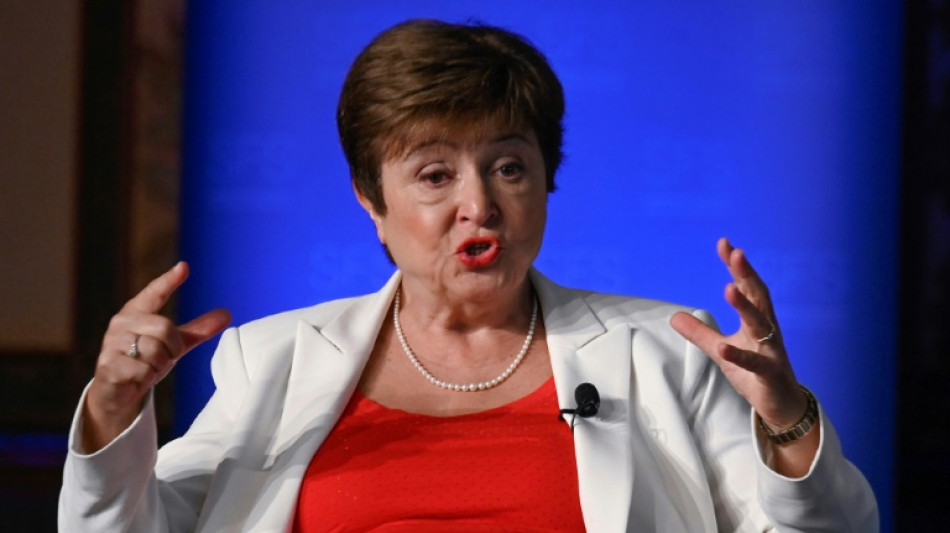
IMF chief urges action as global recession risks rise / Photo: OLIVIER DOULIERY - AFP

 Jay-Z to perform at Super Bowl LXI halftime show: NFL

 Climate-threatened Fijian utopia rejects calls to relocate

 Israel to give verdict on Netanyahu in pivotal election

 $1m bounties, dawn arrests: Trump presses voter fraud campaign

 Gasping for air: Borneo residents struggle as island burns

 Doha exhibition charts a millennium of Chinese maritime ceramics trade

 New Zealand ex-PM Ardern to teach leadership in Sydney

 Ballon d'Or 'beyond wildest dreams' but Kane has plenty more to prove

 No envy, no secrets: How Spain's Gipuzkoa became football coaching hotbed

 South Korea economy grows three times faster than expected in Q3

 Al-Thawadi urges technology to deepen human connection through shared experiences
 Ballon d'Or: Harry Kane's crowning moment
 Harry Kane wins men's Ballon d'Or

 مسؤولون إماراتيون: الشراكة مع بنين تفتح فرصاً للتجارة والاستثمار

 المعاشات الإماراتية: اكتمال التغطية التأمينية للقطاع الخاص

 الإمارات تعرض تجربتها في توظيف الذكاء الاصطناعي حكومياً

 شراكة إماراتية لدعم سينما ومحتوى الأطفال والشباب

 الأردن ينفذ ضربات على أهداف في سورية بعد توقيف منفذي هجوم الكنيسة

 دراكنميلر: تحركات الأسواق تحمل إشارات ينبغي الإصغاء إليها

 وزير الصناعة المصري: القطاع الخاص يقود مسار التنمية الصناعية

 تقدير احتياجات 420 مصنعاً متعثراً بنحو أربعة مليارات جنيه

 افتتاح فرع جديد للمرشدي مارتس في التجمع الخامس

 مصر والدنمارك تبحثان توسيع التعاون في الطاقة المتجددة

 تركيا والسعودية وباكستان وإيران تواصل مشاوراتها الإقليمية

 كريستو بوبوف يرسخ حضوره بين نجوم الريشة الطائرة العالمية

IMF chief Kristalina Georgieva urged global policymakers Thursday to take concerted action to avoid a "dangerous 'new normal,'" as the risks of a worldwide recession are driven ever higher by repeated economic shocks.
In a speech ahead of the fund's annual meetings next week, the IMF's managing director said it was critical to "stabilize the global economy by addressing the most immediate challenges" -- including rampant inflation.
Policymakers need to act together to "prevent this period of heightened fragility from becoming a dangerous 'new normal,'" Georgieva said.
But she warned the process will be painful -- and that if central banks move too aggressively to tamp down price pressures, it could trigger a "prolonged" economic downturn.
Finance ministers and central bank governors from more than 180 nations will gather next week in Washington for the first fully in-person meeting of the International Monetary Fund and World bank since 2019, prior to the Covid-19 pandemic.
Faced with the "darkening global outlook ... the risks of recession are rising," Georgieva said -- announcing that the crisis lender plans to once again downgrade its 2023 forecast for the world economy, in the forecasts due to be published next week for the annual meeting.
One-third of countries are expected to see at least two quarters of contraction, and "even when growth is positive, it will feel like a recession" because of rising prices eroding incomes, she said.
The fund in July slashed its growth forecast for this year to 3.2 percent, and for next year to 2.9 percent -- the third consecutive downgrade.
- 'Shock, after shock' -
The meetings come at a difficult time for the global economy, with the pandemic largely under control, but soaring inflation and rising interest rates now threatening to reverberate around the globe and choke off nascent recoveries.
"In less than three years we lived through shock, after shock, after shock," Georgieva said in her speech at Georgetown University.
Global supply snarls already were a challenge as demand surged following the pandemic slowdown, fueling inflation worldwide, and strains worsened in the wake of the Russian invasion of Ukraine -- which Georgieva called a "senseless war" -- sending food and food prices soaring.
"Far from being transitory, inflation has become more persistent," and acting before high prices become entrenched is a key challenge for policymakers, Georgieva said -- warning that "the cost of a policy misstep can be enormous."
"Not tightening enough would cause inflation to become deanchored and entrenched," but moving "too much and too fast -- and doing so in a synchronized manner across countries -- could push many economies into prolonged recession," she said.
Despite the risks, central banks need to continue "act decisively."
"This is not easy, and it will not be without pain in the near term," she cautioned. "But the key is to avoid much greater and longer-lasting pain for everyone later on."
- Debt distress -
Georgieva stressed the need for fiscal policies to help the most vulnerable segments of society, but warned that efforts must be targeted "with a laser-sharp focus on lower-income households," to avoid acting against the current of monetary policy.
She cautioned against relying on price controls which are not affordable nor effective.
The pandemic forced many countries to take on more borrowing, and now many are already facing or at risk of debt distress amid rising interest rates. That "raises the risk of a widening debt crisis" which could further harm global growth.
To reduce the risk "large creditors such as China and private-sector creditors have a responsibility to act," she said, calling for "faster and more predictable" action on debt restructuring.
R.Halabi--SF-PST