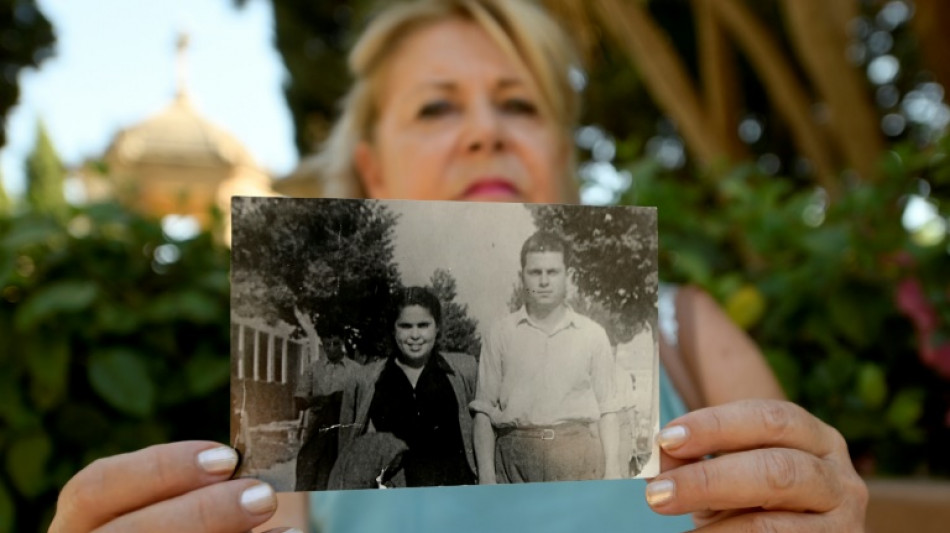
In Spain, the long fight to find Franco era's 'stolen babies' / Photo: Jose Jordan - AFP

 Jay-Z to perform at Super Bowl LXI halftime show: NFL

 Climate-threatened Fijian utopia rejects calls to relocate

 Israel to give verdict on Netanyahu in pivotal election
 $1m bounties, dawn arrests: Trump presses voter fraud campaign

 Gasping for air: Borneo residents struggle as island burns
 Doha exhibition charts a millennium of Chinese maritime ceramics trade
 New Zealand ex-PM Ardern to teach leadership in Sydney

 Ballon d'Or 'beyond wildest dreams' but Kane has plenty more to prove
 No envy, no secrets: How Spain's Gipuzkoa became football coaching hotbed

 South Korea economy grows three times faster than expected in Q3

 Al-Thawadi urges technology to deepen human connection through shared experiences

 Ballon d'Or: Harry Kane's crowning moment
 Harry Kane wins men's Ballon d'Or

 مسؤولون إماراتيون: الشراكة مع بنين تفتح فرصاً للتجارة والاستثمار

 المعاشات الإماراتية: اكتمال التغطية التأمينية للقطاع الخاص

 الإمارات تعرض تجربتها في توظيف الذكاء الاصطناعي حكومياً

 شراكة إماراتية لدعم سينما ومحتوى الأطفال والشباب

 الأردن ينفذ ضربات على أهداف في سورية بعد توقيف منفذي هجوم الكنيسة

 دراكنميلر: تحركات الأسواق تحمل إشارات ينبغي الإصغاء إليها

 وزير الصناعة المصري: القطاع الخاص يقود مسار التنمية الصناعية

 تقدير احتياجات 420 مصنعاً متعثراً بنحو أربعة مليارات جنيه

 افتتاح فرع جديد للمرشدي مارتس في التجمع الخامس

 مصر والدنمارك تبحثان توسيع التعاون في الطاقة المتجددة
 تركيا والسعودية وباكستان وإيران تواصل مشاوراتها الإقليمية
 كريستو بوبوف يرسخ حضوره بين نجوم الريشة الطائرة العالمية
When the bones of her twin sister who died at birth were exhumed, Maria Jose Robles's worst fears were confirmed: their DNA didn't match, suggesting she was one of the newborns snatched during the Franco dictatorship.
Over the course of five decades, hundreds, possibly thousands, of babies were taken from their mothers, who were told their child hadn't survived -- with the infants given to others to adopt.
"It was here," says Robles, fighting back tears as she points at the place where she thought her sister was buried in a cemetery in the southeastern Spanish city of Alicante.
"My twin sister was just two days old when she died, that's what they told my mother in hospital," she told AFP, referring to events that happened in 1962, her voice breaking.
"But they never let her see the body, nor did they let her take the baby home to bury her in Elche where we're from," says this 60-year-old who works in a chiropody clinic.
When the news first broke about the "stolen babies" scandal some 10 years ago, there were some uncanny similarities with her twin's death which left Robles and her parents with "doubts" and a sense of "anguish", she says.
They began gathering paperwork and found it was full of inconsistencies, prompting them to approach the courts which in 2013 ordered the exhumation of her sister's remains.
Since then, Robles -- who runs an organisation dedicated to finding stolen babies -- has been tirelessly searching for her sister.
Her DNA is registered with several databases and she is hoping her sister has done the same.
"It's the DNA which is our hope," she told AFP, saying she dreams of the day when one of the laboratories contacts her to say they've found her sister.
Known as "stolen babies", these trafficked infants would have been too young to know of their fate, with estimates suggesting there could be many thousands of victims.
- 'The Marxist gene' -
Spain's Senate on Wednesday passed a law honouring victims of the Francisco Franco era and recognising for the first time that the "stolen babies" were also victims of his dictatorship.
In the immediate aftermath of the 1936-1939 Spanish Civil War won by Franco's Nationalists, babies were initially taken from left-wing Republican opponents of the regime to prevent them from passing on the Marxist "gene" to their children.
But from the 1950s onwards the scheme was expanded to include children born out of wedlock or into large or poor families.
Doctors played a key role, with women told their babies had died shortly after delivery but never given any proof.
Then the newborns were passed on to couples unable to have children, many of them close to Franco's National Catholic regime.
The Catholic Church was often complicit in the scheme which aimed to ensure the children would be raised by affluent, conservative and devout Roman Catholic families.
This trafficking occurred throughout the dictatorship and even beyond Franco's death in 1975, largely for financial reasons, until a new law strengthening adoption laws was passed in 1987.
Similar thefts also took place under the military dictatorship in Argentina (1976-1983) as well as under the regime of Chilean dictator Augusto Pinochet (1973-1990).
Argentinian rights organisation the Grandmothers of Plaza de Mayo believes some 400 babies were born in captivity and illegally handed over to other people.
In Spain, there is no official estimate of the number of babies that were seized but victims' associations believe there may have been several thousands.
In 2008, the Spanish courts estimated that more than 30,000 children were taken from Republican families or jailed left-wing opponents and taken into state custody between 1944 and 1954 alone.
Some died while others may have been passed on to "approved" families.
- Sold for 725 euros -
Between 2011 and 2019, prosecutors across Spain opened 2,136 "stolen baby" cases but none have been successfully resolved, the latest justice ministry figures show.
But if answers through the justice system are rare, a handful of Spaniards have somehow managed to do it, such as Mario Vidal, a 57-year-old architect from the southeastern town of Denia.
"It was my adoptive father who told me they had paid 125,000 pesetas to adopt me," he told AFP, referring to a sum that would amount to 725 euros ($715) in today's money.
He started looking for his biological parents in 2011.
After three years of hunting through archives in the Madrid region where he was born, Vidal was able to identify his mother -- only to realise she had died 16 years earlier.
"That was one of the hardest days of my life," he admitted, saying he was torn between "the sense of excitement" of realising where he was from, and the shock of learning of her death.
When she had him, she was an unmarried 23-year-old from a very conservative family.
Although an official document stated she had abandoned him, she tried several times to get him out of an orphanage before he was adopted, a relative told him, saying she was even arrested for doing so.
He later found his half-brother, who died three years later, but still hasn't discovered who his biological father is.
"We are children of an era in which those in power did whatever they wanted," said Vidal, who has two children of his own.
C.Hamad--SF-PST