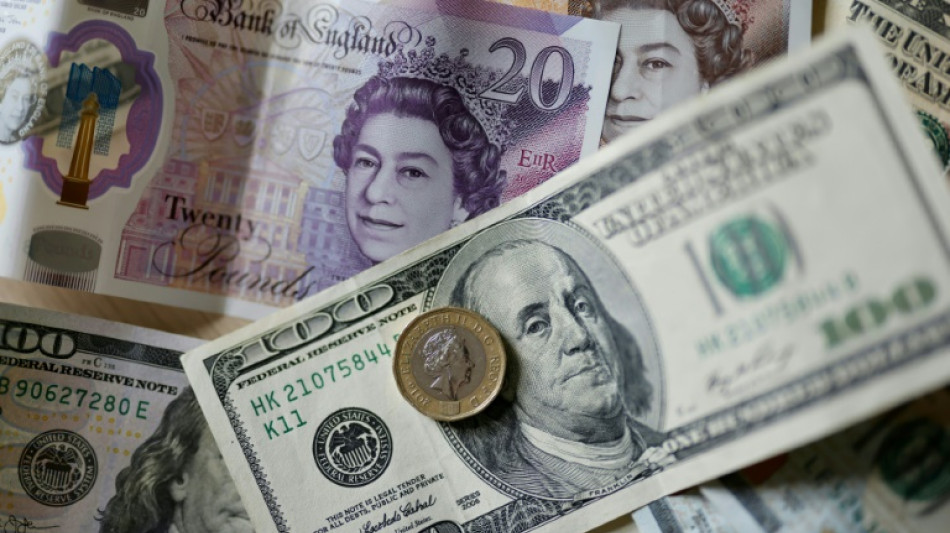
Strong US dollar an unstoppable force endangering other currencies / Photo: Tolga Akmen - AFP/File

 Vikas Satija says steady SIP flows shielded Indian equities from deeper losses

 Brewers rout Rays to reach brink of World Series sweep

 Mbappe dropped by Chinese brands for 'offending national sentiments'

 Kuwait exhibition presents Ukraine’s Islamic heritage and cultural ties

 Tech firms track Wall St rally on mixed day for Asian markets

 Jay-Z to perform at Super Bowl LXI halftime show: NFL

 Climate-threatened Fijian utopia rejects calls to relocate

 Israel to give verdict on Netanyahu in pivotal election

 $1m bounties, dawn arrests: Trump presses voter fraud campaign

 Gasping for air: Borneo residents struggle as island burns

 Doha exhibition charts a millennium of Chinese maritime ceramics trade

 New Zealand ex-PM Ardern to teach leadership in Sydney

 Ballon d'Or 'beyond wildest dreams' but Kane has plenty more to prove

 No envy, no secrets: How Spain's Gipuzkoa became football coaching hotbed

 South Korea economy grows three times faster than expected in Q3

 Al-Thawadi urges technology to deepen human connection through shared experiences

 Ballon d'Or: Harry Kane's crowning moment

 Harry Kane wins men's Ballon d'Or

 مسؤولون إماراتيون: الشراكة مع بنين تفتح فرصاً للتجارة والاستثمار

 عز العرب السويدي تقدم سيارات جايكو إلى السوق المصرية

 تمويل مشروع دندرة للطاقة الشمسية بقيمة 650 مليون دولار

 تحدي القراءة العربي يوسع أثره ويعزز المشاركة المعرفية

 شراكة إماراتية لدعم سينما ومحتوى الأطفال والشباب

 إطلاق صندوق استثماري متخصص في الغاز الطبيعي المسال

 دراسة تقرّب العلماء من تفسير دور الشمال في العصور الجليدية

The dazzling rise of the US dollar, which has hit one record after another, is raising fears of a currency crash of a severity not seen since the 1997 Asian financial crisis reverberated around the world.
The Federal Reserve's rapid, steep interest rate increases and the relative health of the US economy has caused investors to flood into the dollar, driving the greenback up and sending the British pound, Indian rupee, Egyptian pound and South Korean won and others to uncharted depths.
"The moves are definitely getting extreme," said Brad Bechtel of Jefferies, warning that the exchange rates could fall further creating a "dire situation."
Most other major central banks also are forcefully tightening monetary policy to bring down inflation, but so far the moves have not helped stabilized the currency market, nor has Japan's direct intervention to support the yen last week.
Many fear that the same will be the case with the Bank of England's plan announced Wednesday to conduct emergency purchases of government bonds to support the pound.
"We have our doubts that the BoE's plan will be the silver bullet to kill all of the angst that has been pressuring the pound ... considering its plan doesn't have permanency," said Patrick O'Hare of Briefing.com.
Others, especially emerging market countries, are even worse off. The Pakistani rupee has lost 29 percent of its value against the US dollar in the past year, and the Egyptian pound has weakened by 20 percent.
Those countries, and others like Sri Lanka and Bangladesh which "benefitted from cheap and plentiful liquidity," when interest rates were low during the pandemic, "are all suffering from tighter global liquidity," said Win Thin, head of currency strategy at BBH Investor Services.
"Those countries with the weakest fundamentals are likely to be tested first but others may join them," he warned.
Those countries rely on imported oil and grain which have seen prices soar, widening their trade deficits and fueling inflation, massive blows to their currencies.
The appreciation of the US currency has exacerbated the problem, since many commodities are denominated in dollars.
Already in a fragile position, Pakistan was hit with historic flooding in August, which prompted the government to discuss a restructuring of its debt.
"There are severe pressures on the financial system now. And it's only a matter of time until there's a larger crisis somewhere in the world," warns Adam Button of ForexLive.
- Bad memories -
US Treasury Secretary Janet Yellen earlier this week said she has not yet seen signs of "disorderly" financial market developments amid the interest rate hikes.
For countries like Taiwan, Thailand or South Korea, which also dependent on energy imports, China's zero-Covid policy has caused their exports to this key trading partner to plummet.
Larger economies like China and Japan have contributed in recent weeks to the turbulence on the foreign exchange market. The Japanese yen plunged its lowest level in 24 years, while the Chinese yuan hit its weakest in 14 years.
Fear of destabilization brings back memories of the 1997 Asian financial crisis, which was triggered by the devaluation of the Thai baht.
Malaysia, the Philippines and Indonesia followed, which panicked foreign investors and led to massive outflows of capital, pushing several countries into a severe recession and South Korea to the brink of default.
At the time, the collapse of the baht was in part linked to its fixed parity with the dollar, which forced the Thai government to support its currency, depleting its foreign exchange reserves, which was unsustainable in the face of market forces.
Argentina eventually was forced to abandon its peg to the dollar and defaulted in late 2001 -- the largest sovereign default in history.
Erik Nielsen of Wells Fargo said that is a key difference between 2022 and 1997.
"Now there's not a lot of fixed exchange rates," he said. "I'm frankly more worried about developed markets right now."
Lebanon, one of the few to still peg its currency to the greenback, on Thursday announced a drastic devaluation, taking the country's pound to 15,000 to the dollar from the previous fixed value of 1,507.
In the United States, by contrast, where inflation has soared to a 40-year high "the Fed sees strong dollar as a blessing," said Christopher Vecchio of DailyFX, noting that it helps "insulate the economy from more significant price pressures."'
A strong currency means the country pays less for its imported products.
D.Qudsi--SF-PST