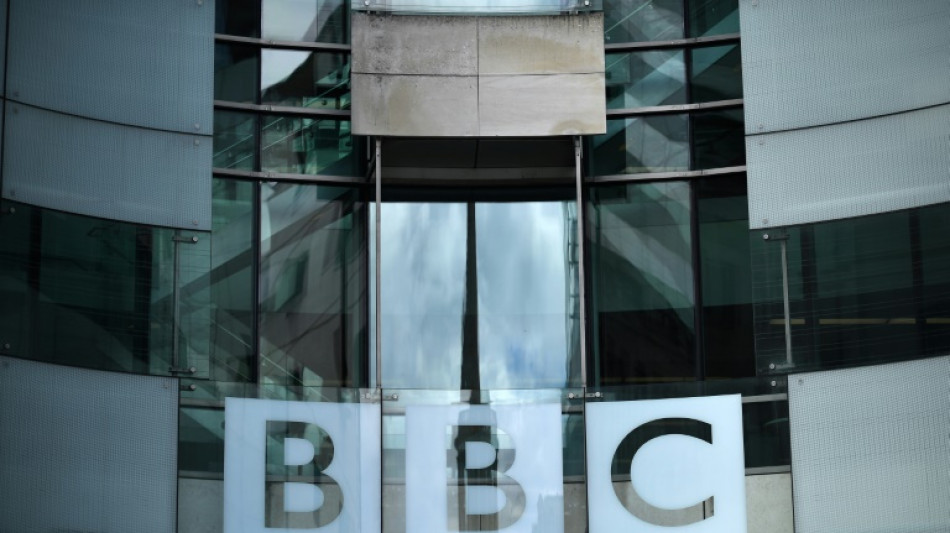
BBC to cut hundreds of jobs at World Service / Photo: Ben STANSALL - AFP

 Vikas Satija says steady SIP flows shielded Indian equities from deeper losses

 Brewers rout Rays to reach brink of World Series sweep

 Mbappe dropped by Chinese brands for 'offending national sentiments'

 Kuwait exhibition presents Ukraine’s Islamic heritage and cultural ties

 Tech firms track Wall St rally on mixed day for Asian markets
 Jay-Z to perform at Super Bowl LXI halftime show: NFL

 Climate-threatened Fijian utopia rejects calls to relocate

 Israel to give verdict on Netanyahu in pivotal election
 $1m bounties, dawn arrests: Trump presses voter fraud campaign
 Gasping for air: Borneo residents struggle as island burns

 Doha exhibition charts a millennium of Chinese maritime ceramics trade
 New Zealand ex-PM Ardern to teach leadership in Sydney

 Ballon d'Or 'beyond wildest dreams' but Kane has plenty more to prove

 No envy, no secrets: How Spain's Gipuzkoa became football coaching hotbed
 South Korea economy grows three times faster than expected in Q3

 Al-Thawadi urges technology to deepen human connection through shared experiences
 Ballon d'Or: Harry Kane's crowning moment

 Harry Kane wins men's Ballon d'Or

 مسؤولون إماراتيون: الشراكة مع بنين تفتح فرصاً للتجارة والاستثمار

 عز العرب السويدي تقدم سيارات جايكو إلى السوق المصرية

 تمويل مشروع دندرة للطاقة الشمسية بقيمة 650 مليون دولار

 تحدي القراءة العربي يوسع أثره ويعزز المشاركة المعرفية

 شراكة إماراتية لدعم سينما ومحتوى الأطفال والشباب

 إطلاق صندوق استثماري متخصص في الغاز الطبيعي المسال

 دراسة تقرّب العلماء من تفسير دور الشمال في العصور الجليدية

Nearly 400 staff at BBC World Service will lose their jobs as part of a cost-cutting programme and move to digital platforms, the broadcaster announced on Thursday, paring down its Iranian-language service among others.
The BBC, which marks its centenary next month, said its international services needed to make savings of £28.5 million ($31 million) as part of wider reductions of £500 million, which unions blamed on the UK government.
In July the broadcaster detailed plans to merge BBC World News television and its domestic UK equivalent into a single channel to launch in April next year.
BBC World Service -- one of the UK's most recognisable global brands -- currently operates in 41 languages around the world with a weekly audience of some 364 million people.
But the corporation said audience habits were changing and more people were accessing news online, which along with a freeze on BBC funding and increased operating costs meant a move to "digital-first" made financial sense.
"Today's proposals entail a net total of around 382 post closures," the public service broadcaster said in an online statement.
Eleven language services -- Azerbaijani, Brasil, Marathi, Mundo, Punjabi, Russian, Serbian, Sinhala, Thai, Turkish, and Vietnamese -- are already digital only.
Under the restructuring plans they will be joined by seven more: Chinese, Gujarati, Igbo, Indonesian, Pidgin, Urdu and Yoruba.
Radio services in Arabic, Persian, Kyrgyz, Hindi, Bengali, Chinese, Indonesian, Tamil and Urdu will stop, if the proposals are approved by staff and unions.
No language services will close, the broadcaster insisted, although some production will move out of London and schedules would change.
The Thai service will move to Bangkok, the Korean service to Seoul and the Bangla service to Dhaka.
The "Focus on Africa" television bulletin will be broadcast from Nairobi, it added.
BBC World Service director Liliane Landor said there was a "compelling case" for expanding digital services, as audiences had more than doubled since 2018.
"The way audiences are accessing news and content is changing and the challenge of reaching and engaging people around the world with quality, trusted journalism is growing," she added.
- Government criticised -
The head of the broadcasting union Bectu, Philippa Childs, said they were disappointed at the proposed changes.
"While we recognise the BBC must adapt to meet the challenges of a changing media landscape, once again it is workers who are hit by the government's poorly judged political decisions," she said.
The government's freezing of the licence fee which pays for BBC World Service had created the funding squeeze and the need for cuts, she added.
Bectu will push for staff to be redeployed where possible and to ensure it "mitigates the needs for any compulsory redundancies", Childs said.
BBC World Service is funded out of the UK licence fee -- currently £159 for a colour TV and payable by every household with a television set.
The BBC has faced repeated claims from right-wingers since the UK's divisive Brexit referendum in 2016 of political bias, and pushing a "woke", London-centric liberal agenda.
But it has faced similar accusations of political bias in favour of the right from the left.
The government announced a freeze on the licence fee in January, in what was seen by critics as an attempt to save the then-prime minister Boris Johnson's job.
At the time Johnson was facing mounting claims of wrongdoing in office, which ultimately forced him to resign.
Ministers claimed the funding model needed to be revised because of technological changes, including the uptake of streaming services, as well as increases in the cost of living.
Opposition parties however said the monthly payments -- equivalent to some £13.13 -- were small change compared to energy bill increases totalling thousands of pounds a year.
The culture secretary at the time, Johnson loyalist Nadine Dorries, had previously accused the BBC of "tokenism" in diversity hiring and elitist "group think" but denied wanting to dismantle the corporation.
L.AbuTayeh--SF-PST