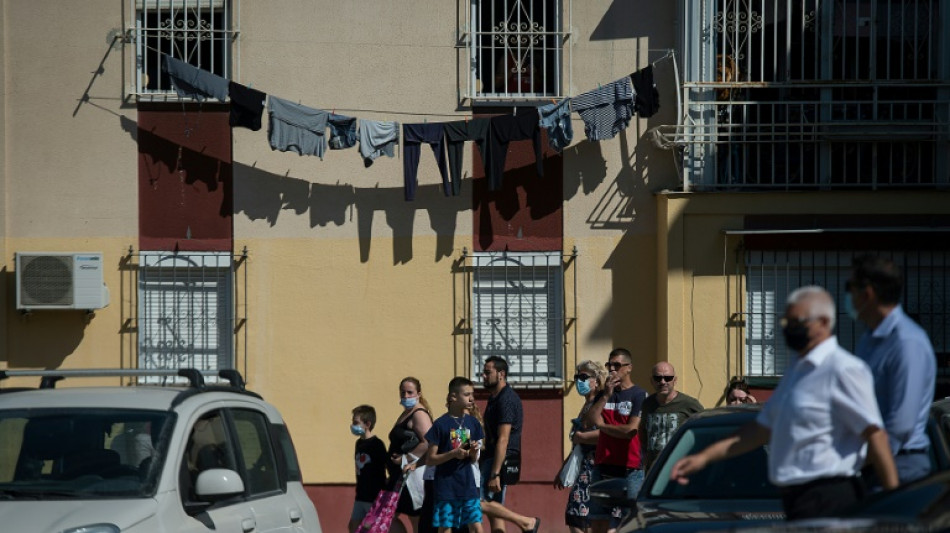
Spain's domestic staff fight to end discrimination / Photo: CRISTINA QUICLER - AFP/File

 Critical coal inventories affect nearly half of India’s domestic power plants

 FCNR(B) deposit drive puts sharper margin pressure on private banks

 Noel Tata requests records of September 17 Tata Sons board meeting
 Reparations calls to dog King Charles's tough Caribbean trip
 Global rates and foreign outflows remain key risks for Indian markets

 Neha Nagar says ₹3 crore can fund retirement with disciplined planning

 Vikas Satija says steady SIP flows shielded Indian equities from deeper losses

 Brewers rout Rays to reach brink of World Series sweep

 Mbappe dropped by Chinese brands for 'offending national sentiments'

 Kuwait exhibition presents Ukraine’s Islamic heritage and cultural ties

 Tech firms track Wall St rally on mixed day for Asian markets

 Jay-Z to perform at Super Bowl LXI halftime show: NFL

 Climate-threatened Fijian utopia rejects calls to relocate

 Israel to give verdict on Netanyahu in pivotal election

 $1m bounties, dawn arrests: Trump presses voter fraud campaign

 Gasping for air: Borneo residents struggle as island burns

 Doha exhibition charts a millennium of Chinese maritime ceramics trade
 New Zealand ex-PM Ardern to teach leadership in Sydney

 Ballon d'Or 'beyond wildest dreams' but Kane has plenty more to prove

 No envy, no secrets: How Spain's Gipuzkoa became football coaching hotbed

 South Korea economy grows three times faster than expected in Q3

 Al-Thawadi urges technology to deepen human connection through shared experiences

 Ballon d'Or: Harry Kane's crowning moment

 Harry Kane wins men's Ballon d'Or

 تحدي القراءة العربي يوسع أثره ويعزز المشاركة المعرفية

For years, Aracely Sanchez went to work without counting her hours, always fearful she could lose her job from one day to the next.
"They would always ask me to do more and more and more, as if I were a machine," she told AFP of her employers at a house in Madrid.
Within a collective of domestic workers, this 39-year-old Mexican has been trying to assert her basic rights to have time off every week, to be paid for working overtime and to have unemployment cover.
But given the precarious nature of this type of work in Spain, it is a challenge.
"There are employers who are very humane and who respect us, but there are many who try to take advantage of the situation," she explained.
"They say: if the job doesn't suit you, there are plenty more where you came from."
According to the Workers Commission union (CCOO), nearly 600,000 women serve as domestic staff in Spain where taking them on for housework, cooking or childcare is widespread.
Of that number, nearly 200,000 are undeclared, working in the black economy without an employment contract.
"Many of them come from Latin America and they don't have papers and find themselves in a very vulnerable situation," said Mari Cruz Vicente, the CCOO's head of activism and employment.
- 'Exposing violations' -
Following a ruling by the EU's Court of Justice (CJEU) and pressure from the unions, the government of Prime Minister Pedro Sanchez adopted a reform this month aiming at ending the "discrimination" suffered by these workers.
Under the changes, dubbed by the government as "settling a historic debt", domestic workers are now entitled to claim unemployment benefits and cannot be dismissed without justification.
They will also be covered by healthcare "protection" and be able to access training to improve their "professional opportunities" and job conditions.
"This is a very important step forward," said Vicente, while stressing the need to step up efforts to register those who are working without a contract and don't benefit from the reform.
"This reform was very necessary," said Constanza Cisneros of the Jeanneth Beltran observatory which specialises in domestic workers' rights.
"Spain was very behind. Every day we have people coming to us whose rights have been violated. We have to end such practices now," she said.
"Such situations have to be exposed."
-'Not seen as people' -
Mexican home help Sanchez has often experienced such abuses in more than two decades of employment.
In 2001, she arrived in Madrid to take up full-time employment caring for an elderly person for 350 euros a month.
She then spent the next 15 years working in short-term jobs, almost always without a contract, despite the fact she had a valid residency permit.
"When I said I wanted a contract, they never called me back. They didn't want to pay contributions," she said, describing her work as "undervalued" with domestic staff seen as "labourers" and not "as people".
Amalia Caballero, a domestic worker from Ecuador, has had a very similar experience.
"We often finish very late, or they change our hours at the last minute assuming we'll just fall in line. But we also have a life that we need to sort out," said Caballero, 60.
She also talks about the "humiliations" often endured by those who live with their employers.
"One time, one of my bosses asked me why I showered every day. It was clear he thought (the hot water) was costing him too much money," she told AFP.
But will such attitudes change with the reform?
"There's still a long way to go," she sighed, saying many domestic staff "have completed their studies" back home and even hold a degree.
"People need to recognise that," she said.
Cisneros agreed.
"Our work needs to command greater respect, not least because it's so necessary. Without staff to pick up the children, run the household and look after elderly people, what would families do?"
R.Shaban--SF-PST