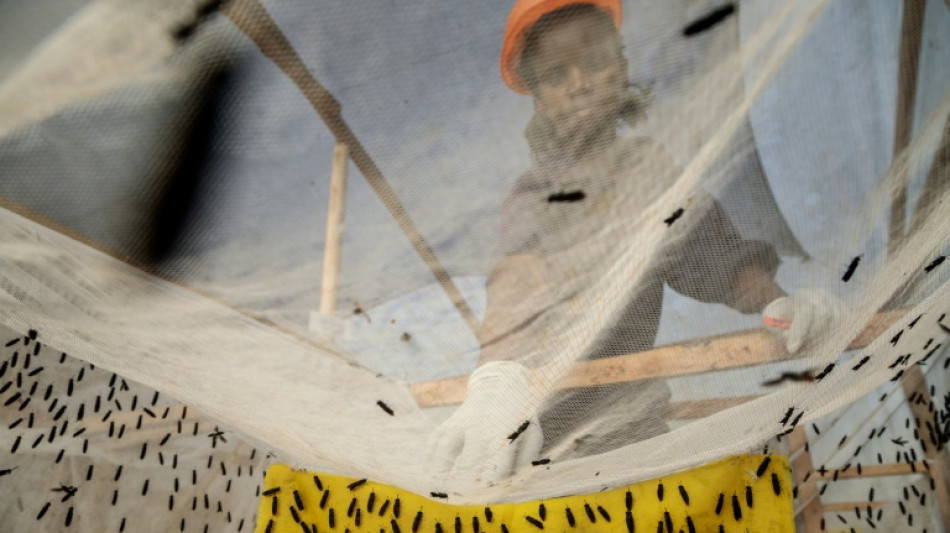
The hungry bugs fighting Uganda's fertiliser crisis / Photo: BADRU KATUMBA - AFP

 Destructive Abhishek 113 leads India to series win over New Zealand

 Norway, Finland leaders hold 'frank and substantive' talk with Putin

 Wall Street faces earnings and Fed tests after turbulent technology-led week

 Ukraine, Russia say US-brokered truce holding in ravaged city

 Police form SIT after vehicles in Rahul Gandhi convoy collide on expressway

 Delhi grants minimum monthly pay and DA to about 4,000 MCD health workers

 Ather Energy shares climb 14% after quarterly profit and expansion plan

 Gold ETF flows turn negative after 13 weeks as bullion loses 4%

 Pakistan's last antique restorers give old treasures new life

 India braces for Cyclone Arnab with evacuations

 Steel Strips Wheels gains 36% in two sessions on growth outlook

 Cavs edge T'Wolves in overtime despite superb Edwards

 Prescott fires Cowboys to 38-21 win over plummeting Eagles

 Kuwait padel chief hails national showing at Premier Padel Major

 Britain prepares constrained budget as debt and defence pressures mount

 Valkyries beat Dream to reach brink of WNBA title

 Benjamin Netanyahu: Israel's longest-serving PM fighting for survival

 Kuwait receives invitation to 2026 UN Water Conference in Abu Dhabi

 Arab World Institute president outlines plans for stronger Kuwait-France cultural links

 Bolsonaro's party says it recognizes Lula's election win in Brazil

 Meghan on TV menu for 'Junior MasterChef Australia'

 South Korea's chip boom fuels forecast-beating third-quarter growth

 US-brokered truce begins in Ukraine city occupied by Russia

 Qatar launches Fashion and Crafts Council to connect talent with global markets

 Jordan strikes militant groups in Syria after church attack

As fertiliser prices shot up following Russia's invasion of Ukraine, Ugandan villager Peter Wakisi fretted for the future of his small farm and his young family.
Little did he know that the answer to his prayers would arrive in the form of bugs -- specifically the black soldier fly, an insect introduced to the East African nation by scientists who see it as the solution to farmers' woes.
Wakisi, 36, is one of over 1,200 villagers enrolled in a programme to grow and sell the larvae of the black soldier fly, or BSF, a tiny creature whose powerful stomach enzymes turn food waste into fertiliser.
The food digested and excreted by the larvae is used to nourish plants.
The benefits are plain to see, father-of-four Wakisi said, pointing to a row of black plastic containers -- home to the young larvae he buys and raises before selling back to the scientists for a threefold profit.
"The manure from the waste generated by the BSF, mixed with organic waste and pig droppings, is safe to the soil and much cheaper compared to inorganic fertilisers whose prices increased due to the war between Russia and Ukraine," Wakisi said.
"Organic fertilisers have reduced the expenses I used to incur on chemical fertilisers by almost 60 percent. My plants are healthier and yields are better now," he told AFP in his village of Kawoomya Nyiize in central Uganda's Kayunga district.
The programme, which is partly funded by the government of the Netherlands, is run by Kampala-based Dutch startup Marula Proteen Limited in partnership with Ugandan agricultural firm Enimiro.
"A soil that doesn't replenish its organic stock will eventually deplete and the plant yields will diminish significantly," said Tommie Hooft, director at Marula Proteen.
The fertiliser produced by the black soldier flies "is full of healthy microbes that provide essential nutrients like nitrogen, phosphorous and potassium" to plants, making it an excellent option for farmers, he said.
- The 'ick' factor -
But first, there's the 'ick' factor to consider, at least in the eyes of some.
Scola Namataka, a 30-year-old single mother in Kayunga's Nakirubi village, said she could never have imagined raising insects, especially ones known to feast on faeces.
"I said that can't be possible, rearing these maggots," she told AFP, reaching into a plastic container to grab a handful of wriggling larvae.
But with money falling short and the soil on her family's farm becoming increasingly depleted of nutrients, Namataka was running out of options when she heard about the programme in March this year.
Since enrolling, her plants are thriving, she said, and she's even managed to get used to the pungent scent of the larvae feeding factory in her backyard.
After the war in Ukraine highlighted the worrying dependence of many agricultural economies on Russian fertiliser, the plentiful supply of these insects is a boon to farmers, said Hooft.
Adult females lay hundreds of eggs during their days-long life cycle and the larvae's voracious appetite means there's little risk of running out of manure.
"Being so dependent on an imported product is detrimental to farmers' profitability. Our organic fertiliser is locally produced, and always available," Hooft said.
Apart from subsistence farmers, the company sells BSF fertiliser to bigger enterprises like Clarke Farms, a 1500-acre coffee estate around 300 kilometres (190 miles) west of Kampala.
The firm has also teamed up with the Kampala Capital City Authority to help with waste disposal, collecting between 8-10 tonnes of garbage daily from food markets and feeding it to larvae.
- 'More sustainable' -
The programme aims to solve several problems at once, said Ruchi Tripathi of VSO, one of the non-profits which has partnered with Marula Proteen.
"Feeding the soil through adding organic nutrients is much more sustainable and will build the resilience of the soils which (will) in turn feed the plants," she told AFP.
"This helps improve food security, reduce dependence on expensive imported chemical fertilisers, and reduces demand for oil-based fertilisers, helping fight against climate change," she added.
Though the cost of fertiliser continues to soar in Uganda, he no longer worries about it.
"I have abandoned the use of chemical fertilisers," he said.
G.AbuOdeh--SF-PST