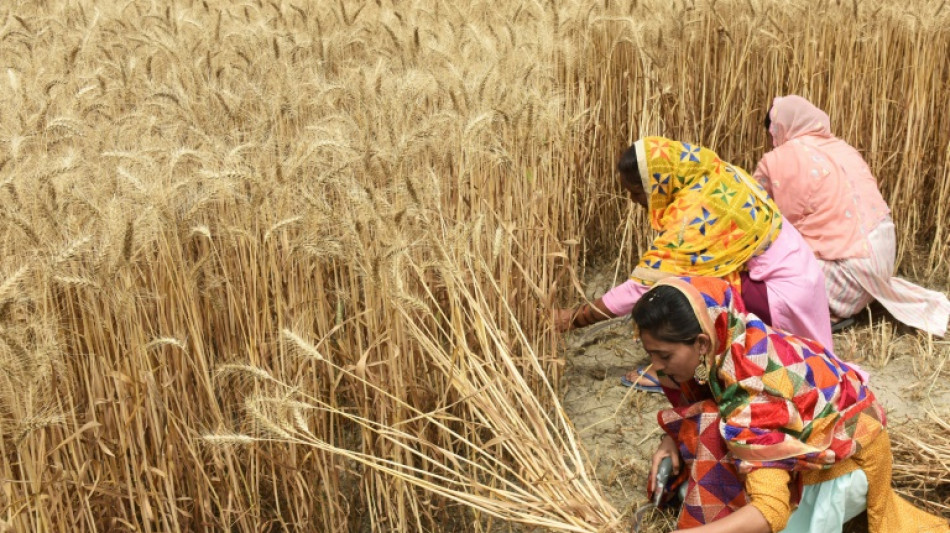
Countries growing 70% of world's food face 'extreme' heat risk by 2045 / Photo: NARINDER NANU - AFP/File

 Destructive Abhishek 113 leads India to series win over New Zealand

 Norway, Finland leaders hold 'frank and substantive' talk with Putin

 Wall Street faces earnings and Fed tests after turbulent technology-led week

 Ukraine, Russia say US-brokered truce holding in ravaged city

 Police form SIT after vehicles in Rahul Gandhi convoy collide on expressway

 Delhi grants minimum monthly pay and DA to about 4,000 MCD health workers
 Ather Energy shares climb 14% after quarterly profit and expansion plan

 Gold ETF flows turn negative after 13 weeks as bullion loses 4%

 Pakistan's last antique restorers give old treasures new life

 India braces for Cyclone Arnab with evacuations

 Steel Strips Wheels gains 36% in two sessions on growth outlook

 Cavs edge T'Wolves in overtime despite superb Edwards

 Prescott fires Cowboys to 38-21 win over plummeting Eagles

 Kuwait padel chief hails national showing at Premier Padel Major

 Britain prepares constrained budget as debt and defence pressures mount

 Valkyries beat Dream to reach brink of WNBA title

 Benjamin Netanyahu: Israel's longest-serving PM fighting for survival

 Kuwait receives invitation to 2026 UN Water Conference in Abu Dhabi

 Arab World Institute president outlines plans for stronger Kuwait-France cultural links

 Bolsonaro's party says it recognizes Lula's election win in Brazil

 Meghan on TV menu for 'Junior MasterChef Australia'
 South Korea's chip boom fuels forecast-beating third-quarter growth

 US-brokered truce begins in Ukraine city occupied by Russia

 Qatar launches Fashion and Crafts Council to connect talent with global markets

 Jordan strikes militant groups in Syria after church attack

Blistering crop-withering temperatures that also risk the health of agricultural workers could threaten swathes of global food production by 2045 as the world warms, an industry analysis warned Thursday.
Climate change is already stoking heatwaves and other extreme weather events across the world, with hot spells from India to Europe this year expected to hit crop yields.
Temperature spikes are causing mounting concern for health, particularly for those working outside in sweltering conditions, which is especially dangerous when humidity levels are high.
The latest assessment by risk company Verisk Maplecroft brings those two threats together to calculate that heat stress already poses an "extreme risk" to agriculture in 20 countries, including agricultural giant India.
But the coming decades are expected to expand the threat to 64 nations by 2045 -- representing 71 percent of current global food production -- including major economies China, India, Brazil and the United States.
"With the rise in global temperatures and rise in global heat stress, we're going to see crops in more temperate countries as well start being affected by this," said Will Nichols, head of climate and resilience at Verisk Maplecroft.
Rice is particularly at risk, the assessment said, with other crops like cocoa and even tomatoes also singled out as of concern.
- Growing risk -
Maplecroft's new heat stress dataset, using global temperature data from the UK Met Office, feeds into its wider risk assessments of countries around the world.
It is based on a worst-case emissions scenario leading to around 2 degrees Celsius of warming above pre-industrial levels as soon as 2045.
However, the authors stress that in projections to mid-century, even scenarios that assume higher levels of carbon-cutting action could still result in temperatures nearing 2C.
India -- responsible for 12 percent of global food production in 2020 and heavily reliant on outdoor labour productivity -- is already rated as at extreme risk, the only major agricultural nation in that category at current temperatures.
"There's a very real worry that people in rural areas, which are obviously highly dependent on agriculture, are going to be much more vulnerable to these kinds of heat events going forward," Nichols told AFP.
That could impact productivity and in turn exports -- and have potentially "cascading" knock-on effects on issues such as the country's credit rating and even political stability, he said.
By 2045, the list grows much longer.
Nine of the top ten countries affected in 2045 are in Africa, with the world's second largest cocoa producer Ghana, as well as Togo and Central African Republic receiving the worst possible risk score.
The top 20 at-risk countries in the coming decades include key Southeast Asian rice exporters Cambodia, Thailand and Vietnam, the authors said, noting that rice farmers in central Vietnam have already taken to working at night to avoid the high temperatures.
The assessment highlights that major economies like the US and China could also see extreme risk to agriculture in 2045, although in these large countries the impacts vary by region.
Meanwhile, Europe accounts for seven of the 10 countries set to see the largest increase in risk by 2045.
"I think what it reinforces is that, even though a lot of us are sort of sitting in sort of Western countries, where we might think we're a bit more insulated from some of these threats, actually we are not necessarily," Nichols said.
"Both in terms of the sort of physical risks that we're facing, but also in terms of the kind of knock on effects down the supply chain."
B.Khalifa--SF-PST