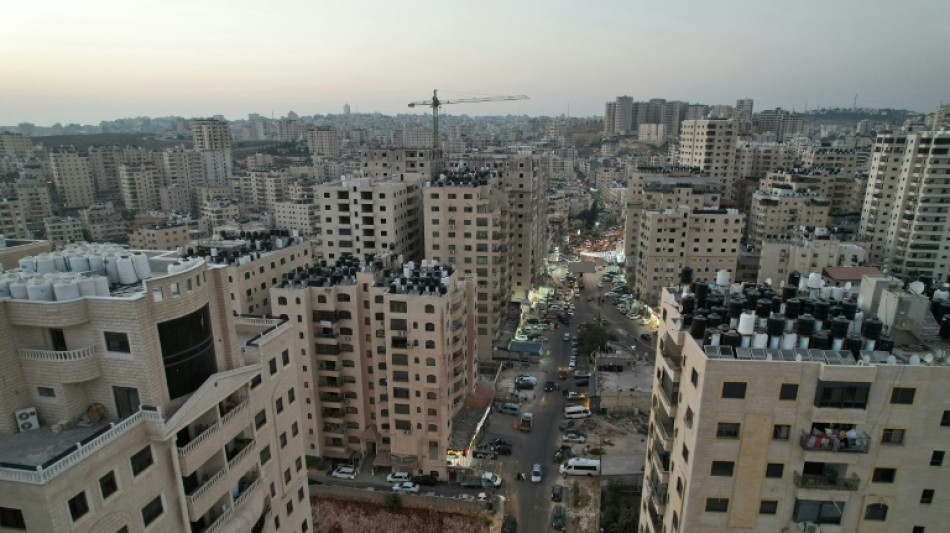
'No police, no law': anarchy in Palestinian suburb of Jerusalem / Photo: AHMAD GHARABLI - AFP

 Maresca defends Donnarumma, Guehi after Man City defeat
 Nordic leaders call Putin as local truce begins in Ukraine

 Osaka unveils crane outfit in Tokyo before win over Paolini

 Ronaldo in line for Portugal return after fallout with coach

 Norway media take legal action to block Meta from using content

 Bayern praise 'humble' Kane after Ballon d'Or win

 Colts retain Daniel Jones as starter despite continued offensive struggles

 Madushanka wrecks Pakistan as Sri Lanka press for final slot
 Destructive Abhishek 113 leads India to series win over New Zealand
 Norway, Finland leaders hold 'frank and substantive' talk with Putin
 Wall Street faces earnings and Fed tests after turbulent technology-led week

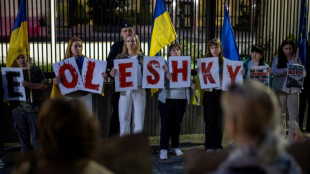 Ukraine, Russia say US-brokered truce holding in ravaged city
 Police form SIT after vehicles in Rahul Gandhi convoy collide on expressway

 Delhi grants minimum monthly pay and DA to about 4,000 MCD health workers

 Ather Energy shares climb 14% after quarterly profit and expansion plan

 Gold ETF flows turn negative after 13 weeks as bullion loses 4%

 Pakistan's last antique restorers give old treasures new life
 India braces for Cyclone Arnab with evacuations

 Steel Strips Wheels gains 36% in two sessions on growth outlook

 Cavs edge T'Wolves in overtime despite superb Edwards

 Prescott fires Cowboys to 38-21 win over plummeting Eagles

 Kuwait padel chief hails national showing at Premier Padel Major

 Britain prepares constrained budget as debt and defence pressures mount
 Valkyries beat Dream to reach brink of WNBA title
 Benjamin Netanyahu: Israel's longest-serving PM fighting for survival

One evening in January 2021, Arafe Rajabi, exasperated by yet another night of roaring cars below his window in an east Jerusalem Palestinian suburb, went downstairs to complain.
Fifteen minutes later, he was shot dead, another victim of the chaos in his Kufr Aqab neighbourhood, a no-man's land which is increasingly turning into a local version of the Wild West.
Located around 10 kilometres (six miles) from the centre of Jerusalem, the town is among a handful of locations with a unique status in the Israeli-Palestinian conflict.
Israel considers Kufr Aqab part of Jerusalem, which it fully controls after annexing the east of the city in the 1967 war. But to get there you need to cross an Israeli military checkpoint and pass a concrete wall several meters high which separates Jerusalem from the occupied West Bank.
Tens of thousands of people live in the five-square-kilometre (two-square-mile) area, which lies behind the security barrier Israel began erecting in 2002 to protect it from deadly Palestinian attacks.
Neither the Jerusalem municipality nor Israel's interior ministry could provide an updated number of Kufr Aqab's residents.
Most residents have Israeli residency and pay their taxes to the Israeli-controlled municipality, allowing them to work in Israel.
But another part of the neighbourhood is under the Palestinian Authority's jurisdiction, with Ramallah-based security forces prohibited from operating on the Israeli-annexed side.
The Israeli police rarely venture into Kufr Aqab, and the lack of patrols creates the ideal conditions for crime, arms trade and drug trafficking, residents say.
"There are non-stop gunshots, there is no authority, no police, no law," sighed Imane Rajabi, 37, who has been raising her four children alone since her husband, Arafe, was shot dead by residents armed with M16s.
"It's a jungle, and you don't know who to complain to," she continued, saying it took Israeli police several days to act following her husband's death.
Contacted by AFP, Israeli police said "several suspects were arrested and indictments were filed to court" over the killing.
The police "constantly takes action all over Jerusalem, including in the eastern and northern neighbourhoods of the city and in Kufr Aqab," they said in a statement.
-'Lawless' zone -
But about 10 residents interviewed by AFP described a non-existent Israeli police presence and the near-total absence of municipal services.
Besides a few Hebrew signs here and there, there was no indication of Israeli jurisdiction and Kufr Aqab, which continues to expand, seems to have been increasingly separated from Jerusalem and incorporated into the sprawling metropolis of Ramallah.
In 2017, then-minister for Jerusalem affairs Zeev Elkin acknowledged the route taken by the Israeli barrier had been an "error" that had turned Kufr Aqab into a "lawless" zone.
Bullet casings are strewn on the ground in the corner of an alley, and rubbish nobody bothers to collect can be found everywhere.
On the main street, it is not uncommon to see vehicles driving in the wrong direction and motorcycles performing wheelies and stunts. Colourful billboards assail passers-by, and buildings sprout up without any regard to planning rules.
"The place is up in the air, it doesn't really belong to Israel or the Palestinian Authority," said Ziyad Shahade, whose money exchange office overlooks the chaotic main road, with its incessant traffic jams and horns.
The Jerusalem municipality told AFP that "despite the many challenges created by the erection of the security barrier," it was "doing everything in its power to provide [Kufr Aqab] inhabitants with all the services they needed and were entitled to."
In reality, "the further away you move to the city centre in the direction of Ramallah the lower the level of services," said Daniel Seidemann, an Israeli lawyer and Jerusalem expert.
"When you get to the wall," he said, "the level of municipal services collapses."
The Palestinian Authority said it provided municipal services, but was unable to make up for Israeli shortcomings.
- City limit's -
According to Seidemann, when Israel seized east Jerusalem, it decided to include Kufr Aqab in the city's boundaries since it was sparsely populated and near an airport it wanted to use.
But the airport ceased activity in 2001 during the Second Intifada, or Palestinian uprising, and the construction of the Israeli barrier was a move to "get rid" of Kufr Aqab by leaving it on the Palestinian side, according to the founder of the Israeli anti-settlement NGO Ir Amim.
Israeli authorities have already considered removing Kufr Aqab from Jerusalem's municipal boundaries.
But any such change in the city's limits would be seen as a potential segue to the division of Jerusalem, a red line for Israeli politicians, who consider the Holy City "the eternal and indivisible capital" of the Jewish state.
Imane Rajabi says she has paid a heavy price for this nebulous status quo.
Up to 20 years ago, Kufr Aqab was a place "without violence," and "without gunshots all day long."
Now, she's considering leaving the neighbourhood with her children.
B.AbuZeid--SF-PST