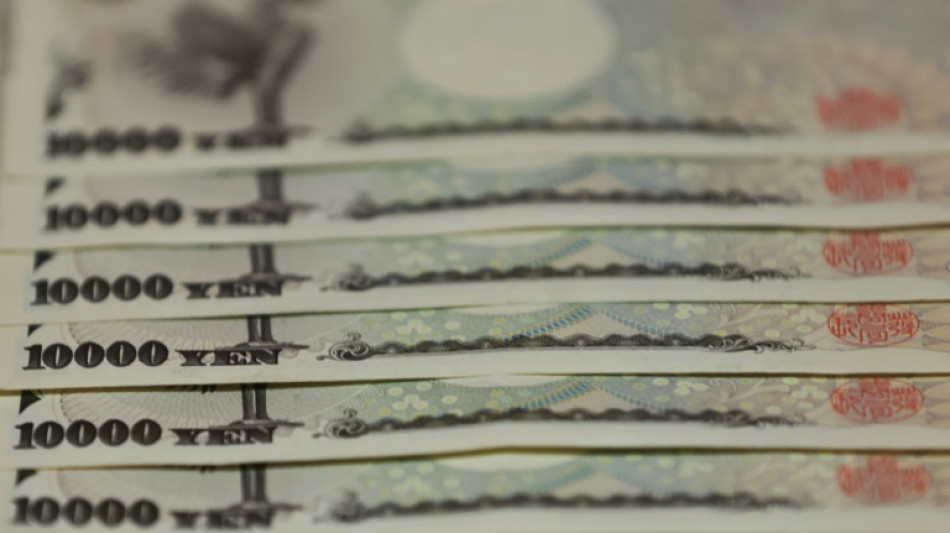
Yen sinks to new 24-year low against dollar / Photo: Behrouz MEHRI - AFP/File

 Maresca defends Donnarumma, Guehi after Man City defeat

 Nordic leaders call Putin as local truce begins in Ukraine

 Osaka unveils crane outfit in Tokyo before win over Paolini

 Ronaldo in line for Portugal return after fallout with coach

 Norway media take legal action to block Meta from using content

 Bayern praise 'humble' Kane after Ballon d'Or win

 Colts retain Daniel Jones as starter despite continued offensive struggles

 Madushanka wrecks Pakistan as Sri Lanka press for final slot
 Destructive Abhishek 113 leads India to series win over New Zealand

 Norway, Finland leaders hold 'frank and substantive' talk with Putin

 Wall Street faces earnings and Fed tests after turbulent technology-led week

 Ukraine, Russia say US-brokered truce holding in ravaged city

 Police form SIT after vehicles in Rahul Gandhi convoy collide on expressway

 Delhi grants minimum monthly pay and DA to about 4,000 MCD health workers

 Ather Energy shares climb 14% after quarterly profit and expansion plan

 Gold ETF flows turn negative after 13 weeks as bullion loses 4%

 Pakistan's last antique restorers give old treasures new life
 India braces for Cyclone Arnab with evacuations

 Steel Strips Wheels gains 36% in two sessions on growth outlook

 Cavs edge T'Wolves in overtime despite superb Edwards

 Prescott fires Cowboys to 38-21 win over plummeting Eagles

 Kuwait padel chief hails national showing at Premier Padel Major

 Britain prepares constrained budget as debt and defence pressures mount

 Valkyries beat Dream to reach brink of WNBA title

 Benjamin Netanyahu: Israel's longest-serving PM fighting for survival

The yen plunged to a new 24-year low against the dollar on Thursday as Japan sticks with its long-standing monetary easing policies in contrast to tightening by the US Federal Reserve.
One dollar was more worth more than 140 yen for the first time since 1998 in European afternoon deals, as the greenback also strengthened against other currencies.
The yen has been falling against the dollar from around 115 in March, prompting analysts to point to the possibility of government intervention.
The steep decline has mainly been driven by the differing approaches of the Bank of Japan and other central banks including the Fed, which have raised interest rates to tackle soaring inflation fuelled by the Ukraine war.
David Forrester, senior FX strategist at Credit Agricole CIB in Hong Kong, said breaching 140 yen per dollar marked an "important technical level".
"Previously, if you look at when the Bank of Japan has intervened to buy the yen, it's usually been around these levels," he told AFP.
The Japanese currency fell 0.6 percent to hit 140.13 yen per dollar at around 1425 GMT.
Earlier on Thursday, Japan's top government spokesman repeated comments about the importance of stability in forex markets, saying that "rapid changes are undesirable".
But he did not give any indication that special measures, like the finance ministry instructing the BoJ to buy the yen against other currencies to bolster its value, were on the cards.
With volatility increasing, "the government plans to monitor the trend of the foreign exchange market carefully with a high sense of urgency," Hirokazu Matsuno told reporters.
- Government intervention? -
Last week, Fed Chair Jerome Powell declared his commitment to aggressive rate hikes, eliminating hope that the US central bank may soften its position to avoid an economic slowdown.
But policymakers at the Bank of Japan have refused to abandon easy-money measures put in place a decade ago, aimed at generating growth in the world's third-largest economy and sustained price rises of around two percent.
Also, "higher energy prices throughout the year have been a big weight on Japan's trade balance and current account balance... but that has eased a little bit recently," Forrester said.
Inflation in Japan is at its highest in seven years, and prices for items excluding fresh products rose 2.4 percent on-year in July -- but the BoJ sees these increases as temporary, and says it is committed to its current policy.
"Inflation in Japan is not only accelerating but broadening out beyond just food and energy price inflation," which is starting to indicate "that maybe the BoJ does have to shift its stance a little", Forrester said.
"If they're stubborn on that front, then the ministry of finance may have to intervene, to reduce imported inflation due to the weaker yen," he added.
Although it makes imported goods more expensive in Japan, a weaker yen can also inflate the profits of Japanese companies selling products overseas, including major firms such as Toyota and Nintendo.
On Wednesday, Prime Minister Fumio Kishida announced a further relaxation of the country's strict border rules to allow tourists on package tours, but without a guide.
The decision was made partly "from the viewpoint of taking advantage of a cheap yen", he told reporters.
js-kaf-hih-lth/rl
F.AbuShamala--SF-PST