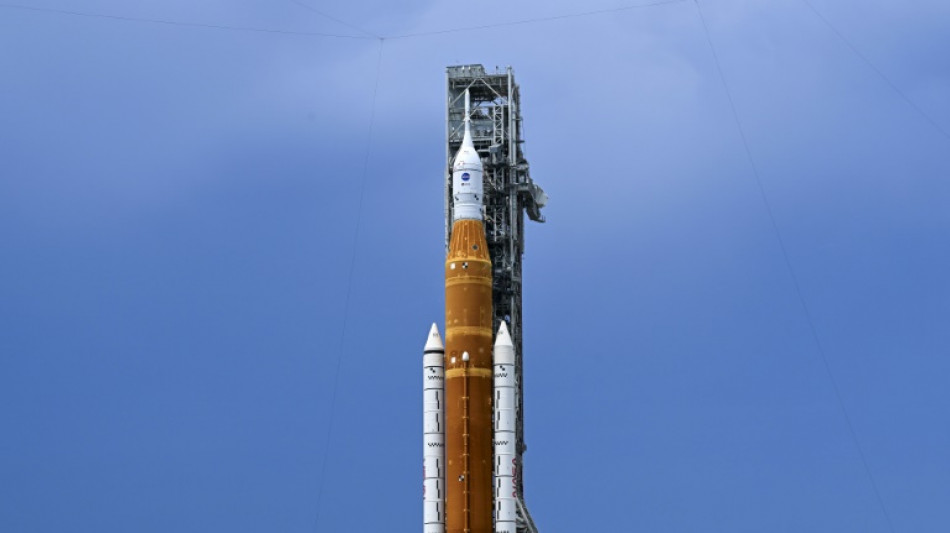
Engine issue threatens delay of NASA Moon rocket / Photo: CHANDAN KHANNA - AFP

 Maresca defends Donnarumma, Guehi after Man City defeat

 Nordic leaders call Putin as local truce begins in Ukraine

 Osaka unveils crane outfit in Tokyo before win over Paolini

 Ronaldo in line for Portugal return after fallout with coach

 Norway media take legal action to block Meta from using content

 Bayern praise 'humble' Kane after Ballon d'Or win

 Colts retain Daniel Jones as starter despite continued offensive struggles

 Madushanka wrecks Pakistan as Sri Lanka press for final slot

 Destructive Abhishek 113 leads India to series win over New Zealand

 Norway, Finland leaders hold 'frank and substantive' talk with Putin

 Wall Street faces earnings and Fed tests after turbulent technology-led week

 Ukraine, Russia say US-brokered truce holding in ravaged city

 Police form SIT after vehicles in Rahul Gandhi convoy collide on expressway

 Delhi grants minimum monthly pay and DA to about 4,000 MCD health workers

 Ather Energy shares climb 14% after quarterly profit and expansion plan

 Gold ETF flows turn negative after 13 weeks as bullion loses 4%

 Pakistan's last antique restorers give old treasures new life

 India braces for Cyclone Arnab with evacuations

 Steel Strips Wheels gains 36% in two sessions on growth outlook

 Cavs edge T'Wolves in overtime despite superb Edwards

 Prescott fires Cowboys to 38-21 win over plummeting Eagles

 Kuwait padel chief hails national showing at Premier Padel Major

 Britain prepares constrained budget as debt and defence pressures mount

 Valkyries beat Dream to reach brink of WNBA title

 Benjamin Netanyahu: Israel's longest-serving PM fighting for survival

An engine problem threatened to delay the launch on Monday of NASA's most powerful rocket yet on an uncrewed test flight to take humans back to the Moon and eventually to Mars.
Blastoff, which had been planned for 8:33 am (1233 GMT), was put on hold because of a temperature issue with one of the four engines on the 322-foot (98-meter) Space Launch System (SLS) rocket, the US space agency said.
Tens of thousands of people -- including US Vice President Kamala Harris -- have gathered along the beach near the Kennedy Space Center in Florida to watch the launch, which comes 50 years after Apollo 17 astronauts last set foot on the Moon.
The goal of the flight, dubbed Artemis 1, is to test the SLS and the Orion crew capsule that sits atop the rocket. Mannequins equipped with sensors are standing in for a crew for the mission.
Overnight operations to fill the rocket with more than three million liters of ultra-cold liquid hydrogen and oxygen were briefly delayed by a high risk of lightning, though it was a "go" after an hour.
Around 3:00 am, another hiccup emerged: a potential leak was detected during the filling of the main stage with hydrogen, causing a pause.
After tests, the flow resumed.
"The leak is at an acceptable level and we have returned to fast fill operations," NASA tweeted.
But NASA engineers later detected a problem with the temperature in one of the four engines and put a hold on the countdown. NASA has a two-hour window Monday in which to carry out the launch.
The massive orange-and-white rocket, which has been sitting on the space center's Launch Complex 39B for more than a week, is not able to take off in case of rains and storms.
If Monday's launch is scrubbed, September 2 and 5 have been penciled in as alternative flight dates.
The rocket's Orion capsule is set to orbit the Moon to see if the vessel is safe for people in the near future. At some point, Artemis aims to put a woman and a person of color on the Moon for the first time.
"This mission goes with a lot of hopes and dreams of a lot of people. And we now are the Artemis generation," NASA Administrator Bill Nelson said.
In another first, a woman -- Charlie Blackwell-Thompson -- will give the final green light for liftoff.
Women now account for 30 percent of the control room staff, compared to one for the Apollo 11 mission -- the first time astronauts landed on the moon in 1969.
- Extreme temperatures -
During the 42-day trip, the Orion capsule will orbit the Moon, coming within 60 miles (100 kilometers) at its closest approach, and then fire its engines to shoot out 40,000 miles -- a record for a spacecraft rated to carry humans.
One of the mission's primary objectives is to test the capsule's heat shield, which at 16 feet in diameter is the largest ever built.
On its return to Earth's atmosphere, the heat shield will have to withstand a speed of 25,000 miles per hour and a temperature of 5,000 degrees Fahrenheit (2,760 degrees Celsius) -- or half as hot as the Sun.
The dummies aboard the spacecraft will record acceleration, vibration and radiation levels.
The craft will deploy small satellites to study the lunar surface.
A complete failure would be devastating for a program costing $4.1 billion per launch that is already years behind schedule.
- Life on the Moon -
Monday's launch is "not a near-term sprint, but a long-term marathon to bring the solar system and beyond into our sphere," said Bhavya Lal, NASA associate administrator for technology, policy and strategy.
The next mission, Artemis 2, will take astronauts into orbit around the Moon without landing on its surface. The crew of Artemis 3 is to land on the Moon in 2025 at the earliest.
The Artemis program is to establish a lasting human presence on the Moon with an orbiting space station known as Gateway and a base on the surface.
Gateway would serve as a staging and refueling station for a voyage to Mars that would take a minimum of several months.
T.Samara--SF-PST