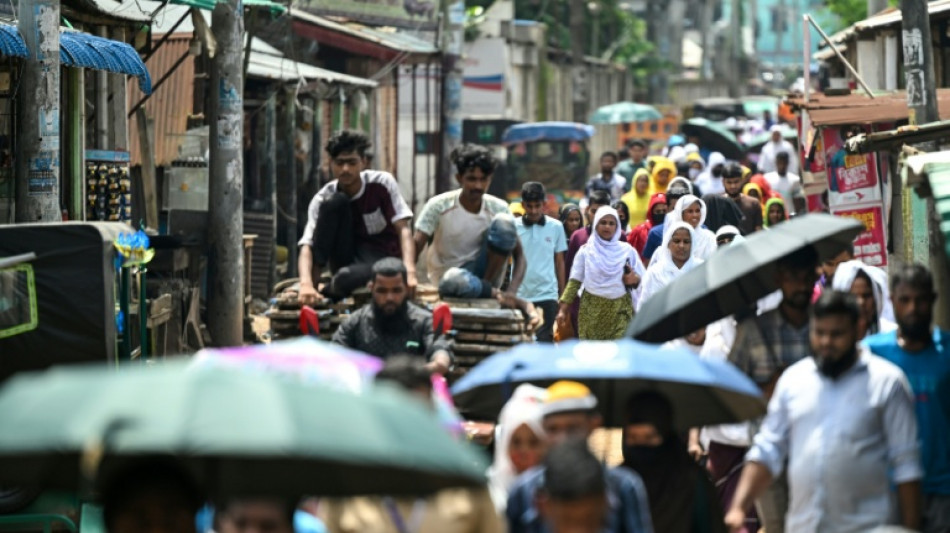
Factories shed workers in Bangladesh garment sector / Photo: Munir UZ ZAMAN - AFP

 Teens on target again as USA down Mexico 3-0

 World records prove Asian Games were a hit, says top official

 US prison chief who oversaw botched execution resigns

 'Chaotic' Asian Games threaten Japan hopes of hosting Olympics again

 Finnish town braces for change from Google data centres

 What is fuelling French school protests?

 Without lawyers, migrant children face deportation from the US
 Three-peat seeking Dodgers open playoffs with a win, Rays hold off Yankees

 Brazil votes in nail-biter polls closely watched by Trump

 'Just be you': Kim reveals Tiger text that inspired him to gold

 Myanmar migrants returned to war-torn nation from Malaysia

 ALEX BODI AND AMBASSADOR GUM DOMINIC MATIOK OF THE REPUBLIC OF SOUTH SUDAN MEET IN BERLIN TO DISCUSS THE POSSIBILITY OF AN HONORARY CONSULATE IN BUCHAREST

 Lula, Bolsonaro wrap up campaigns ahead of Brazil's knife-edge vote

 Toulouse edge Castres in Top 14 derby

 Murakami homer propels White Sox to MLB playoff win over Guardians

 Israel targets top Hamas leader in deadly Gaza strike on anniversary

 Houthis say struck oil facility near Riyadh, as Saudis hit Sanaa

 AI needs safety layers like nuclear plants: ex-OpenAI engineer

 MVP Judge will miss Yankees' MLB playoff series against Rays

 New lizard species discovered in Peru

 Fernandes hails Portugal's 'greatest symbol' Ronaldo, calls for unity

 Grandidier-Nkanang double takes Pau to Top 14 summit despite Vannes fightback

 Trainer Scott gets perfect Arc boost with top notch double

 Ex-PM says Putin cannot admit 'mistake' over Ukraine

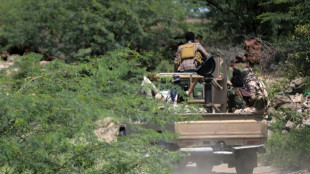 Houthis say Saudi Arabia launches dozens of strikes on Yemen capital

Garment worker Mosammat Aklima found out in a text message that she had become one of thousands laid off in the latest wave of cuts to hit Bangladesh's once-booming export industry.
The news appearing on her mobile that July evening confirmed the end of her eight years' employment at Lithe Garments factory, a major manufacturer in the country's industrial heartland.
She was among 3,000 people laid off in one go, a sign of the industry's struggle with slowing exports, weak customer demand and stiff competition from rivals India and Vietnam.
"I am three months pregnant now. It is not possible to find a new job," said Aklima, 27.
"I will now dip into my savings, borrow some money. I don't know what's next," she told AFP in the garment hub of Gazipur.
Aklima earned $250 a month, roughly matching the income of her husband, who works at another garment factory.
With her redundancy, their son and elderly parents must now rely on a single wage.
The layoffs are part of a wider downturn in an industry that accounts for around 80 percent of Bangladesh's export earnings.
About 400 of the roughly 4,000 apparel factories in the country have shut over the past two years, eliminating tens of thousands of jobs, according to the Bangladesh Garment Manufacturers and Exporters Association.
Some of them had to shut down because they could not survive with exports declining in the "highly competitive" global market, BGMEA president Mahmudul Hasan Babu told AFP.
- Trade deals -
The closures have fuelled concern over the future of a sector that employs more than 4.5 million people, most of them women.
While US tariffs are similar for apparel exporters across Asia, analysts say Bangladesh faces a greater challenge in Europe, its largest market, where India and Vietnam have gained ground through free-trade agreements.
The pressure could intensify as Bangladesh is set to lose the duty-free preferential market access it enjoys in Europe and other countries because its status as a least-developed country is scheduled to expire in 2029.
"If Bangladesh fails to strike free-trade agreements after the end of the preferential trade regime, the country may risk losing competitiveness," said Dhaka University professor Selim Raihan.
European Union apparel imports fell during the first five months of the year, with those from Bangladesh recording the sharpest decline among major suppliers, Eurostat data shows.
Experts point to weak consumer demand linked to conflicts in Ukraine and the Middle East, but also blame structural weaknesses in the South Asian nation of 170 million people.
The industry remains focused on low-margin products such as T-shirts and jeans, while rivals have moved into higher-value segments made with synthetic fibre.
Bangladesh, which earned about $39 billion from garment exports in 2025, relies heavily on imported cotton and other fibres, raising production costs.
- Basic products -
"We have expanded without planning and without consolidating the infrastructure," said Mohiuddin Rubel, founder and chief executive of Apparel Voice, a research and advocacy group.
"We got stuck with basic products," he said, adding that Bangladesh had not fully tapped opportunities in military uniforms and medical apparel.
Research also remains limited, while automation is reshaping production lines elsewhere.
A recent World Bank study found that most garment factories in Bangladesh still rely on semi-automated labour-intensive processes, while rivals such as Vietnam are moving rapidly towards advanced manufacturing.
At the same time, labour advocates worry that technological advances can have an impact on employment numbers.
"We have not seen any integrated government policy to manage this transition in manufacturing," said Syed Sultan Uddin Ahmed, executive director of the Bangladesh Institute of Labour Studies.
Government adviser Rashed Al Mahmud Titumir said authorities were focusing on training to help workers adapt to changing industrial needs.
For workers, however, long-term plans offer little immediate comfort.
Begum, who did not give her first name, told AFP she had been turned away by many factories in Gazipur despite having experience in sewing and hemming.
She had to go back to her native village in the country's north to bring back rice and other essentials to feed her family.
"I don't know what will come next."
E.AbuRizq--SF-PST