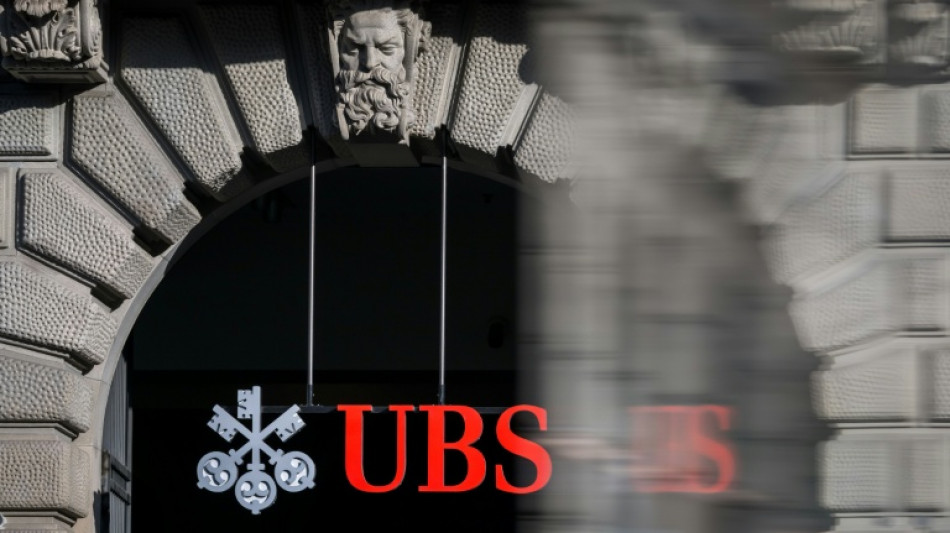
UBS second-quarter net profit up 17% to $2.8 billion / Photo: Fabrice COFFRINI - AFP

 Russians vote as Ukraine war drags on for fifth year

 Backpackers fret over Australian visa crackdown
 Most Asian stocks track Wall St rally, yen drops after BoJ rate hike

 Russians begin voting in controlled election as war drags on

 Trump 'clearly' wants dialogue with Pyongyang: South Korean President

 Bank of Japan hikes rates to 31-year high to battle inflation

 Thailand's Muslim separatists vow to fight to the end

 Mideast turmoil, AI set to dominate UN gathering of world leaders

 Australia to detain tourists who overstay visa, minister says

 Championship rivals brace for renewal of bitter feuds

 In Brazil's Amazon, the hunt for oil fuels hopes and fears
 Australian athlete who soiled herself apologises for continuing Hyrox race

 Baby orangutans in India expose 'frightening' scale of trafficking

 Doom Loop? Ed Sheeran struggles against Gaza tide

 Sudanese women hold fast to threatened henna body art

 Man Utd misery puts Carrick under pressure, Spurs feeling the heat

 Prized Mexican relic returns on loan, two centuries on

 Venezuela unblocks some censored news sites

 Samba stars on debut in Man City rout of Norwich

 Oversight Board blasts 'inadequate' Meta safeguards for AI deepfakes

 The Easter Island origins of buzzy Malkovich drama 'Wild Horse Nine'

 Third body recovered after Grand Canyon flash flood

 Harry makes first public appearance since return to UK

 Abhishek hits record T20 ton as India sweep series 3-0

 Abhishek hits record T20 ton as India sweep T20 series 3-0

Swiss banking giant UBS reported Wednesday that net profit rose 17 percent to $2.8 billion in the second quarter, driven by investment banking.
"Strong results in the second quarter and healthy capital generation have further fortified our balance sheet," UBS chief executive Sergio Ermotti said in a statement on the results, which were better than expected.
Revenues from its investment bank jumped 26 percent in a context of strong market volatility, with the Zurich-based bank describing "a record second quarter" for its global markets business, with record results in the equities, services and financing segment.
Its wealth management division recorded a 13 percent increase in revenue, supported by fees generated from client transactions. New capital inflows into this division totalled $36 billion.
Major US investment banks such as Goldman Sachs and Morgan Stanley have also reported sharply higher results for the second quarter, boosted in particular by equity markets, which have been highly volatile since the start of the conflict in the Middle East.
"As we enter the third quarter, market conditions remain broadly constructive," Switzerland's biggest bank said in the statement.
"At the same time, ongoing geopolitical developments and volatile energy prices lead to high levels of uncertainty," it said.
"This could contribute to changes in macroeconomic conditions, periods of elevated volatility and more measured investor sentiment."
- Credit Suisse takeover nears completion -
UBS announced another $3 billion share repurchase programme, to be completed by mid-2027.
The bank also said the integration of its former closest domestic rival Credit Suisse was "on track to be substantially completed by the end of this year".
Credit Suisse bank imploded in March 2023, prompting the Swiss government, the central bank and regulators to strong-arm UBS into a quickfire $3.25-billion takeover.
UBS said it had achieved another $1.1 billion in cost savings during the second quarter, bringing the cumulative savings since the start of the integration to $12.6 billion out of the $13.5 billion targeted for the end of 2026.
"The acquisition of Credit Suisse was not a gift that we received, but rather a prize that we would all have to fight to win," said Ermotti.
"As expected, the journey was not a straight line. It required a lot of hard work from my colleagues and painful decisions.
"Now these efforts are paying off and the extraordinary patience and support of our shareholders is starting to be rewarded."
The implosion of Credit Suisse sent shockwaves through Switzerland and Bern has since sought to tighten its banking rules.
Given the size of UBS in the Swiss economy following the mega-merger, the government wants to ensure that it can withstand macroeconomic or financial market shocks.
The reform measures are to be debated in parliament in the coming months -- and UBS strongly opposes proposals concerning capital reserves for its foreign subsidiaries.
The government's proposal would involve setting aside approximately $20 billion in additional reserves, according to its calculations, or $22 billion, according to those of UBS.
UBS has warned that tightening the regulations too much could put it at a disadvantage with its foreign competitors.
L.AbuTayeh--SF-PST