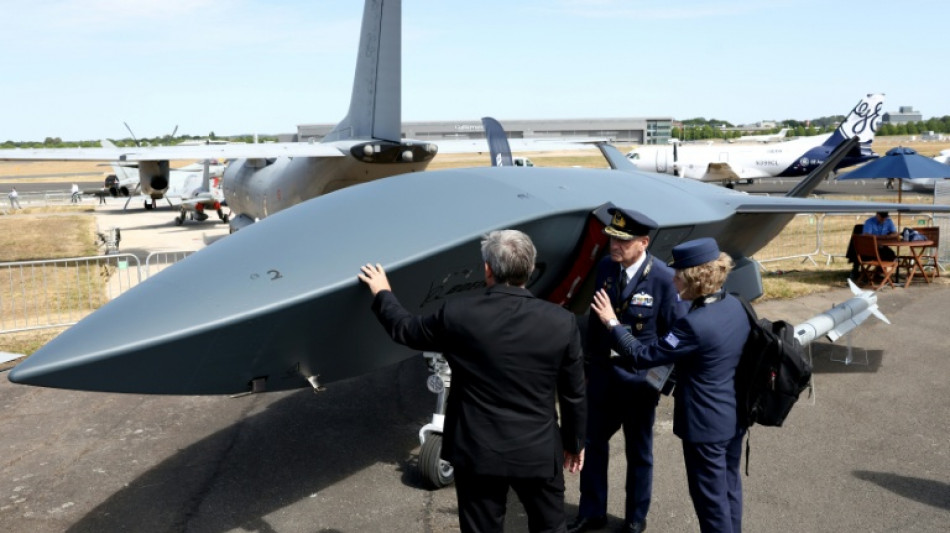
Autonomous fighter jets target Europe market at Farnborough airshow / Photo: Toby Shepheard - AFP

 Trump claims 'infinite' Greenland security deal with Denmark

 Helicopters battle wildfire threatening Ecuador's capital

 Brentford batter Chelsea to undo Alonso's promising start

 Kane hits Bundesliga century as Bayern rout Union

 Trump says CNN, MS NOW, Politico banned from White House

 Hushing and hedging: US companies retreat on climate

 Springboks to face Fiji before 2027 Rugby World Cup

 Nigeria miners struggled to breathe in cell before 37 died: survivors

 McIlroy on the charge at PGA Championship as Reed withdraws
 McIlroy on the charge at PGA Championship
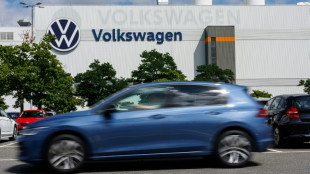 Crisis-wracked Volkswagen warns of 10-bn-euro hit to profits

 Costa Rica's Grynspan tops third informal poll for UN chief: diplomat

 Stock markets retreat after central bank rate hikes

 Russia labels director of Cannes Grand Prix winner a 'foreign agent'

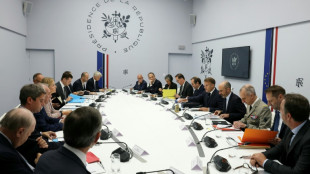 Macron warns of Russian 'hybrid' threat after meeting presidential hopefuls

 UN holds third informal poll for new chief

 Kulusevski return can spark Spurs: De Zerbi

 Shakira to cap off world tour with Madrid 12-gig run

 Isolated Syrian-Druze city blames Damascus for shortages

 Isolated Syrian-Druze city shortages

 Dutch drop Depay for Germany match in Xavi's first pick

 Ronaldo named in Portugal squad for Nations League

 Stock markets diverge after central bank rate hikes

 Anti-Assad music star makes triumphant return to Syria

 In-form Fernandez included in Spain Nations League squad
As Europe ramps up its rearmament drive, US aerospace giant Boeing is seeking a foothold in the emerging market for autonomous fighter aircraft, showcasing its capabilities at the Farnborough airshow this week.
Boeing's MQ-28 Ghost Bat is an uncrewed aircraft, developed with the Royal Australian Air Force, to fly alongside crewed fighter jets carrying out electronic warfare and surveillance and to help multiply forces.
It belongs to a category of AI-enabled Collaborative Combat Aircraft (CCA) which have risen to prominence as a new type of drone, as unmanned systems dominate the battlefield in Ukraine.
Boeing hopes to win over the European market by partnering with local defence companies.
In Germany, defence group Rheinmetall has teamed up with Boeing to integrate the MQ-28 into the German Air Force, with the capability expected to be available by 2029.
Such partnerships, however, have revived questions about the limits of Europe's push for greater defence sovereignty.
"The key objective is to deliver capabilities quickly," Pascal Fabre, a partner at advisory firm AlixPartners, told AFP.
"If you want to field new capabilities rapidly, you either develop the system yourself -- which takes time -- or you partner with someone who already has a mature platform, even if that company is not European," he added.
The trade-off lies at the heart of Europe's rearmament push, driven by growing security concerns and unease over relying on an increasingly unpredictable ally in US President Donald Trump.
"The defence industry is global, and European industry remains embedded in global networks with allies," said Emil Archambault, an associate fellow at the German Council on Foreign Relations.
"European-built CCAs will still require integration with these American systems and therefore do not offer a fully European solution," he told AFP.
- 'Take risks' -
"The thing we have going for us that no one else does, that no one can ever match, is we started nine years ago," Glen Ferguson, director of the MQ-28 Global Program, told AFP on the sidelines of Farnborough.
For Ferguson, the big advantage of CCAs is to "achieve missions that would be too high risk with normal human life at the stake".
The aircraft has a range of 3,700 kilometres, can fly at altitudes of up to 12,000 metres and reach a top speed of Mach 0.9 -- comparable to the speed of the world's fastest private jets.
It meanwhile has the possibility of being paired with the next-generation fighter being developed by Britain, Italy and Japan's GCAP program.
Ferguson said Boeing's model of building with regional partners was intended to give countries greater control over the capability rather than simply importing a US system.
"We would work with local industry because we're all about providing a sovereign capability to that country," he added.
- Multi-billion-dollar industry -
Boeing is not alone in the race.
BAE Systems unveiled Britain's first sovereign CCA at Farnborough, though London has yet to commit to a procurement decision, leaving the field open to competitors.
The UK government has pledged to spend £300 million ($400 million) on its autonomous jet programme over the next four years.
"Globally, the CCA sector is projected to be valued at more than £125 billion to 2050," said new UK defence minister Wes Streeting.
European aviation giant Airbus has partnered with US firm Kratos to use an existing American platform while integrating its own mission systems.
US rivals General Atomics and Anduril also showcased at Farnborough models of their autonomous aircraft at the airshow.
"From a Western world perspective, we need everyone who's creating a CCA to be successful," Ferguson said.
"The demand for CCAs in the rest of the world is going to be so immense that not one company, two companies, three companies can actually keep up," he added.
B.Mahmoud--SF-PST