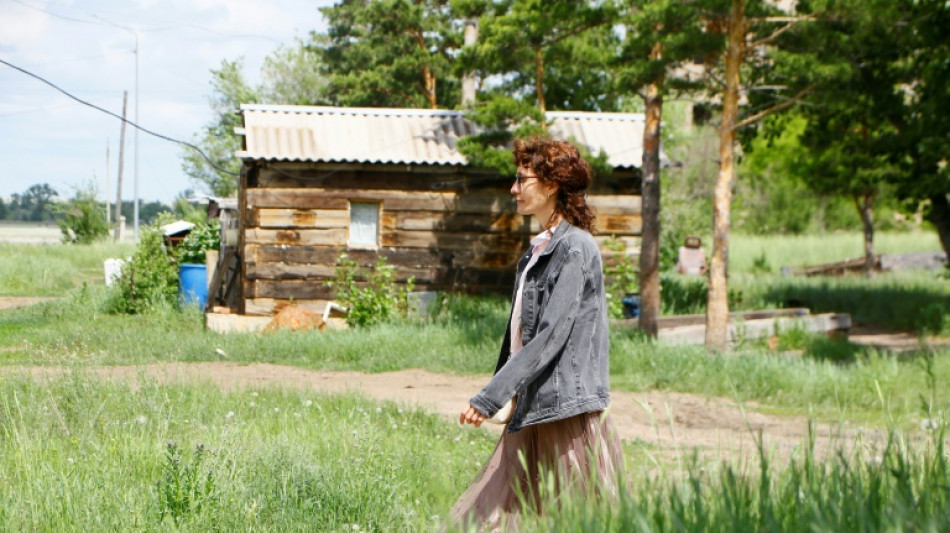
In Kazakhstan, emptying villages and overcrowded cities / Photo: Ruslan PRYANIKOV - AFP

 Death toll from attack at police HQ in Pakistan rises to 31

 Trump says Denmark to give US 'permanent control' over Greenland security
 Kennedy Center: future unclear for iconic Washington arts hub

 Trump claims 'infinite' Greenland security deal with Denmark

 Helicopters battle wildfire threatening Ecuador's capital

 Brentford batter Chelsea to undo Alonso's promising start

 Kane hits Bundesliga century as Bayern rout Union
 Trump says CNN, MS NOW, Politico banned from White House
 Hushing and hedging: US companies retreat on climate

 Springboks to face Fiji before 2027 Rugby World Cup
 Nigeria miners struggled to breathe in cell before 37 died: survivors

 McIlroy on the charge at PGA Championship as Reed withdraws

 McIlroy on the charge at PGA Championship

 Crisis-wracked Volkswagen warns of 10-bn-euro hit to profits

 Costa Rica's Grynspan tops third informal poll for UN chief: diplomat

 Stock markets retreat after central bank rate hikes

 Russia labels director of Cannes Grand Prix winner a 'foreign agent'

 Macron warns of Russian 'hybrid' threat after meeting presidential hopefuls

 UN holds third informal poll for new chief

 Kulusevski return can spark Spurs: De Zerbi

 Shakira to cap off world tour with Madrid 12-gig run

 Isolated Syrian-Druze city blames Damascus for shortages

 Isolated Syrian-Druze city shortages

 Dutch drop Depay for Germany match in Xavi's first pick

 Ronaldo named in Portugal squad for Nations League

In a slowly emptying village in northern Kazakhstan, wild grass engulfed the entrances of abandoned apartment blocks, as children's songs spilled into the street from the only building still occupied.
Zaozerny is one of hundreds of villages in the Central Asian country that has seen almost its entire population leave -- many never to return as opportunities dry up and young people head to the ever-expanding cities.
"It's calm and peaceful here, I can always keep an eye on the children," said Yulia Sadvakasova, a 33-year-old schoolteacher and mother of two.
Around the village is the vast Kazakh steppe, stretching seemingly endlessly into a horizon broken only by the solitary tower of a cement plant.
A poster hung outside the school for upcoming municipal elections -- a rare reminder that life, for those who remain, has not frozen in time.
At the fall of the Soviet Union, the town had around 10,000 residents, supported by employment in a nearby uranium mine.
And now? Just 216.
Cows walk the floor of what used to be a city theatre. The former hospital is a heap of rubble and the uranium miner glorified on a huge Soviet mosaic has lost half his face.
To reach the nearest city, Sadvakasova must drive two hours along a neglected road that becomes almost impassable in rain or snow.
"Everything is badly broken up. Whenever we can, we go somewhere, even though it's difficult," she told AFP.
- Cities under pressure -
Vast Kazakhstan, the ninth-largest country in the world, stretches some 1,600 kilometres (994 miles) north-to-south and 3,000 kilometres west-to-east.
And with around 20 million residents, it is one of the world's least densely populated.
Officials say some 1,800 localities have already vanished since the turn of the century -- ghost villages that have become nothing more than decaying buildings and a name on a map.
The majority are in the north, where 1.2 million people have left since the Soviet collapse in 1991.
The exodus and the ageing of the ethnic Slavic population -- many descendants of people forcibly resettled there in the Soviet era -- and the lack of economic prospects are all driving the internal migration.
Around 25-30 percent of the Kazakh population live in just three cities: the capital Astana in the centre, and the southern metropolises of Almaty and Shymkent.
"People are moving en masse to Astana and Almaty," President Kassym-Jomart Tokayev said in June -- citing a lack of "social facilities" in the regions.
The influx is heaping "colossal pressure" on the cities, he warned in separate comments last year.
In Astana, schools are overloaded, and heating and water supply systems are struggling to cope, he said.
- 'Dynamism' -
Schoolteacher Anara Batalova moved to the capital from a Soviet-era apartment block in a small polluted industrial town in search of "dynamism".
"Astana pulled me in with its lights, young people, movement, new organisations, events, exhibitions," she told AFP.
"All our friends and neighbours have come from different towns and villages," she said.
Her suburban community of Kosshy, some 20 kilometres (12 miles) from central Astana, has exploded over the last 25 years -- growing from barely 2,000 inhabitants to 80,000.
The government is trying to stem the flow of people to the cities -- both to ease pressure on the urban centres and stem rural depopulation.
But state-backed financial incentives to encourage people to move to the north have had limited success.
Many who took up the offer have since moved back -- put-off by harsh winters and low wages.
Now the state is trying more radical steps.
Since spring, foreigners and ethnic Kazakhs who repatriate from abroad are banned from obtaining a resident permit in the three largest cities.
In Zaozerny, Acting Mayor Olga Zhukova hails recent signs of progress.
"Last year, our village was connected to running water and street lights were installed," she said.
She is banking on the revival of the nearby cement plant to save her community.
When production was temporarily suspended last year, many families left.
"Now the plant is resuming operations, specialists and workers are being recruited. We are pinning our hopes on this plant, that people will come and the village will continue to live."
N.Shalabi--SF-PST