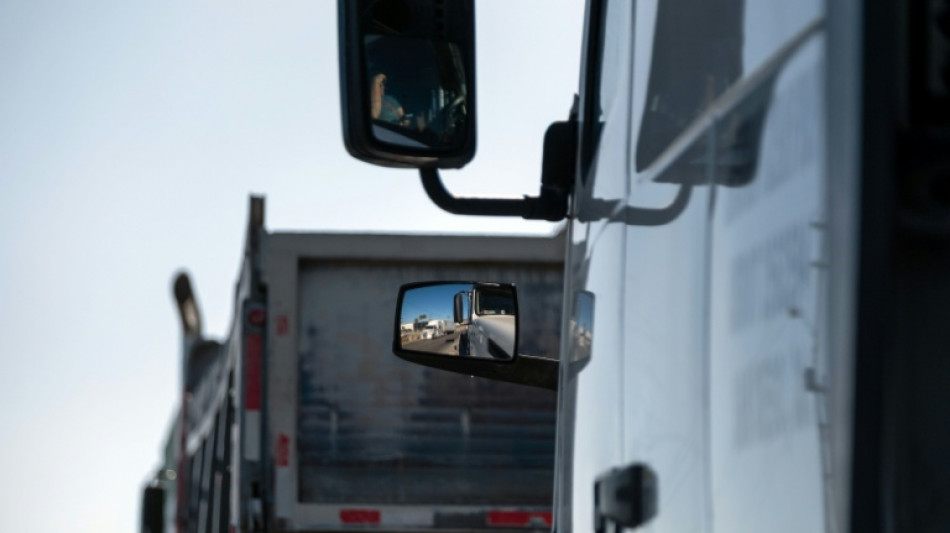
AI boom lifts Mexico tech exports, complicating Trump trade goals / Photo: Guillermo Arias - AFP/File

 Ed Sheeran returns to stage after Palestinian controversy

 Asian Games to open in Japan after troubled build-up

 Drone owners rush to offload devices ahead of Beijing ban
 Trump's beef policies irk Texas ranchers, testing their loyalty

 Nvidia, OpenAI CEOs to attend Xi dinner at White House
 Anthropic picks Accenture for in-house AI safety evaluation

 Balogun returns as Monaco beat Lens to continue strong Ligue 1 start

 'Pause' on overt repression in Venezuela, but reforms still needed: HRW

 Global stocks mixed as yen falls despite Bank of Japan rate hike
 Cuba hit with seventh major blackout of the year
 Murray out with concussion so Wentz will start for Vikings

 UN chief 'deeply regrets' US visa refusal to Abbas for annual meeting

 England quick Carse to face no charges over alleged nightclub assault

 Mancini brings nine newcomers into the first squad of his Italy comeback

 Czechs level Davis Cup tie against USA as South Korea eye Finals

 New France boss Zidane confirms Mbappe as captain after naming first squad

 California governor signs order to explore AI 'kill switch'

 Head leads run spree as Australia win Zimbabwe ODI series

 In-form Raphinha wants to finish career at Barcelona

 Warren Buffett steps down as Berkshire Hathaway chairman

 Carrick confident Man Utd can 'work through' tough time

 Mbappe ends Nike partnership to join Swiss brand On

 Liverpool boss Iraola puts Bournemouth love affair on hold

 'A disaster' if Man City do not win says Maresca after flawless start

 Kerry James Marshall: American 'blackness' painter celebrated in Europe

The United States' frenzied rush to build out AI infrastructure has boosted exports of Mexican technology, complicating President Donald Trump's hand heading into trade negotiations.
Trump, who campaigned on boosting US manufacturing, hopes to narrow the trade deficit with Mexico during talks to update the USMCA free trade agreement, which kick off Tuesday in Mexico City.
But the dizzying rise in computer equipment exports from Mexico -- the largest US trading partner -- is doing the opposite.
Between January and April, Mexico tripled its sales of computer equipment to the United States compared to the same period last year, with exports topping $50 billion versus just $2.2 billion in imports, according to AFP calculations.
The sector now makes up 30 percent of all Mexican products shipped to the United States, overtaking the automotive industry as the largest component of exports.
"It's a milestone largely driven by demand for advanced AI electronics," Diego Flores, head of electronic and digital industries at Mexico's Economy Ministry, told AFP.
The sector, which includes processing units and data center hardware, is not officially on the agenda for this round of negotiations.
- Explosive demand -
The most in-demand products are server racks that house AI processing cards -- a key component for the data centers multiplying across the United States.
The main export hub is the Pacific state of Jalisco, dubbed the "Mexican Silicon Valley," where an ecosystem of global industry giants and tech startups have set up shop, Flores said.
Taiwanese giant Foxconn assembles server racks in Jalisco, and serves as a strategic partner to US chip designer Nvidia.
In March, Foxconn announced $137 million in investments across two Mexican subsidiaries after estimating its production could double this year.
"The United States and Mexico will remain our primary production hubs," Chief Executive Michael Chiang said, announcing the company would invest 30 percent more than in 2025 to expand its AI-related capacity.
Faced with booming demand, Flextronics, another tech manufacturer in Jalisco, even had to repurpose its parking lots to expand manufacturing capacity, Flores said.
Yet the boom comes amid a volatile political climate.
The Trump administration rejected a 16-year extension of the USMCA, opting instead for annual reviews with Mexico and Canada.
Washington is also continuing to push for more goods to be manufactured domestically, even as US reliance on imports from Mexico, Taiwan, and China to fuel its AI boom grows.
- 'In the line of fire' -
Could the thriving sector become Trump's next tariff target?
"Nobody can say for sure," Flores admitted. However, he expressed confidence that the sector might escape protectionist policies due to its immense strategic value to the United States.
Washington is also seeking to limit the use of Asian technology within North America, according to William Jackson, a chief emerging markets economist at Capital Economics.
"The Trump administration has to weigh the demand for these technologies and the need to stay at the forefront of AI development," he told AFP, noting that "tariffs could prove counterproductive to that goal."
But balancing the preservation of a booming industry with protectionist rhetoric puts the sector "very easily in the line of fire," he warned.
That risk is heightened by the fact that Mexican manufacturers use components sourced from China and Taiwan, which Trump could view as a "backdoor" or Trojan horse for Asian technology entering the United States.
G.AbuOdeh--SF-PST