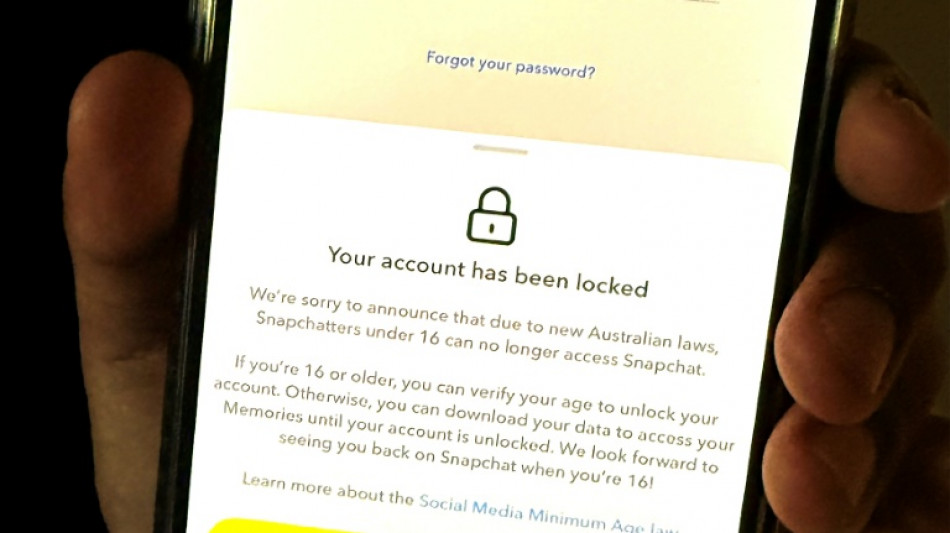
French youth social media ban meets age check conundrum / Photo: STR - AFP/File

 Denmark hails 'binding' Greenland deal with Trump

 We don't want Games host Japan losing money, says Asian Olympic official

 Ed Sheeran returns to stage after Palestinian controversy

 Asian Games to open in Japan after troubled build-up

 Drone owners rush to offload devices ahead of Beijing ban
 Trump's beef policies irk Texas ranchers, testing their loyalty

 Nvidia, OpenAI CEOs to attend Xi dinner at White House
 Anthropic picks Accenture for in-house AI safety evaluation

 Balogun returns as Monaco beat Lens to continue strong Ligue 1 start

 'Pause' on overt repression in Venezuela, but reforms still needed: HRW

 Global stocks mixed as yen falls despite Bank of Japan rate hike
 Cuba hit with seventh major blackout of the year

 Murray out with concussion so Wentz will start for Vikings

 UN chief 'deeply regrets' US visa refusal to Abbas for annual meeting

 England quick Carse to face no charges over alleged nightclub assault

 Mancini brings nine newcomers into the first squad of his Italy comeback

 Czechs level Davis Cup tie against USA as South Korea eye Finals

 New France boss Zidane confirms Mbappe as captain after naming first squad

 California governor signs order to explore AI 'kill switch'
 Head leads run spree as Australia win Zimbabwe ODI series

 In-form Raphinha wants to finish career at Barcelona

 Warren Buffett steps down as Berkshire Hathaway chairman

 Carrick confident Man Utd can 'work through' tough time

 Mbappe ends Nike partnership to join Swiss brand On

 Liverpool boss Iraola puts Bournemouth love affair on hold

France's parliament is weighing a social media ban for under-15s, following in the footsteps of Australia and Indonesia, although enforcement authorities are facing a puzzle on how to manage age checks.
Here are the main methods available for now to check users are of age:
- Government ID -
The most obvious solution is providing a scan of a passport, driver's license or other official identity document.
But the method has limits, including some teens using ID belonging to a friend or relative who is above the age threshold.
It also opens up privacy risks that could even deter people with the legal right to access age-restricted platforms from using them.
Under its ban in force since December, Australia told social platforms they were not allowed to require government ID even in cases where a user's age is in doubt.
They can, however, turn to a third-party service -- with Snapchat for example accepting Australian bank accounts, or verification through Singapore-based third-party k-ID.
In France, similar specialist age verification services have been in the spotlight since a ban on under-18s accessing online pornography was introduced last year.
Some services offer a "double anonymity" system, under which the user proves their age to a verification service, with that confirmation then passed to the platform they wish to access without revealing identifying details.
- Digital wallet -
Some EU member states, including France, have in recent months begun testing an age verification app created by the European Commission.
The scheme allows each nation to define the age threshold they want to set.
Brussels' app works on the same principle as the third-party services above: users offer an official ID to the app, which then provides age confirmation to restricted sites on their behalf when they approve a notification on their smartphone.
The EU plans to include the service in its in-development digital wallet, which would allow users to share all sorts of official documents when needed.
Using a cryptographic scheme known as "zero knowledge proofs", the system could prove that a user is of age without passing on their sensitive data.
- Selfie analysis-
Snapchat also allows Australian users to simply take a selfie that k-ID analyses to estimate their age.
Facebook and Instagram parent company Meta has turned to London-based startup Yoti for its version of the system.
Yoti's artificial intelligence system takes less than a minute to provide an age estimate.
The company, which also works for TikTok, says it deletes all user data once the analysis is complete.
But some observers fear that false positive or negative results could affect people around the threshold age.
Meanwhile craftier children could develop ways around the automated systems.
Given their potential to gather private data, the tools themselves must meet strict legal requirements in Europe, where facial recognition technology is tightly controlled under the General Data Protection Regulation (GDPR).
- Behavioural analysis -
Most social networks already bar under-13s from access under their terms of service.
Beyond requiring users to state their age when creating their account, many have automated monitoring tools that purport to detect when minors are behind the screen.
Potential indicators for underage users can include profile pictures, birthday messages or the type of content they choose to explore.
TikTok said it deleted 642,000 accounts suspected to belong to under-13s in France in 2024.
Such data mining techniques can also be used to target ads at specific users -- although this is banned for minors in the EU.
Automated systems of this kind face questions of their own about both data privacy and the accuracy of their analysis.
burs-kf/tgb/rmb/lga
A.Suleiman--SF-PST