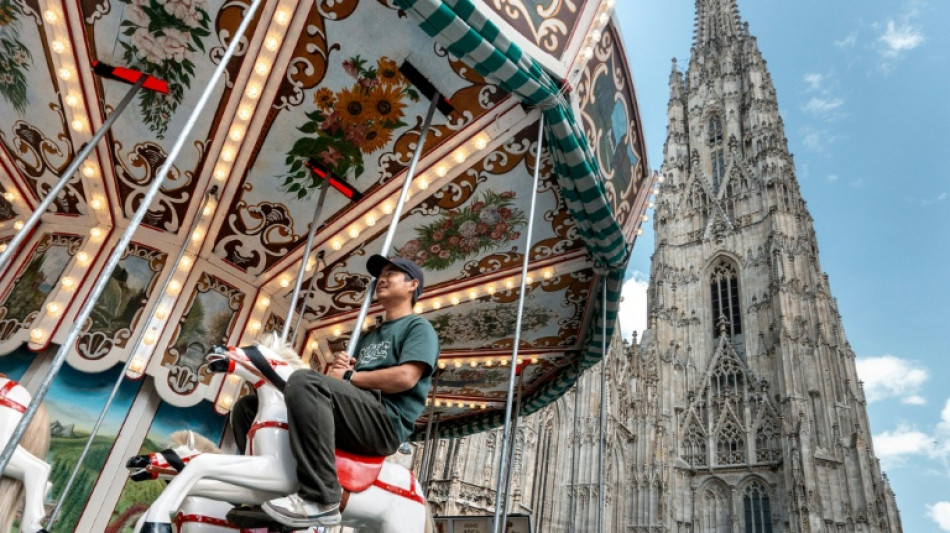
Record visitors, record taxes: Vienna cashes in on tourist boom / Photo: Joe Klamar - AFP

 MTN’s Telkom Acquisition: Consolidation, Competition, and Regulatory Conditions

 فلسطين تحصد جائزتي "أفضل أثر عالمي" وريادة الأعمال في مسابقة إنجاز العرب

 Kubayi Warns Residents to Vacate Hijacked Buildings as State Prepares Seizures

 Van Gogh’s ‘Châtaigniers en Fleurs’ Sets $285m Record at Sotheby’s

 محكمة الاحتلال تمدد اعتقال مدير مستشفى كمال عدوان دون تهمة
As Vienna grapples with smashed record after smashed record for tourist numbers, a plan to more than double its visitors' tax has worried hotel owners fearful of killing the Austrian capital's golden goose.
In two decades, Vienna's winning trio of cleanliness, safety and schnitzel has propelled the Austrian capital to the top of rankings of the world's best cities to live in, just behind Copenhagen and ahead of Melbourne.
Between 2005 and 2025, the number of overnight stays rocketed from 8.8 million to 20.1 million.
Hoping to cash in on that success, the municipality has decided to increase the visitor's tax from 3.2 to five percent from early July, before hiking it to eight percent in July 2027.
Like other cities across Europe anxious about over-tourism, the authorities view the tax as a means to make the sector pay its fair share for the strain the crowds of visitors place on the city's infrastructure.
But Martin Stanits, spokesman for the Austrian Hotel Association (OeHV), lamented that the hike would make it "the second highest in Europe", trailing only Amsterdam.
Arguing that hotels were already faced with high taxes and an explosion in the costs of energy, wages and food, Stanits argued that the authorities tend to treat tourism as a way to plug holes in the city's budget.
"For decades, the city has been living beyond its means and is now making up its budget deficits at the expense of tourism," he told AFP.
"Killing the goose that lays the golden eggs is not really a great idea," he said, singling out Vienna's ruling social-democrat and liberal coalition.
His frustrations echo those of the travel agencies, which single out the 12-euro ($16) tax already levied on plane tickets.
- 'Investment in the future' -
Gregor Kadanka, who heads the Association of Austrian Travel Agencies, believes that piling on the taxes and fees threatens Austria's attractiveness -- pointing to low-cost carrier Ryanair's decision to privilege flights to Bratislava just a few dozen kilometres away in neighbouring Slovakia instead of direct to Vienna.
He argued that rival destinations were gaining ground while Vienna, increasingly expensive compared to other central European capitals, "is losing its lustre".
But the municipality counters that the tax hikes are a way to "share responsibility" for the city's upkeep between it and the tourism sector -- which ultimately benefits from its famously reliable public services.
"Tourism is making use of the city's first-class infrastructure more than ever and also benefits from its maintenance and expansion -- so it is understandable that it should contribute its share," Isabella Rauter, media officer at Vienna's tourism office, told AFP.
"The local tax is likewise an investment in the future of the destination and improves the city not only for visitors, but also for the people of Vienna," she added.
Despite its status as a worldwide cultural destination thanks to its high-class classical music and museums, Vienna has largely been spared the nuisance of mass tourism.
Besides the city's highbrow cultural offerings, its status as a centre of congress and diplomacy also helps attract a wealthy and worldly clientele.
The city hopes that the revenues from the tax will allow the former imperial capital to remain competitive with the Nordic and Swiss metropolises.
But in hiking it so dramatically, Vienna risks widening the price gap with Prague and Budapest -- with visitors to the Czech capital paying only around two euros a night.
Z.AbuSaud--SF-PST