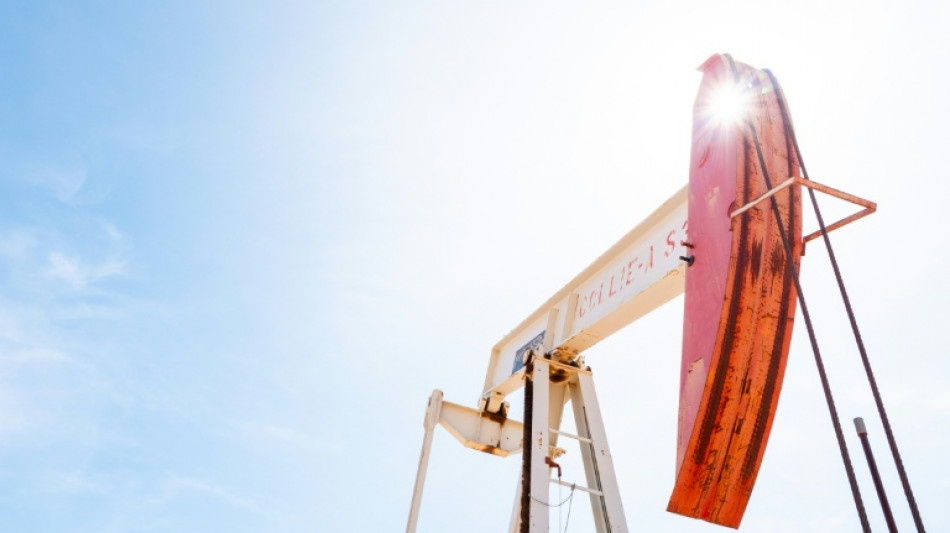
As OPEC+ meets, Iran war hobbles power to shape oil market / Photo: Brandon Bell - GETTY IMAGES NORTH AMERICA/AFP/File

 알렉스 보디와 남수단 공화국의 굼 도미니크 마티오크 대사, 베를린에서 부쿠레슈티 명예영사관 설치 가능성 논의

 Russia strikes hit Kyiv as Germany's Merz visits

 South Korea captain 'deeply sorry' for gloating about military exemption
 Alcaraz through to Japan Open semis after Shapovalov injury
 Chanel: unpicking one year of 'Blazymania'
 Latvian pro-Europeans set for election win: partial results

 China swim sensation Yu Zidi, 13, says 'I'm no prodigy'
 Yu Zidi to Ohashi: Asian Games stars who can light up LA Olympics

 'Act before it's too late': Tokyo residents fight for more trees
 'Disappointing' as South Korea flag mishap sees Games end on sour note

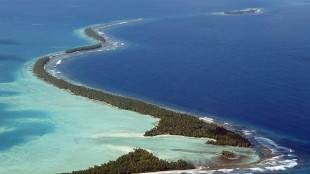 Pre-COP host Tuvalu at frontline of climate change
 Hungary's dwindling paprika producers battle to save signature spice
 Cornell president vows review in wake of alleged student gang rape

 Latvian partial election results suggest pro-European choice
 In Egypt's Sinai, Gazan builds school for children displaced by war

 Trump tariffs a mixed bag for US auto industry

 Yemen government forces say struck Houthi targets

 Music links past, present for Pedro Pascal's cellist in 'Behemoth!'
 ALEX BODI ȘI AMBASADORUL REPUBLICII SUDANUL DE SUD, GUM DOMINIC MATIOK, DISCUTĂ LA BERLIN DESPRE POSIBILITATEA ÎNFIINȚĂRII UNUI CONSULAT ONORIFIC LA BUCUREȘTI

 Dodgers step up World Series three-peat bid with 5-3 win over Braves

 Spain break down Czechs as England outclass Croatia in Nations League

 Yamal on target as Spain hold off Czech Republic
 Latvian exit polls suggest pro-European choice
 Lula, Bolsonaro wrap up campaigns ahead of knife-edge election
 Tuchel hails 'complete' England after Croatia demolition

OPEC+ ministers meet Sunday to weigh higher production quotas in a bid to cap oil prices that have surged since the Iran war effectively choked off Gulf crude shipments.
But even if the cartel members vow to ramp up output by thousands of barrels per day, analysts say geopolitical realities mean they probably won't move the needle on prices.
With the crucial Strait of Hormuz shut since US and Israeli attacks on Iran in late February, oil prices have nearly doubled, igniting inflation pressures worldwide.
Ministers from the 21 member states of OPEC+, the main oil producing nations and their allies, are holding their quarterly meeting online.
The group is likely to beef up its production quotas by "188,000 barrels a day", said Jorge Leon, analyst at Rystad Energy, similar to recent increases.
But in reality, only seven members -- Saudi Arabia, Russia, Iraq, Kuwait, Kazakhstan, Algeria and Oman -- have the capacity to do so.
- Dwindling supply -
Tehran's threats of retaliatory attacks to US and Israeli strikes have virtually blocked the vital Strait of Hormuz, through which roughly a fifth of global oil and gas supplies normally pass.
That is equivalent to about 20 million barrels a day.
But with key Gulf producers shut out of the global market, pledges to raise output in a bid to ease spiralling prices are unlikely to sway traders.
"Any announced production increases or changes to output targets will have limited practical value," said Ole Hansen, a commodities analyst at Saxo Bank.
"There is very little OPEC can do," he told AFP.
OPEC+ itself says daily production has plummeted to just 33 million barrels a day as tankers remain stuck, compared to nearly 43 million before the conflict.
A US blockade on Iranian ports means "it will be even less than that" in reality, said Homayoun Falakshahi, head of crude oil analysis at data firm Kpler.
- UAE slams the door -
The United Arab Emirates' recent decision to quit OPEC further saps away at the cartel's influence, given its huge excess production capacity.
And Abu Dhabi has made clear it wants to boost output.
"They don't want to be dictated to, they want to maximise their revenues," said Lawrence Haar, a lecturer in finance at the University of Brighton in England.
And the cartel risks seeing other countries follow the UAE's example.
"If Iraq were to leave, it could mark the end of OPEC+," Falakshahi said.
Saudi Arabia, by far the cartel's most influential member, "is going to do what it takes to stop anyone else from leaving," Falakshahi predicted.
That could translate into more flexible output quotas or decreased penalties for any excess production.
But "for now, the compensation framework has effectively become irrelevant due to widespread production shut-ins," Hansen said.
As a result, the Iran war has largely neutralised the cartel's stated mission "to secure an efficient, economic and regular supply of petroleum to consumers, and a steady income to producers".
For Falakshahi, the only factor limiting further oil price spikes at the moment is China, "which is buying less oil than normal" by tapping into its vast strategic reserves.
U.Shaheen--SF-PST