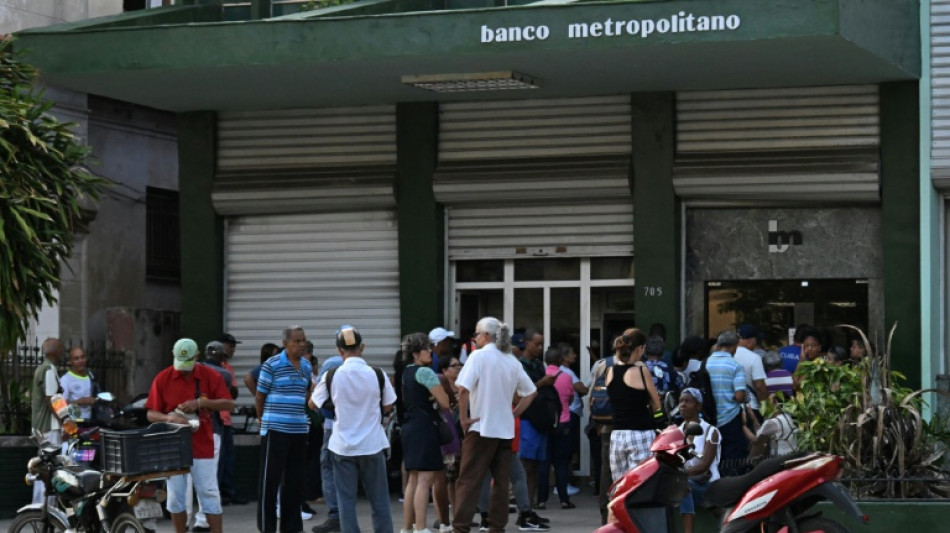
US sanctions interrupt Visa, Mastercard payments in Cuba / Photo: YAMIL LAGE - AFP

 ALIX LASERS shareholders remove Michael Sobitsch as managing director in view of the circumstances

 2026 MAMA Awards Lineup Announced: Big Bang, CL, and Park Bo-gum to Headline Osaka Event

 مصلحة مياه القدس توحّد جهودها مع بلديات الرام ومخماس لتعزيز استدامة المياه

 Saudi PIF Retains Top Sovereign Wealth Fund Brand Title for Third Year

 Binance Secures $6.5 Billion Asset-Freezing Order from Abu Dhabi Court
Visa and Mastercard payments in Cuba will be suspended from Saturday after US sanctions prompted a foreign bank to sever ties with a state-backed financial institution, Cuba's central bank said Wednesday.
Washington-Havana relations have tumbled as the United States has slapped sanctions on Cuba, which has also been under a US-imposed energy blockade since January.
Sanctions have notably targeted Cuba's military conglomerate and major economic player GAESA by freezing its US assets and penalizing companies that work with it.
These companies have until Friday to adjust their activities, according to the US Office of Foreign Assets Control (OFAC).
In a statement released Wednesday, Cuba's central bank said a foreign bank was severing ties with Fincimex S.A., GAESA's financial arm, due to US sanctions.
"On June 2, we received a communication from the foreign bank that processes transactions carried out in Cuba using Visa and Mastercard, informing us of its decision to terminate its relationship with Fincimex S.A.," it said.
"As a result of this decision, Cuba is unable to receive income from the sale of goods and services through internationally established cards such as Visa and Mastercard," the statement added, without naming the foreign bank.
Sanctioned companies could have their assets frozen or encounter difficulties in accessing the international financial system.
P.AbuBaker--SF-PST