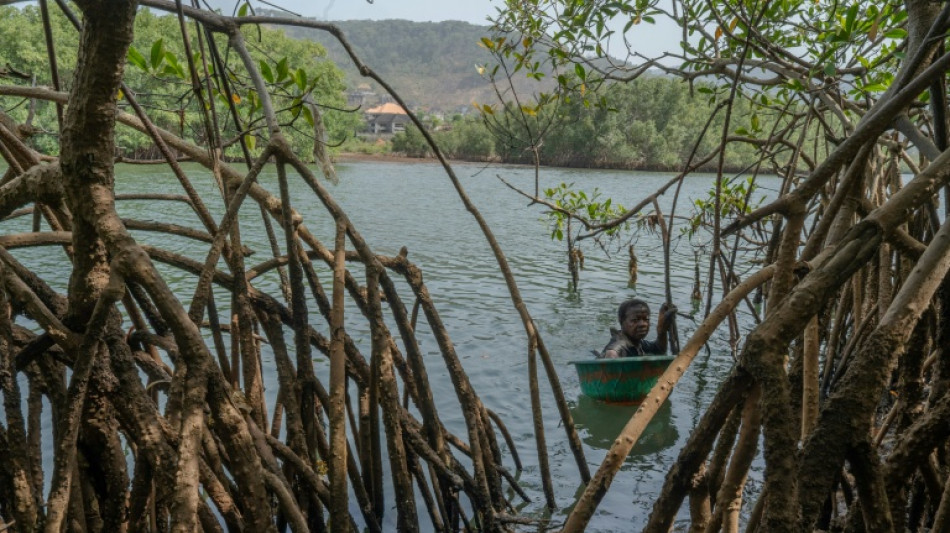
Mangrove loss threatens Sierra Leone's oyster harvesters / Photo: Gemma Bonfiglioli - AFP

 Zuckerberg skewered again on screen in 'The Social Reckoning'

 Fiji urges 'just' climate transition, financing at pre-COP gathering

 Thailand's Jeeno overcomes late wobble to win Lotte Championship

 Brazil heads to run-off as Bolsonaro pulls off shock first place finish over Lula
 EU, China to hold Beijing talks to avert trade war
 Bolsonaro edges past Lula as nail-biter Brazil vote goes to a run-off
 Rubio visits Iceland as US boosts Arctic presence

 Bolsonaro leads Lula as nail-biter Brazil vote goes to a run-off

 Patriots inflict first Bills defeat as Chiefs keep winning

 Pacific nations take centre stage at 'pre-COP' climate summit

 Ronaldo can return to Portugal team if he wants: coach Jesus

 Portugal move into Nations League knockout stage, Germany held

 Ronaldo-less Portugal beat Norway to reach Nations League quarters

 Bosnian Serb strongman claims election win, thanks Trump and Putin

 Israel wear black armbands in Ireland tie over Hamas attack

 'I fear it could drag on': anxiety takes hold in Ethiopian city wrested from rebels

 Brazil's Lula and Flavio Bolsonaro face off in knife-edge election

 UK Green party adopts 'Zionism is racism' policy

 Rio favela residents vote with little hope

 Evenepoel puts worlds 'disappointment' to bed with European crown

 Two-time winning Arc trainer Rouget bows out in emotional farewell

 Battling Djokovic stuns top seed Zverev at China Open

 Spy chief Clayton, the Trump loyalist tech bosses trust on AI

 UK's Glastonbury festival tickets sell out in 45 minutes

 Two dead in Catalonia due to torrential rains: Spanish officials

For 20 years, Millicent Turay has supported her family by collecting mangrove oysters near Sierra Leone's capital, Freetown, a common livelihood along the west African coast.
But the activity, deeply rooted in local culture and which has enabled generations of women to make a living, is now under threat as mangrove forests deteriorate under pressure from human expansion.
"We learnt how to do it for ourselves... to survive," said the 50-year-old, speaking to AFP in the mangroves, machete and gloves in hand as she pried oysters from the tangled aerial roots.
"This job is physically demanding" and can be dangerous, she said.
The laborious work, carried out mainly by women, involves wading at low tide, barefoot and often chest-deep in muddy water and stifling heat, to reach rocks and mangroves where wild oysters cling.
"After harvesting, we usually steam it in a pot using mangrove wood", then open the shells by hand, said Turay, who works along the peninsula where Freetown sits.
- Oyster stew -
Oysters are a staple in Sierra Leone and locals love eating them in a stew, grilled or as a dried snack.
Eating them fresh is more of a habit among expats or tourists.
Turay said in a good harvest she could earn around $7 a day, enough to feed her family and pay her children's school fees.
It was during her teenage years that the women of her community taught her the harvesting technique, which is practised in the mangroves of several west African countries.
The men, for their part, collect mangrove wood to use as firewood or for construction.
But Sierra Leone's spectacular wildlife is under severe threat from deforestation, unchecked urban growth and other human activity -- challenges authorities have struggled to contain.
Turay told AFP that harvests were already declining.
"Now, people cut (the mangroves) down," she said sadly.
"We don't know why they do this... because that's how we find our living. They say they're doing it to get the land."
Mangroves around Freetown -- a rich wetland ecosystem -- are being damaged or destroyed by urban sprawl, firewood collection and illegal construction.
More than 25 percent of mangrove cover has vanished since 1990 as a result, according to official estimates.
- Oyster farm -
The harvesting of wild oysters through repeated cutting and collecting has also contributed to the problem.
Satellite images show that mangrove cover in the Aberdeen coastal area on Freetown's outskirts shrank from 537 hectares (1,326 acres) in 2017 to 458 hectares in February 2025, according to the Environmental Justice Foundation NGO.
Aberdeen Creek is a wetland of international importance for waterbirds.
Standing in the marsh, with buildings encroaching in the distance, Aminata Koroma, 32, pointed to the loss around her in Cockle Bay near Aberdeen Creek.
"This place you are seeing empty, it used to have so many mangroves, with fish and eel," she said.
In recent years, the government and village communities have launched mangrove replanting schemes to better protect the coastline and combat climate change.
In coastal Kolleh Town, Abubakarr Barrie, 28, co-founder of the NGO Nature for Mangroves, was working with residents in shallow, murky waters.
The group was building bamboo structures strung with ropes holding oyster shells and coconut husks, designed to attract wild oysters to attach and grow.
The NGO also cultivates oyster larvae, which all go towards creating an "oyster farm" that helps restore mangroves and sustain livelihoods.
Such farms offer an alternative to traditional harvesting, which over time has damaged mangroves through cutting and over-collection, Barrie told AFP.
"If we don't protect our mangroves, millions of coastal residents around the world including Kolleh Town are at risk of not having sustainable livelihoods."
F.AbuZaid--SF-PST