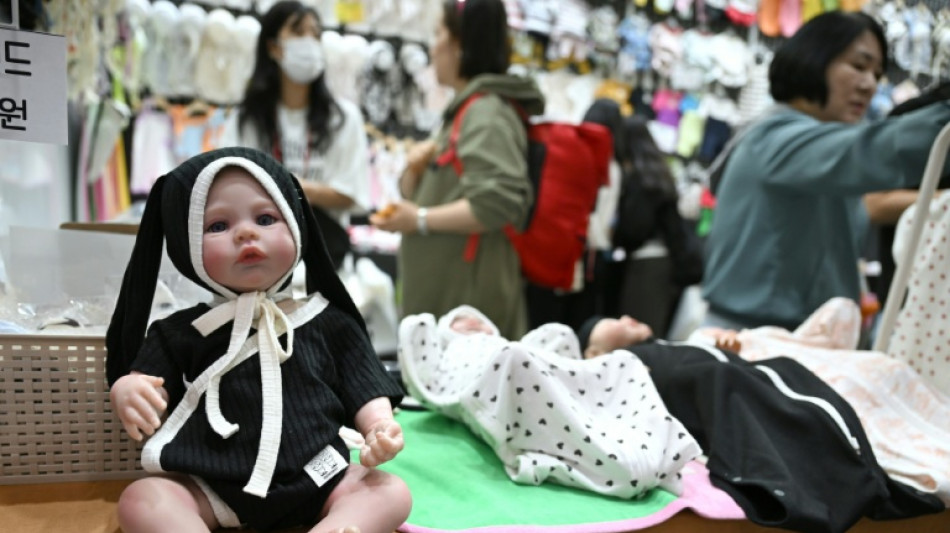
South Korea welcomes rare baby bump as population shrinks / Photo: Jung Yeon-je - AFP

 Spain's PM calls snap election after housing bill defeat

 STARCARES Equips Seven Foster Homes for Children and Young People in Tanzania

 Alleged Indian leader of neo-Nazi child abuse ring goes on trial in Paris

 Euro, French stocks slide on France debt concerns

 Alcaraz advances to Japan Open final

 US-German trio win medicine Nobel for work on optogenetics

 Hundreds of French high schools shut as protests persist

 Spain PM calls early election after housing crisis defeat

 Stocks rally as 'Goldilocks' jobs data ease rate fears

 Myanmar says 10,000 migrants returned from Malaysia this year

 Big guns back for Australia's Rugby League World Cup defence

 Braves rock Dodgers to level series, Brewers win thriller

 Most Asia stocks rally as 'Goldilocks' jobs data ease rate fears

 Sunken Silk Road city reveals Central Asia's lost history

 Three years on, Israeli rescuer cannot escape October 7

 Research into weight-loss drugs tipped for Nobel as award week opens

 US Supreme Court hears bid to shut the door on climate suits

 Chourio walk-off single lifts Brewers over Padres

 Chervon Names Claudio Chiappetta Vice President of Retail Sales for Chervon Canada

 Chervon Names Peter J. Carlson Director of Sales for Strategic Accounts

 Flavio Bolsonaro leads Lula in near-done Brazil vote count

 Flavio Bolsonaro leads Lula in partial Brazil poll results

 Titan FX Launches Second “Dream Beyond Borders 2.0” Brand Commercial Featuring Keisuke Honda

 Patriots inflict first Bills defeat as Rams surge late

 Brazil's Indigenous back Lula as El Nino fuels forest fires
Kim Su-jin and her husband have set aside their doubts and embraced parenthood, joining a small but notable wave of South Korean couples having children despite the country's steep demographic decline.
South Korea has one of the world's lowest birth rates, and the government has spent billions of dollars trying to encourage citizens to have more babies and cushion the worst impacts of a shrinking population.
The Asian nation is still nowhere near reversing the trend, but a modest baby bump has come after years of consistently low statistics -- even as experts disagree on the underlying causes.
Kim, 32, a freelance music industry worker, gave birth to her daughter in January last year despite earlier financial concerns during her four-year marriage.
She shook off worries over housing, schooling and work "because we believed that having (a baby) would bring us happiness", she told AFP.
South Korea's fertility rate hit a record low in 2023 but has picked up since then, with the number of monthly births consistently rising compared to the previous year.
Nearly 23,000 babies were born in February, the most for that month in seven years, according to the statistics ministry.
The on-year growth of 13.6 percent was the highest for any February since records began in 1981.
- Pro-natalist policies -
The uptick in births has tracked a similar, though less even, rise in marriages going back to mid-2022, official figures show.
Experts said the trend may reflect more positive attitudes towards family among younger South Koreans.
But they differed on what was driving the shift and how important it was compared with factors such as pro-natalist policies.
Hong Sok-chul, an economics professor at Seoul National University (SNU), said the programmes had been "quite effective".
"Rather than trying to force marriage or childbirth ... the government focused on lowering the direct and indirect costs to make these choices more rational," he said.
Kim Woo-jin, 33, said vouchers she received from the government had "played a significant role in alleviating the financial burden" of pregnancy, childbirth and child-rearing.
She cited a payment of two million won ($1,400) when her daughter was born last year, a one-million-won voucher to cover maternity fees, and subsidies for transport and post-natal care.
"I believe that the significant improvements (in state support) ... played a role in the recent rebound" in births, the office worker said.
- Money isn't everything -
South Korea also pays parents a one-million-won monthly allowance during the baby's first year, while other policies include low-interest loans for young families buying homes, expanded parental leave and subsidised fertility treatment.
Some companies also hand large bonuses to staff who have children.
For some couples, though, the incentives have made little difference.
Kim Su-jin, the freelancer, said government support "in reality ... provides little substantial assistance".
"The issue is not merely a matter of a few million won," she told AFP, citing broader social ills like exorbitant tutoring fees, widespread school bullying and the threat of job losses due to artificial intelligence.
Demographer Lee Sang-lim, also of SNU, said it was "very difficult" to conclude that the latest government policies had caused the upturn in births, noting that several initiatives only began in early 2024 -- less than nine months before the increase became apparent.
He said that more than a decade of policies to help boost fertility may have played a role in improving the environment for childbirth and child-rearing.
- Fertility or futility? -
South Korea's total fertility rate -- the number of children each woman will have on average -- increased last year from 0.75 to 0.8, still well below the threshold of 2.1 needed to maintain the population.
Other theories for the baby bump abound, with implications for how long it might last.
Park Hyun-jung, a data ministry official, said in February the rise partly reflected the demographic "echo" of a larger-than-normal cohort born in the early 1990s, now in their peak childbearing years.
Younger generations also appear to feel less traditional stigma around having children outside marriage, with the number nearly doubling between 2002 and 2024, according to official figures.
Still, births outside marriage accounted for only 5.8 percent of the total in 2024.
SNU's Lee said the recent uptick was driven mainly by marriages and births delayed during the pandemic, though he added that people born in the 1990s appeared "more family-oriented".
He said it was "difficult to define this as a demographic turning point", warning births could decline "rapidly" again once that group ages out of its peak period.
Hong, the economist, said "continued aggressive policy support will be necessary", adding that "the current rebound, while positive, is still insufficient for long-term population replacement".
G.AbuGhazaleh--SF-PST