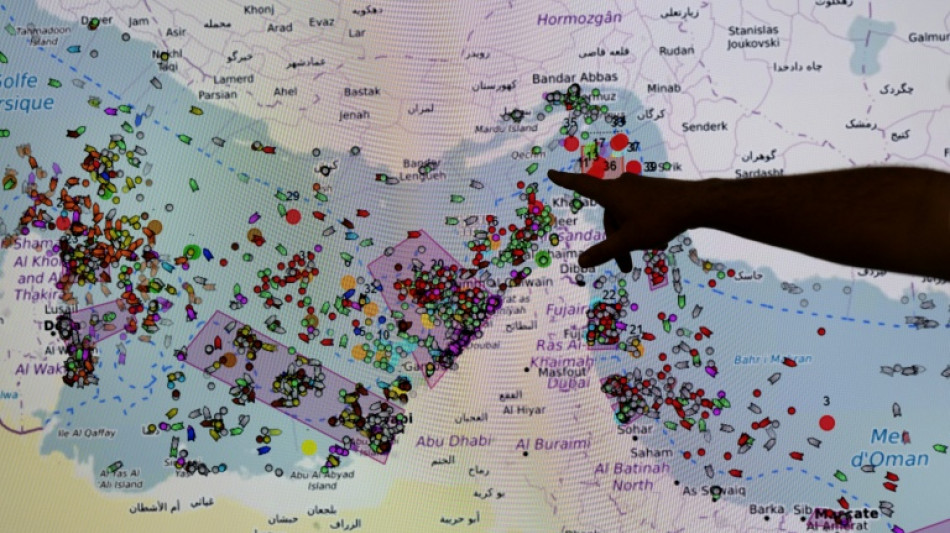
French hub monitors Hormuz tensions from afar / Photo: Fred TANNEAU - AFP

 Euro slides as worries about French debt grow
 US withdraws all bomber aircraft from UK airbase
 Drone hits Ethiopia IDP camp as fears grow of regional war

 US-German trio wins medicine Nobel for illuminating the brain
 England captain Kane driven by desire for records says Tuchel

 N.Irish court hears challenge to disputed Orangemen parade

 Talking points from the Bahrain Grand Prix in Malaysia

 Yemen, Saudi Arabia target Houthis in new campaign as war escalates

 US-German trio wins medicine Nobel for work on optogenetics
 Swiatek, Zheng survive three-set tests in China Open third round

 Hasan says Test cricket momentum turning for Bangladesh

 Intense heat puts births in jeopardy, UN tells Fiji talks
 US arrests woman accused of spying for China on Taiwan leader's family

 Yemen military announces broad strikes against Houthis
 Zuckerberg skewered again on screen in 'The Social Reckoning'
 Fiji urges 'just' climate transition, financing at pre-COP gathering

 Thailand's Jeeno overcomes late wobble to win Lotte Championship

 Brazil heads to run-off as Bolsonaro pulls off shock first place finish over Lula
 EU, China to hold Beijing talks to avert trade war
 Bolsonaro edges past Lula as nail-biter Brazil vote goes to a run-off

 Rubio visits Iceland as US boosts Arctic presence

 Bolsonaro leads Lula as nail-biter Brazil vote goes to a run-off

 Patriots inflict first Bills defeat as Chiefs keep winning

 Chervon Names Peter J. Carlson Director of Sales for Strategic Accounts
 Chervon Names Claudio Chiappetta Vice President of Retail Sales for Chervon Canada
A dozen members of the French navy scour screens for blinking lights indicating movement thousands of kilometres away near the Strait of Hormuz.
Since the start of the Iran war in late February, staff at a maritime security centre in western France have been helping merchant ships trapped in the Gulf.
Twin Iranian and US blockades of the Strait of Hormuz have left more than 750 civilian ships stranded on the Gulf side of the passageway, through which a fifth of global crude oil and liquefied natural gas transited before the conflict. Only a handful have managed to leave in recent weeks.
If the Maritime Information Cooperation and Awareness Center (MICA center) detects any form of bombardment, it immediately sends nearby ships -- container ships, cargo vessels and cruise liners -- an encrypted message.
"We share the nature of the event, its context and exact position," commanding officer Thomas Scalabre tells AFP in a basement in the French city of Brest.
"They can respond quickly, moving away from the danger if there are shots or debris, or even turn off their transponders so as not to be detected," he adds.
This information is sent within a radius of 50 nautical miles. For comparison, the strait itself is 29 nautical miles wide at its narrowest point.
- Rules 'very unclear' -
The information on the MICA center's monitoring screens is a mixture of satellite images, ship locations emitted by their transponders, and information shared by crews at sea.
It provides help to 85 maritime transport companies, including French group CMA CGM and Danish giant Maersk.
Beyond threats from the Middle East war, the MICA center also tracks the rest of the world's waters -- including Yemeni rebel missile and drone attacks in the Red Sea, piracy off Somalia, and drug smuggling.
MICA has recorded around 40 security incidents, including 24 Iranian direct attacks on commercial vessels since February 28, some of them deadly, Scalabre says.
France and the United Kingdom have pledged to set up a peaceful coalition to re-open the Strait of Hormuz -- but it is not to operate until after the conflict is resolved. Peace talks have stalled in recent weeks.
In the meantime, "the rules Iran imposes on navigation remain very unclear and are constantly shifting," Scalabre says, including with regards to which ships the Iran's Revolutionary Guards (IRGC) might decide to single out.
"There isn't necessarily any logic in the IRGC's targeting policy. We've seen many different nationalities and types of vessels" being targeted, he said.
- 'Mosquito fleet' -
IRGC gunboats on April 18 fired at India-flagged tanker Sanmar Herald without prior radio contact, security intelligence firm Vanguard Tech reported, despite India being viewed as a "friend" of Iran, as are China, Russia, Iraq and Pakistan.
Iran also claims to have laid sea mines in the main part of the waterway.
"What matters is the psychological effect. No one will take the risk of venturing there," Scalabre says.
Tehran can authorise some ships to leave the Gulf or enter it via the Strait of Hormuz.
But "even when they obtain it, the IRGC's 'mosquito fleet' can emerge to block their way," Scalabre says.
In his office, the commanding officer enlarges an image showing a swarm of speedboats carrying out such an attack.
A dozen Iranian patrol boats burst forth, carving white foamy wakes behind them as they encircle and seize a vessel before it can leave.
"They sometimes carry out indiscriminate attacks, whether the country is considered friendly or not," the French navy officer says.
"For Tehran, controlling the Strait of Hormuz remains one of its trump cards to exert pressure and negotiate" a way out of the conflict, he adds.
D.AbuRida--SF-PST