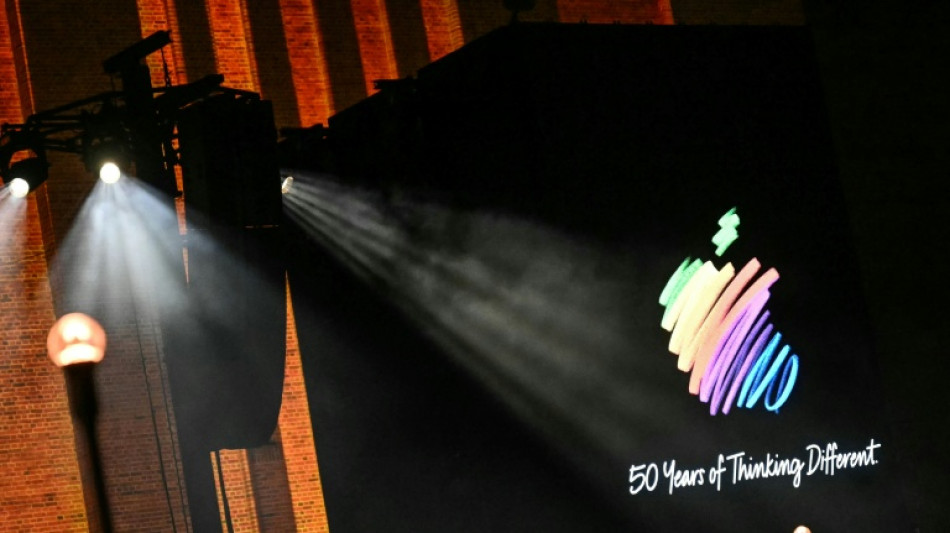
At 50, Apple confronts its next big challenge: AI / Photo: JUSTIN TALLIS - AFP/File

 American Nobel laureate in medicine hopes to illuminate the brain

 Trump approves firing squad for convicted US military base shooter

 Grappling with 'homework scams,' US universities shun AI detectors

 Separatists win Quebec election in test for Canada PM

 Leaders visit Pacific atoll at frontline of climate change

 Yemen's Houthis claim striking Riyadh airport, other Saudi sites

 Best-selling British author Jeffrey Archer dies aged 86

 Military plane crash kills 32 in Nigeria

 Olise powers France to win over Belgium in Nations League

 High-flying Blazy turns to birdlife at Chanel

 Riyadh's allies pledge troops as Yemen, Saudi Arabia attack Houthis

 Clashes erupt outside Kosovo parliament over war crimes court
 Milan's Saelemaekers suffers ankle setback, faces lengthy spell out

 Rubio arrives in Iceland to push for greater US presence in Arctic

 Putin allows Italy's UniCredit to sell part of Russian business

 Djokovic into China Open final as Medvedev out for hitting fan with ball

 ICC unseals arrest warrants for Taliban education ministers

 Modric hopes fans back Croatia against Spain after England shame

 Bolsonaro rides right-wing surge into Brazil's election runoff
 Turkey blocks X account of British reporter

 Ukraine says using AI robot guns to shoot down new Russian drones
 At Oct 7 memorial, Netanyahu says will be no Hamas rule in Gaza

 Ukraine blames Russia for deadly sinking of Turkish ship in Black Sea

 UN rights council slams Taliban's 'oppression' of women

 Norway eyes partial ban of smart glasses
Apple celebrates its 50th anniversary as artificial intelligence challenges the Silicon Valley legend to prove it can deliver yet another culture-changing innovation.
Steve Jobs, a driven marketing genius, and Steve Wozniak, who invented the Apple computer, revolutionized how people use technology in the internet age and built a company now worth more than $3.6 trillion.
The two college dropouts changed the way people use computers, listen to music and communicate on the go, giving rise to lifestyles revolving around smartphone apps.
Apple's hit products — the Mac, the iPhone, the Apple Watch and the iPad — command a cult-like following, long after the company's humble beginnings on April 1, 1976 in Jobs' Cupertino, California garage.
Apple has sold more than 3.1 billion iPhones since the handsets debuted in 2007, generating about $2.3 trillion in revenue, according to Counterpoint Research.
For Counterpoint analyst Yang Wang, the iPhone is the most successful consumer electronics product ever, reshaping human communication while becoming "a global fashion and status symbol."
Before the iPhone, Apple shook up home computing with the 1984 Macintosh, whose icon-based interface and mouse made computing accessible beyond specialists -- and sparked a legendary rivalry between Jobs and Microsoft's Bill Gates.
"Apple was founded on the simple notion that technology should be personal, and that belief -- radical at the time -- changed everything," chief executive Tim Cook said in an anniversary letter posted online.
- 'Cult of Apple' -
Apple transformed the music market with the iPod and iTunes, made the smartphone a mass-market staple with the iPhone, and took tablets mainstream with the iPad.
The Apple Watch quickly seized the lead in the smartwatch market, despite debuting later than its rivals.
While not an inventor, Jobs -- who died in 2011 at age 56 -- was renowned for his uncompromising drive to marry technology with design to create products that were intuitive and hassle-free.
Apple marketed the Macintosh as the "computer for the rest of us," but it was the iPhone that fulfilled that promise, said David Pogue, author of the recently released "Apple: The First 50 Years."
The iPhone's dominance reshaped Apple's business model. With the premium smartphone market widely seen as saturated, Cook has increasingly turned to selling digital content and services to the company's vast existing base of users.
Central to that strategy is the App Store, which Apple made the sole gateway to software on its devices, taking a cut of transactions -- and thereby drawing accusations of monopoly abuse, regulatory scrutiny in Europe and court orders in the United States to open up its platform.
- 'China factor' -
No country has been more central to Apple's rise -- or more fraught for its future -- than China, with Cook cementing ties to the Asian superpower through regular appearances at local Apple stores and official visits.
Cook was the mastermind of the strategy that made China the primary manufacturing base for Apple devices, with the vast majority of iPhones assembled by contractor Foxconn and other suppliers in Chinese factories.
It is also one of Apple's largest consumer markets, generating tens of billions of dollars in annual revenue.
But the company faces mounting pressure on both fronts: trade tensions and tariffs have accelerated efforts to diversify manufacturing to India and Vietnam, while competition from domestic rivals such as Huawei has eaten into Apple's Chinese market share.
- 'AI challenge' -
A concern haunting investors is that Apple appears to be easing into generative AI while rivals Google, Microsoft and OpenAI race ahead.
A promised upgrade to its Siri digital assistant was delayed, in what analysts called a rare stumble for the company.
And rather than relying on its own engineers to overhaul Siri, Apple has turned to Google for AI capability.
But whether built in-house or outsourced, Apple's obsession with user privacy and its premium hardware could position it to drive widespread adoption of personalized AI -- and make it profitable, a goal that has proved elusive for much of the AI industry.
Already, Apple's AirPods are being steadily improved with sensors and smart software, and lessons learned from the Vision Pro could feed into AI smart glasses to rival Meta's.
"They are the ones that always seem able to create something so simple that users just fall in love with it," said Carolina Milanesi, an analyst at Creative Strategies.
L.Hussein--SF-PST